

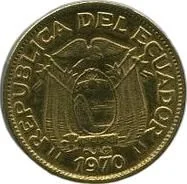
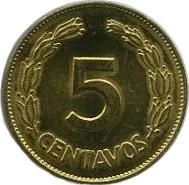
5 centavos – Ecuador
Add to wishlist
Ecuador
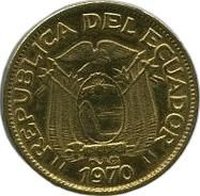
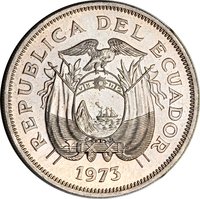
Obverse
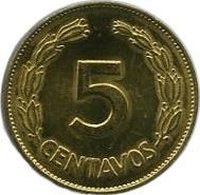
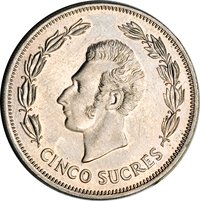
Reverse
Edge
Categories
| Symbols> Coat of Arms |
| Symbol> Wreath |
Mints
| Name | Mark |
|---|---|
| Monnaie de Paris | — |
Mintings
| Year | Mint Mark | Mintage | Quality | Collection |
|---|---|---|---|---|
| 1970 | — | — |
Historical background
In 1970, Ecuador's currency situation was characterized by instability and devaluation, set against a backdrop of economic transition and political uncertainty. The country operated on the sucre, which had been pegged to the U.S. dollar at a fixed rate of 15 sucres per dollar since 1961 under a Bretton Woods-style system. However, this peg became increasingly unsustainable due to a combination of fiscal deficits, high inflation, and a growing imbalance in the country's external accounts. The government of President José María Velasco Ibarra, who had returned to power in 1968, faced mounting pressure as export revenues—primarily from bananas and nascent oil—proved insufficient to support the currency's artificial value.
The core economic weaknesses included a narrow, agrarian-based export sector vulnerable to price swings and chronic government overspending. This led to repeated balance of payments crises and a steady drain on foreign exchange reserves. While the formal devaluation would not occur until 1970, the year was a critical tipping point. In a significant and controversial move, President Velasco Ibarra assumed dictatorial powers in June 1970, partly to enact unpopular economic measures without congressional opposition. His government was forced to officially devalue the sucre, abandoning the 15:1 peg. The new rate was set at 18 sucres per dollar, a 20% devaluation intended to boost exports and correct the external imbalance.
This devaluation was a pivotal moment, marking the end of a period of relative monetary stability and the beginning of a long-term trend of inflationary erosion of the sucre's value. The measures of 1970 failed to provide a lasting solution, as underlying structural issues persisted. The situation foreshadowed the profound economic shifts to come later in the decade, following the 1972 oil boom, which would flood the country with petrodollars but also create new dependencies and inflationary pressures, setting the stage for deeper currency crises in the following decades.
The core economic weaknesses included a narrow, agrarian-based export sector vulnerable to price swings and chronic government overspending. This led to repeated balance of payments crises and a steady drain on foreign exchange reserves. While the formal devaluation would not occur until 1970, the year was a critical tipping point. In a significant and controversial move, President Velasco Ibarra assumed dictatorial powers in June 1970, partly to enact unpopular economic measures without congressional opposition. His government was forced to officially devalue the sucre, abandoning the 15:1 peg. The new rate was set at 18 sucres per dollar, a 20% devaluation intended to boost exports and correct the external imbalance.
This devaluation was a pivotal moment, marking the end of a period of relative monetary stability and the beginning of a long-term trend of inflationary erosion of the sucre's value. The measures of 1970 failed to provide a lasting solution, as underlying structural issues persisted. The situation foreshadowed the profound economic shifts to come later in the decade, following the 1972 oil boom, which would flood the country with petrodollars but also create new dependencies and inflationary pressures, setting the stage for deeper currency crises in the following decades.
✨ Legendary