

¼ Dollar – United States
Non-circulating coins
Commemoration: United States Mint's 50 State Quarters® Program
United States
Context
Year: 2007
Issuer: United States 
Period:
(since 1776)
Currency:
(since 1785)
Subdivision: ¼ Dollar = 25 Cents
Total mintage: 1,094,993
Material
References
KM: #Click to copy to clipboard399a
Numista: #14893
Value
Exchange value: ¼ USD = $0.25
Bullion value: $16.10
Inflation-adjusted value: 0.40 USD
Obverse
Description:
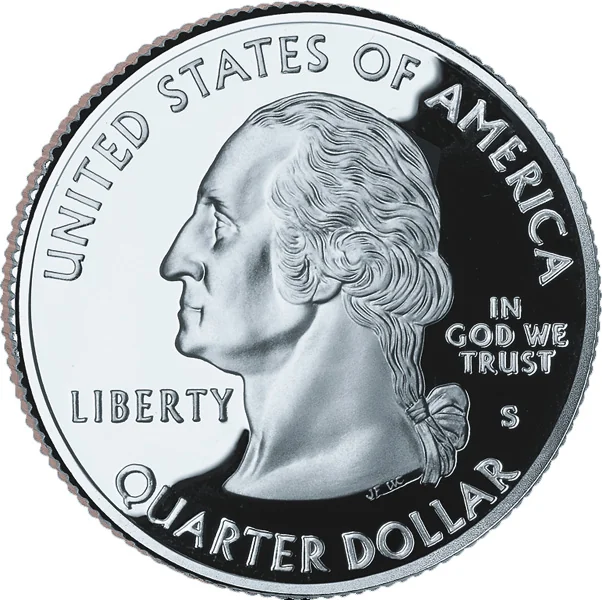
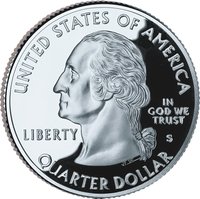
Left-profile portrait of George Washington with "IN GOD WE TRUST" and "LIBERTY," surrounded by the face value and "UNITED STATES OF AMERICA."
Inscription:
UNITED STATES OF AMERICA
IN
GOD WE
TRUST
LIBERTY
S
QUARTER DOLLAR
IN
GOD WE
TRUST
LIBERTY
S
QUARTER DOLLAR
Script: Latin
Engraver: John Flanagan
Reverse
Description:
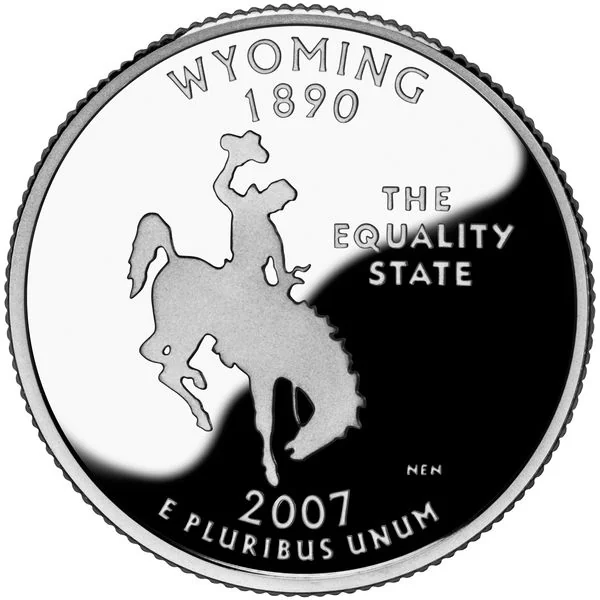
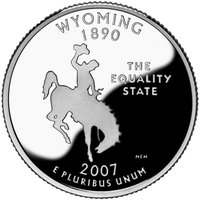
Cowboy on a bucking bronco.
Inscription:
WYOMING
1890
THE
EQUALITY
STATE
NEN
2007
E PLURIBUS UNUM
1890
THE
EQUALITY
STATE
NEN
2007
E PLURIBUS UNUM
Script: Latin
Engravers: Norman E. Nemeth, Donna Weaver
Edge
Reeded
Mints
| Name | Mark |
|---|---|
| United States Mint of San Francisco | S |
Mintings
| Year | Mint Mark | Mintage | Quality | Collection |
|---|---|---|---|---|
| 2007 | S | 1,094,993 | Proof |
Historical background
In 2007, the United States currency situation was characterized by a period of relative stability for the U.S. dollar on foreign exchange markets, masking severe underlying economic vulnerabilities. The dollar had been in a broad, gradual decline since 2002 against major currencies like the euro and yen, driven by large U.S. trade and budget deficits. However, this decline was orderly, and the dollar remained the world's dominant reserve currency. The Federal Reserve, having raised interest rates to combat inflation earlier in the decade, began cutting them in September 2007 in response to growing distress in the housing market. This policy shift started to exert new downward pressure on the dollar's value as yield differentials narrowed.
The core of the currency's underlying fragility was rooted in the domestic financial crisis that erupted that year. The collapse of the subprime mortgage market led to a freezing of credit, massive write-downs at major financial institutions, and the first waves of the "Great Recession." While the dollar initially experienced safe-haven flows during moments of acute panic (such as in August 2007), the fundamental outlook was bleak. The crisis revealed profound weaknesses in the U.S. financial system and foreshadowed a deep economic downturn, which threatened to erode long-term confidence in the dollar. The nation's external imbalances and the prospect of aggressive monetary easing placed the currency on a precarious path.
Consequently, by the end of 2007, the U.S. currency stood at a crossroads. The external value of the dollar was still largely supported by its global role and residual confidence, but the domestic foundations for its strength were crumbling. The Federal Reserve's shift toward an aggressive easing cycle, initiated to rescue the faltering economy, set the stage for a more pronounced dollar depreciation in the years to follow. Thus, the year served as a pivotal transition from a period of controlled decline to one where the dollar's fate became inextricably linked to the unfolding financial catastrophe and unprecedented policy responses.
The core of the currency's underlying fragility was rooted in the domestic financial crisis that erupted that year. The collapse of the subprime mortgage market led to a freezing of credit, massive write-downs at major financial institutions, and the first waves of the "Great Recession." While the dollar initially experienced safe-haven flows during moments of acute panic (such as in August 2007), the fundamental outlook was bleak. The crisis revealed profound weaknesses in the U.S. financial system and foreshadowed a deep economic downturn, which threatened to erode long-term confidence in the dollar. The nation's external imbalances and the prospect of aggressive monetary easing placed the currency on a precarious path.
Consequently, by the end of 2007, the U.S. currency stood at a crossroads. The external value of the dollar was still largely supported by its global role and residual confidence, but the domestic foundations for its strength were crumbling. The Federal Reserve's shift toward an aggressive easing cycle, initiated to rescue the faltering economy, set the stage for a more pronounced dollar depreciation in the years to follow. Thus, the year served as a pivotal transition from a period of controlled decline to one where the dollar's fate became inextricably linked to the unfolding financial catastrophe and unprecedented policy responses.
🌱 Fairly Common