

½ dollar (United States Declaration of Independence) – United States
Add to wishlist
Circulating commemorative coins
Commemoration: Bicentenary of the United States Declaration of Independence 1776-1976
United States
Context
Year: 1976
Issuer: United States
Period:
(since 1776)
Currency:
(since 1785)
Subdivision: ½ dollar = 50 Cents
Total mintage: 528,932,347
Material
References
KM: #
Numista: #1489
Value
Exchange value: ½ USD = $0.50
Inflation-adjusted value: 2.98 USD
Obverse
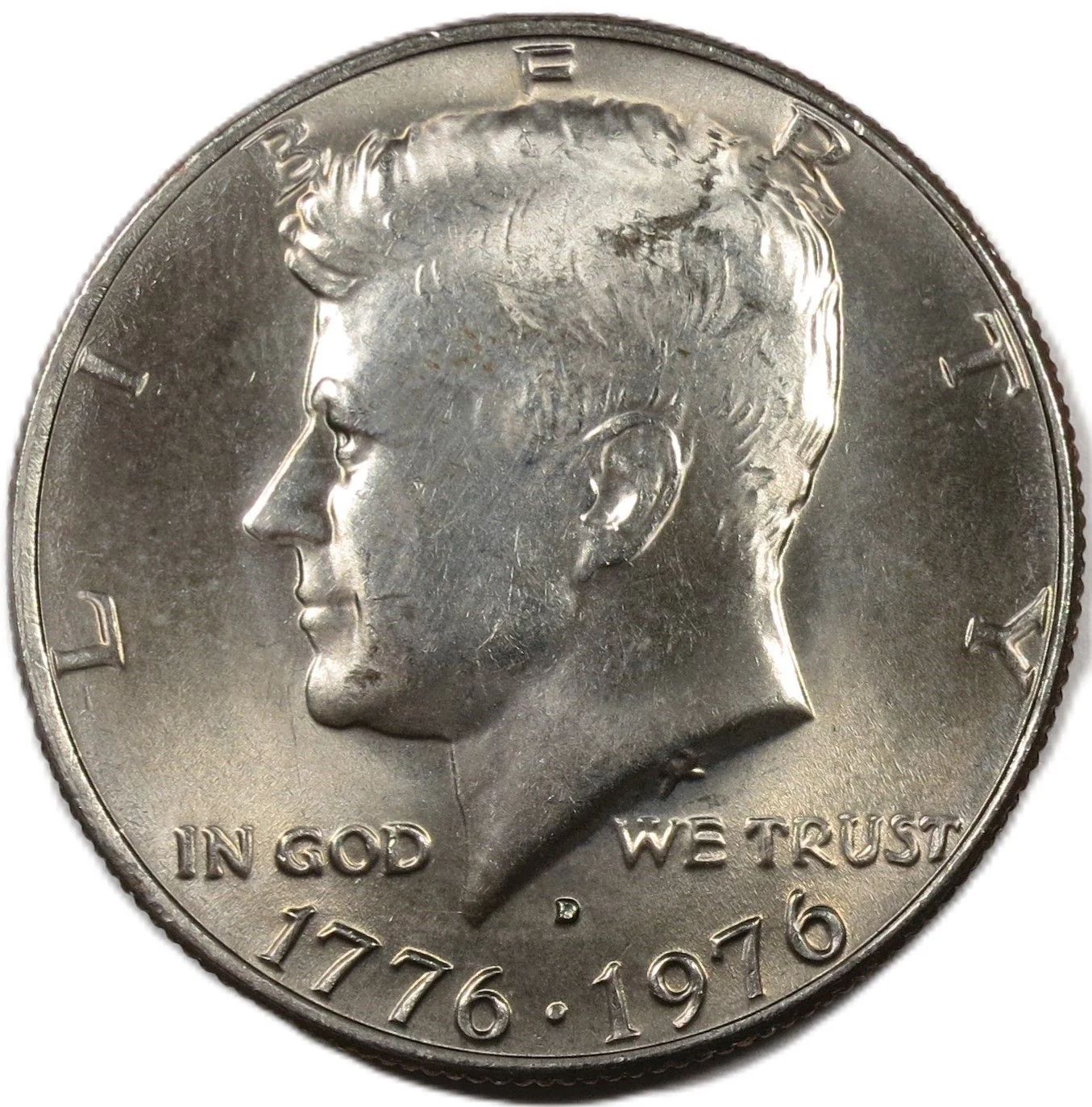
Description:
JFK facing left.
Inscription:
LIBERTY
GR
IN GOD WE TRUST
D
1776 - 1976
GR
IN GOD WE TRUST
D
1776 - 1976
Script: Latin
Engraver: Gilroy Roberts
Reverse
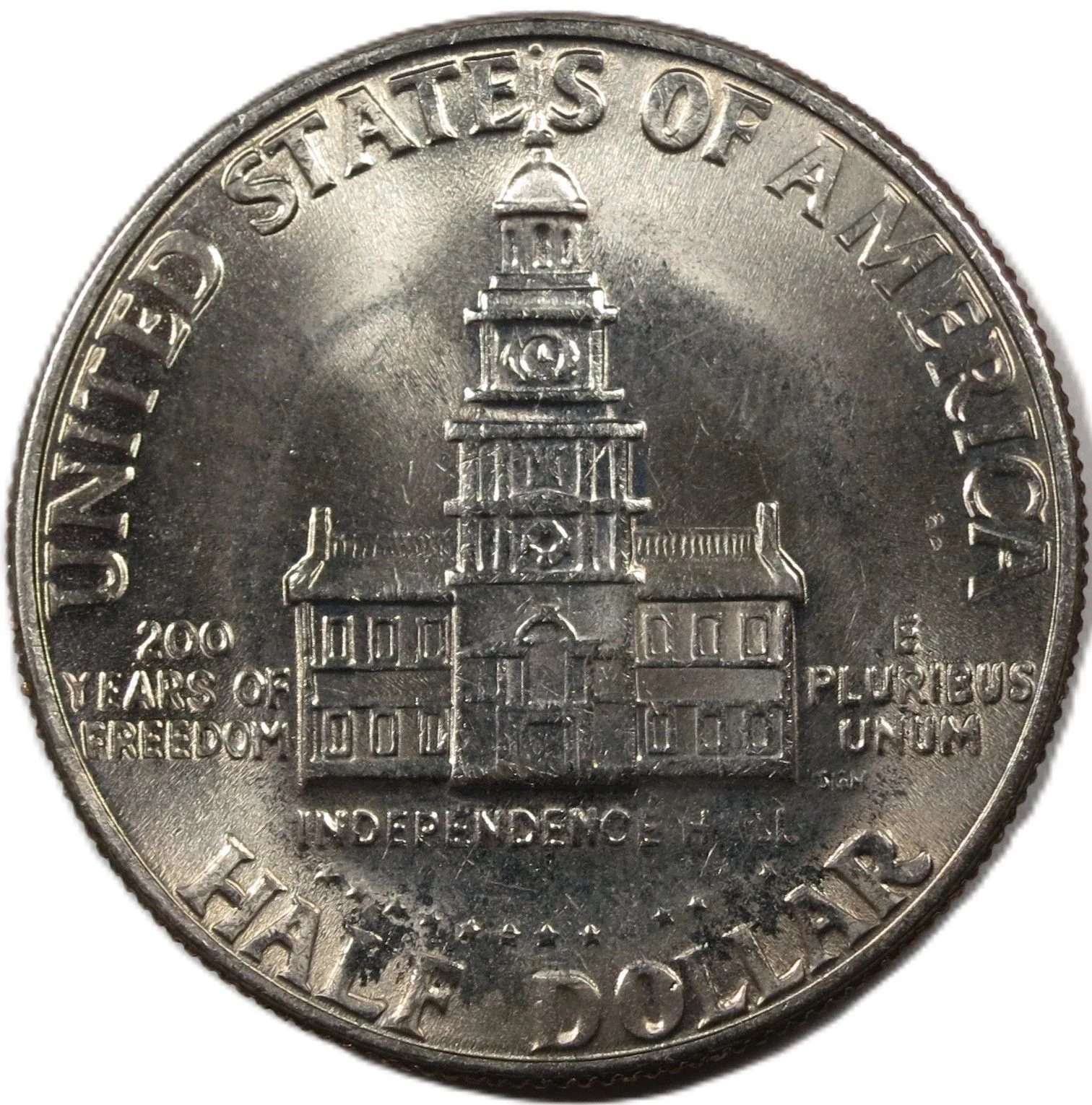
Description:
Birthplace of American liberty.
Inscription:
UNITED STATES OF AMERICA
200 YEARS OF FREEDOM
E PLURIBUS UNUM
SGH
INDEPENDENCE HALL
HALF DOLLAR
200 YEARS OF FREEDOM
E PLURIBUS UNUM
SGH
INDEPENDENCE HALL
HALF DOLLAR
Translation:
UNITED STATES OF AMERICA
200 YEARS OF FREEDOM
OUT OF MANY, ONE
SGH
INDEPENDENCE HALL
HALF DOLLAR
200 YEARS OF FREEDOM
OUT OF MANY, ONE
SGH
INDEPENDENCE HALL
HALF DOLLAR
Script: Latin
Engraver: Seth Huntington
Edge
Reeded (150 reeds)
Categories
| Building> Museum |
| Event> Independence |
| Person> Politician |
Mints
| Name | Mark |
|---|---|
| United States Mint of Philadelphia | — |
| United States Mint of Denver | D |
| United States Mint of San Francisco | S |
Historical background
The United States entered 1976 amidst a challenging and uncertain currency environment, characterized by persistent inflation, a weak dollar, and the ongoing adjustment to a new global monetary system. The Bretton Woods system of fixed exchange rates, which had pegged the dollar to gold and other currencies to the dollar, had collapsed in 1971-1973. By 1976, the world had fully transitioned to a regime of floating exchange rates, leaving the dollar's value to be determined by market forces. This shift exposed underlying economic weaknesses, as the dollar faced significant downward pressure due to a combination of high oil prices following the 1973 embargo, relatively high U.S. inflation compared to trading partners like Germany and Japan, and a loss of confidence in American economic management.
Domestically, the "stagflation" of the era—simultaneous high inflation and unemployment—posed a dilemma for policymakers. The Federal Reserve, under Chairman Arthur Burns, was hesitant to raise interest rates aggressively to defend the dollar for fear of deepening the 1973-75 recession's lingering effects. Consequently, the dollar's decline in foreign exchange markets became a symbol of economic malaise and a focus of international tension. By 1976, the U.S. was actively intervening in currency markets, selling foreign reserves to buy dollars in a concerted effort with allied central banks to stabilize its value, but with limited long-term success.
The situation culminated in a major international agreement that year. The "Jamaica Accords," ratified by the International Monetary Fund in January 1976, formally amended the IMF's articles to legalize the floating exchange rate system that had already taken hold. This agreement officially demonetized gold, eliminating its official role in the international monetary system and allowing central banks to trade it freely. While providing a new legal framework, the Accords did not immediately solve the dollar's weakness, which would continue to be a central issue for the remainder of the decade, eventually leading to the more aggressive anti-inflation policies of the Federal Reserve under Paul Volcker in 1979.
Domestically, the "stagflation" of the era—simultaneous high inflation and unemployment—posed a dilemma for policymakers. The Federal Reserve, under Chairman Arthur Burns, was hesitant to raise interest rates aggressively to defend the dollar for fear of deepening the 1973-75 recession's lingering effects. Consequently, the dollar's decline in foreign exchange markets became a symbol of economic malaise and a focus of international tension. By 1976, the U.S. was actively intervening in currency markets, selling foreign reserves to buy dollars in a concerted effort with allied central banks to stabilize its value, but with limited long-term success.
The situation culminated in a major international agreement that year. The "Jamaica Accords," ratified by the International Monetary Fund in January 1976, formally amended the IMF's articles to legalize the floating exchange rate system that had already taken hold. This agreement officially demonetized gold, eliminating its official role in the international monetary system and allowing central banks to trade it freely. While providing a new legal framework, the Accords did not immediately solve the dollar's weakness, which would continue to be a central issue for the remainder of the decade, eventually leading to the more aggressive anti-inflation policies of the Federal Reserve under Paul Volcker in 1979.
🌱 Very Common