

½ escudo cent – Spain
Add to wishlist
Spain
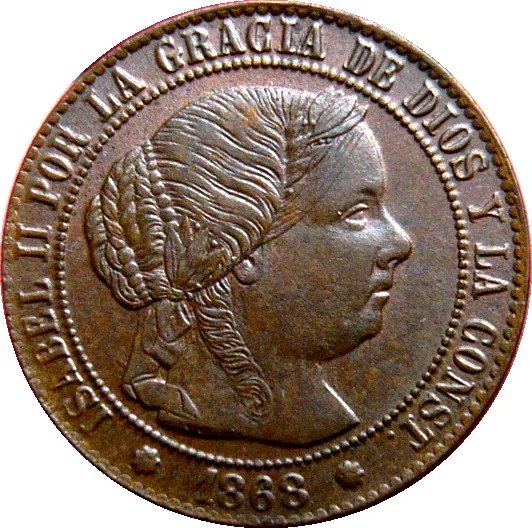
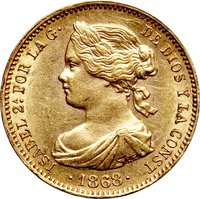
Obverse
Description:
Queen Isabella II facing right.
Inscription:
ISABEL II POR LA GRACIA DE DIOS Y LA CONST.
* 1868 *
* 1868 *
Translation:
ISABELL II BY THE GRACE OF GOD AND THE CONST.
* 1868 *
* 1868 *
Script: Latin
Language: Spanish
Engraver: Luis Marchionni y Hombrón
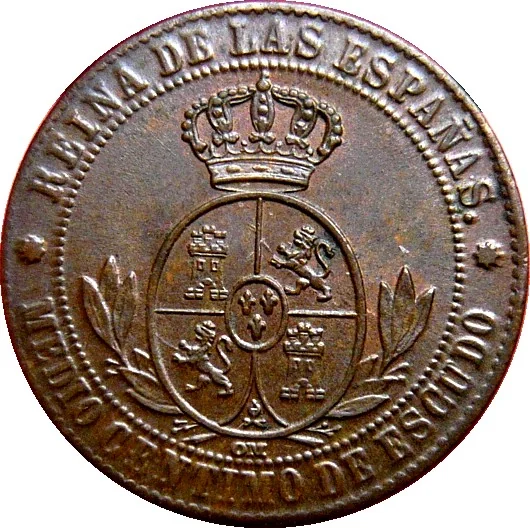
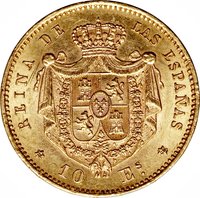
Reverse
Description:
Royal arms of Spain.
Inscription:
REINA DE LAS ESPAÑAS.
* MEDIO CENTIMO DE ESCUDO *
OM
* MEDIO CENTIMO DE ESCUDO *
OM
Translation:
Queen of the Spains.
* Half Centimo of the Escudo *
* Half Centimo of the Escudo *
Script: Latin
Language: Spanish
Engraver: Luis Marchionni y Hombrón
Edge
Plain
Categories
| Symbols> Coat of Arms |
Mints
| Name | Mark |
|---|---|
| Barcelona Mint / La Seca | — |
| Jubia Mint | — |
| Royal Mint of Madrid | — |
| Royal Mint of Segovia | — |
| Royal Mint of Seville | — |
Mintings
| Year | Mint Mark | Mintage | Quality | Collection |
|---|---|---|---|---|
| 1866 | — | — | ||
| 1866 | OM | — | ||
| 1867 | OM | — | ||
| 1868 | OM | — |
Historical background
By 1866, Spain was in the throes of a profound monetary and financial crisis, the culmination of decades of political instability, fiscal mismanagement, and speculative excess. The nation operated on a bimetallic system, but chronic budget deficits were financed not through taxation but by the unrestrained printing of paper money (pesos fuertes or reales de vellón) by the Bank of San Fernando (later the Bank of Spain). This led to a severe divergence between the value of this fiduciary currency and the theoretical silver peseta, which had been introduced in 1864. Public confidence in paper money evaporated, causing widespread hoarding of precious metal coins and effective Gresham's Law in action, where "bad" money (paper) drove "good" money (specie) out of circulation.
The immediate trigger for the 1866 crisis was the collapse of a massive railway investment bubble, fueled by foreign capital and government concessions. When this bubble burst, it brought down major financial institutions, most notably the Caja General de Depósitos in May. A devastating stock market crash in Madrid followed, leading to a cascade of bankruptcies among banks, companies, and private investors. This financial panic coincided with a poor agricultural harvest and exposed the hollow foundations of the state's finances, as the government found itself unable to service its substantial debt or obtain new loans.
The consequences were dire and systemic. A full-scale credit freeze paralyzed the economy, international payments were suspended, and the government of Leopoldo O'Donnell was forced to decree the forced circulation of paper money, further undermining its value. The peseta, intended as a stabilizing unit, existed more on paper than in practice, as the country grappled with effective monetary schism. This economic catastrophe directly contributed to the political unrest that would culminate in the Glorious Revolution of 1868, which deposed Queen Isabella II and whose subsequent provisional government would finally attempt to unify and stabilize the currency around the silver peseta as the sole national unit.
The immediate trigger for the 1866 crisis was the collapse of a massive railway investment bubble, fueled by foreign capital and government concessions. When this bubble burst, it brought down major financial institutions, most notably the Caja General de Depósitos in May. A devastating stock market crash in Madrid followed, leading to a cascade of bankruptcies among banks, companies, and private investors. This financial panic coincided with a poor agricultural harvest and exposed the hollow foundations of the state's finances, as the government found itself unable to service its substantial debt or obtain new loans.
The consequences were dire and systemic. A full-scale credit freeze paralyzed the economy, international payments were suspended, and the government of Leopoldo O'Donnell was forced to decree the forced circulation of paper money, further undermining its value. The peseta, intended as a stabilizing unit, existed more on paper than in practice, as the country grappled with effective monetary schism. This economic catastrophe directly contributed to the political unrest that would culminate in the Glorious Revolution of 1868, which deposed Queen Isabella II and whose subsequent provisional government would finally attempt to unify and stabilize the currency around the silver peseta as the sole national unit.
🌱 Fairly Common