

100 Latu – Latvia
Latvia
Context
Year: 1998
Issuer: Latvia 
Issuing organization: Bank of Latvia
Period:
(since 1991)
Currency:
(1993—2013)
Demonetization: 1 January 2014
Total mintage: 19,890
Material
References
KM: #Click to copy to clipboard40
Numista: #46991
Value
Exchange value: 100 LVL
Bullion value: $2694.01
Inflation-adjusted value: 292.48 LVL
Obverse
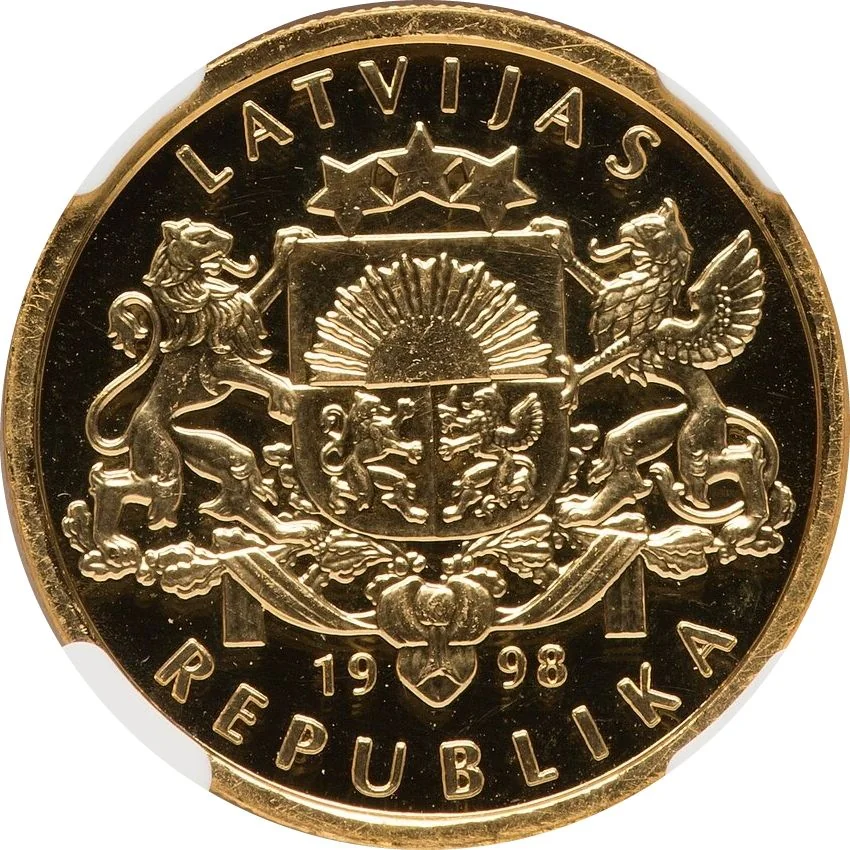
Description:
The Latvian coat of arms is centered, with "LATVIJAS" above and "REPUBLIKA" below it in semicircles, and the year 1998 inscribed beneath.
Inscription:
LATVIJAS REPUBLIKA
19 98
19 98
Translation:
REPUBLIC OF LATVIA
19 98
19 98
Script: Latin
Language: Latvian
Engraver: Jānis Strupulis
Designer: Sandra Belsone
Reverse
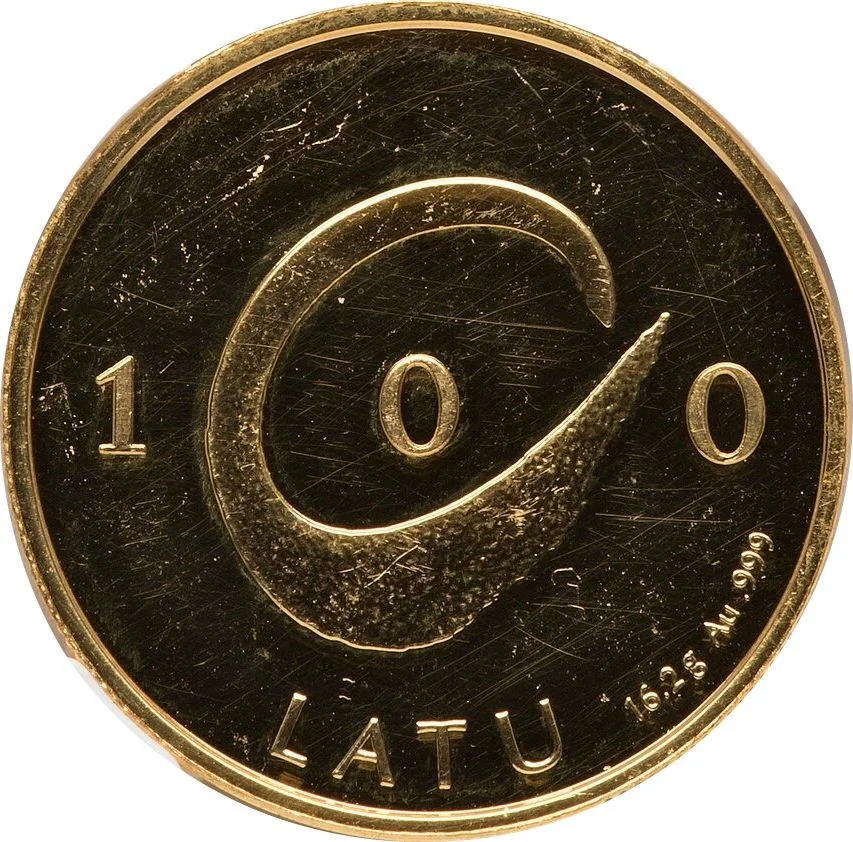
Description:
Centered is the numeral 100 within an open circle of development. Below, a semicircular LATU inscription accompanies the weight and fineness (16.2 g Au .999).
Inscription:
100 LATU
16.2 g Au .999
16.2 g Au .999
Script: Latin
Engraver: Jānis Strupulis
Designer: Sandra Belsone
Edge
Three reeded and smooth segments are alternated.
Mints
| Name | Mark |
|---|---|
| Mint of Finland | — |
Mintings
| Year | Mint Mark | Mintage | Quality | Collection |
|---|---|---|---|---|
| 1998 | — | 19,890 | Proof |
Historical background
In 1998, Latvia was navigating a complex monetary landscape as part of its post-Soviet transition, firmly anchored by its Currency Board Arrangement (CBA). Established in 1993 to halt hyperinflation and restore stability, the CBA strictly pegged the Latvian lats (LVL) first to the IMF's Special Drawing Right (SDR) and then, from 1994, to the IMF's SDR basket, with a de facto strong link to the Deutsche Mark. This rigid system mandated full foreign reserve backing for the domestic currency, successfully delivering low inflation and credibility. However, it also meant Latvia had relinquished independent monetary policy, leaving its economy vulnerable to external shocks and reliant on fiscal discipline.
The year 1998 was a severe test of this framework due to the twin crises of the Russian Financial Crisis and the broader Asian Financial Crisis. As a key trading partner, Russia's default and devaluation in August drastically reduced demand for Latvian exports and triggered a liquidity crunch. Concurrently, the global risk aversion stemming from the Asian turmoil led to capital outflows and pressure on the Latvian banking system. The largest bank, Baltija, had already collapsed in 1995, and in 1998, the sector faced renewed stress, exposing weaknesses in credit allocation and raising concerns about financial stability despite the solid currency peg.
Nevertheless, the Latvian government and the Bank of Latvia responded with stringent austerity measures to defend the CBA, which was seen as the non-negotiable cornerstone of economic stability. They tightened fiscal policy, allowed interest rates to rise sharply to stem capital flight, and secured international support. This painful but decisive commitment to the fixed exchange rate proved successful in the short term; the lats peg held firm without devaluation. The crisis of 1998, however, underscored the structural vulnerabilities of an economy with a fixed exchange rate and a large current account deficit, lessons that would later inform Latvia's path toward European Union and, ultimately, Eurozone membership.
The year 1998 was a severe test of this framework due to the twin crises of the Russian Financial Crisis and the broader Asian Financial Crisis. As a key trading partner, Russia's default and devaluation in August drastically reduced demand for Latvian exports and triggered a liquidity crunch. Concurrently, the global risk aversion stemming from the Asian turmoil led to capital outflows and pressure on the Latvian banking system. The largest bank, Baltija, had already collapsed in 1995, and in 1998, the sector faced renewed stress, exposing weaknesses in credit allocation and raising concerns about financial stability despite the solid currency peg.
Nevertheless, the Latvian government and the Bank of Latvia responded with stringent austerity measures to defend the CBA, which was seen as the non-negotiable cornerstone of economic stability. They tightened fiscal policy, allowed interest rates to rise sharply to stem capital flight, and secured international support. This painful but decisive commitment to the fixed exchange rate proved successful in the short term; the lats peg held firm without devaluation. The crisis of 1998, however, underscored the structural vulnerabilities of an economy with a fixed exchange rate and a large current account deficit, lessons that would later inform Latvia's path toward European Union and, ultimately, Eurozone membership.

💎 Extremely Rare