

2 francs – Madagascar
Add to wishlist
Madagascar
Context
Material
References
KM: #
Numista: #4699
Obverse
Description:
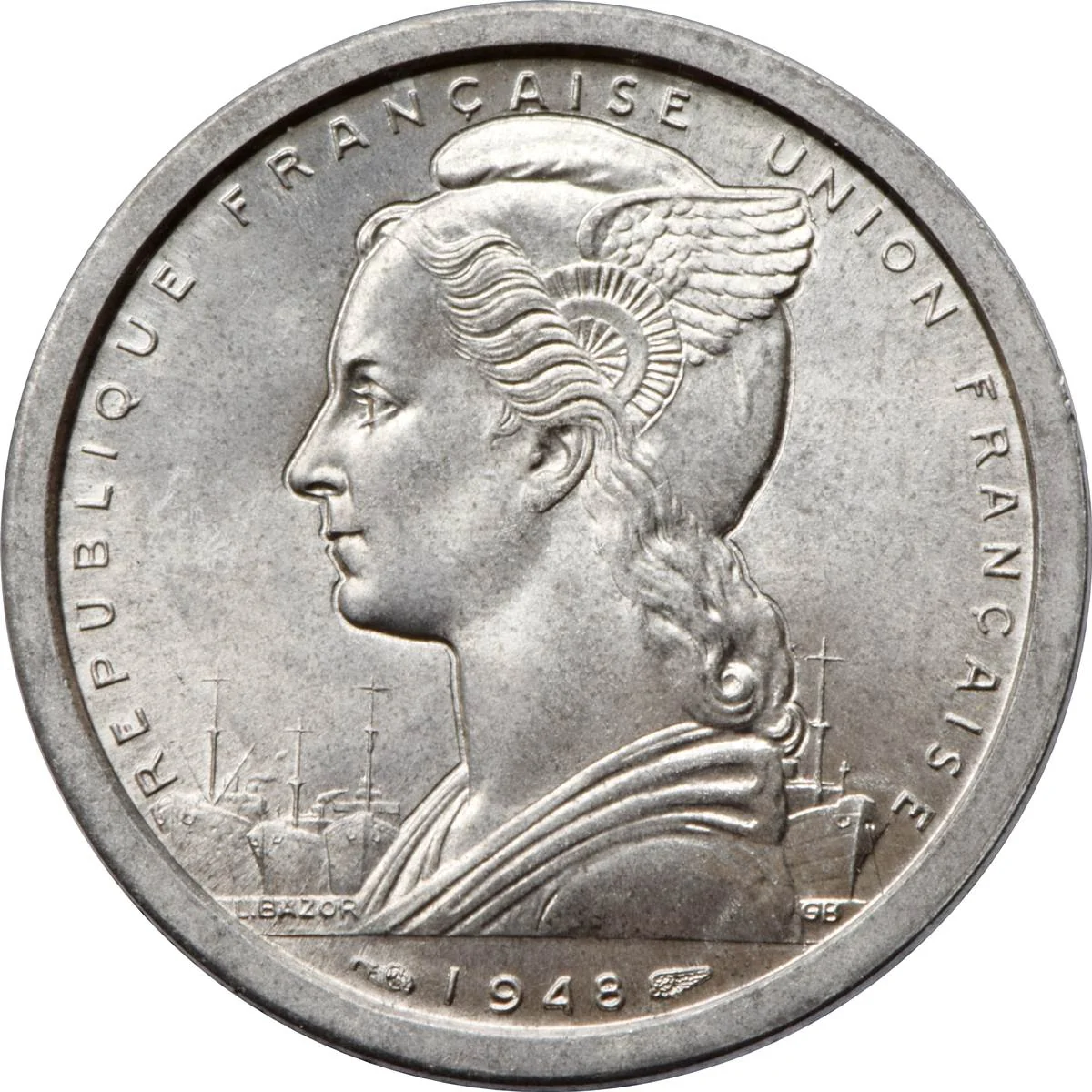
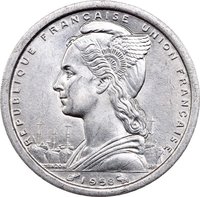
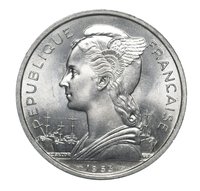
Marianne's bust in a winged Phrygian cap, with four ships behind.
Inscription:
REPUBLIQUE FRANÇAISE UNION FRANÇAISE
L.BAZOR GB
1948
L.BAZOR GB
1948
Translation:
FRENCH REPUBLIC FRENCH UNION
L.BAZOR GB
1948
L.BAZOR GB
1948
Script: Latin
Language: French
Engraver: Lucien Georges Bazor
Reverse
Description:
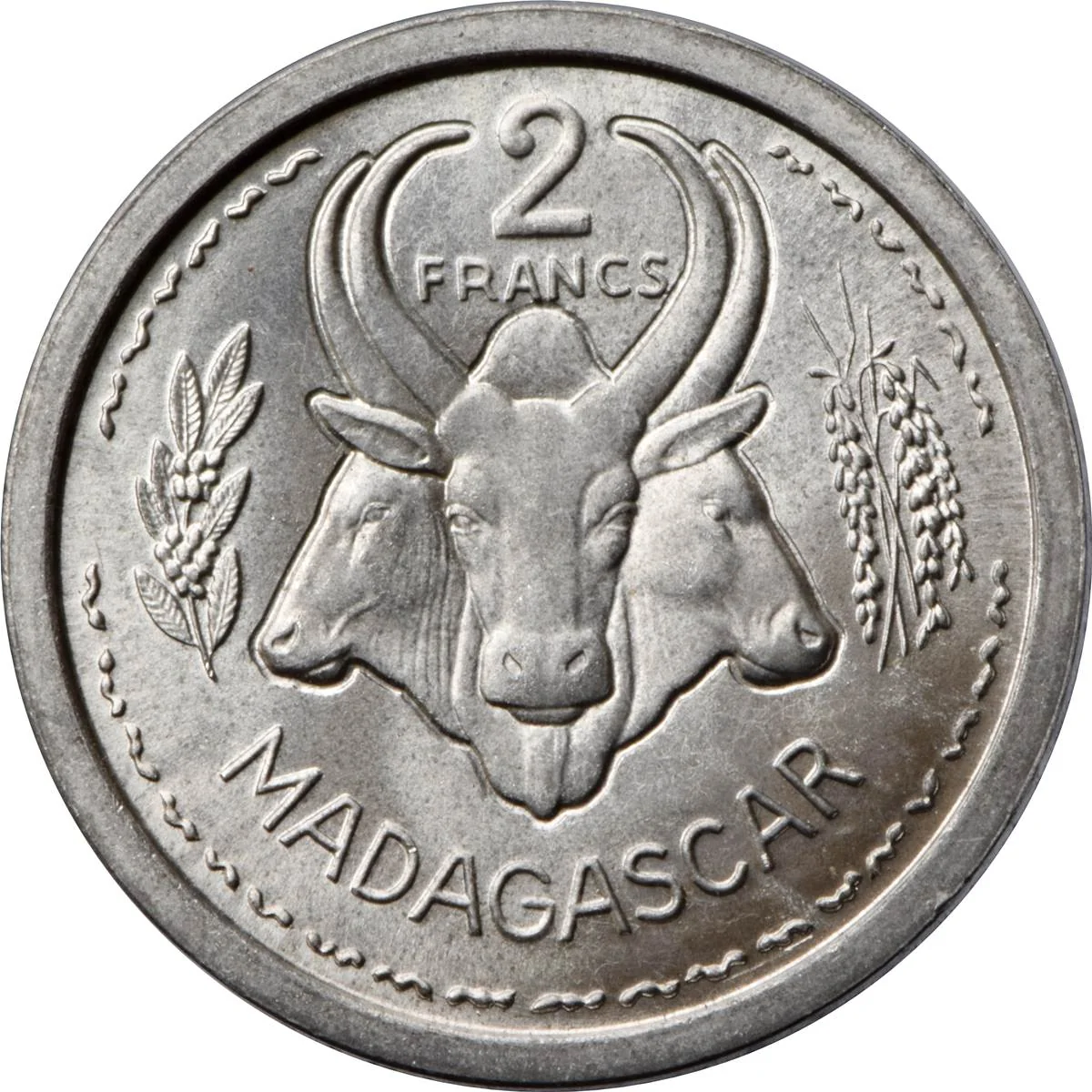
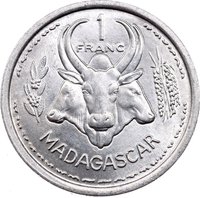
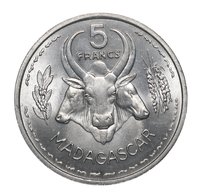
Three zebu heads conjoined, flanked by sprigs, value in horns.
Inscription:
2
FRANCS
MADAGASCAR
FRANCS
MADAGASCAR
Script: Latin
Engraver: Lucien Georges Bazor
Edge
Plain
Categories
| Symbol> Phrygian cap |
| Transportation> Watercraft |
Mints
| Name | Mark |
|---|---|
| Monnaie de Paris | — |
Mintings
| Year | Mint Mark | Mintage | Quality | Collection |
|---|---|---|---|---|
| 1948 | — | — |
Historical background
In 1948, Madagascar's currency situation was firmly under the control of the French colonial administration as part of the French Franc zone. The official currency was the Malagasy Franc (Franc Malgache), which was not an independent currency but a local issuance pegged at par with the French Franc (Franc CFA). This system was managed by the Banque de Madagascar et des Comores, which held the exclusive right of note-issue and acted as the colony's central bank, ensuring the free convertibility and fixed parity with the metropolitan currency. The primary function of this monetary arrangement was to integrate Madagascar's economy into that of France, facilitating trade and the extraction of resources for the benefit of the metropole.
Economically, the post-World War II period was one of significant strain and transition. The global conflict had disrupted trade and caused inflationary pressures worldwide, which were felt in Madagascar. The fixed peg to the French Franc, while ensuring stability in principle, also meant that the colony imported monetary policies decided in Paris, which were not necessarily tailored to local economic conditions. Furthermore, 1948 was a year of profound social and political crisis, marked by the bloody Madagascar Revolt (1947-1948). The brutal suppression of this nationalist uprising devastated much of the island's eastern economy, disrupting agricultural production (particularly of rice and coffee) and infrastructure, thereby creating localized monetary instability and hardship despite the formal currency stability.
Consequently, the currency situation in 1948 reflected the broader colonial reality: a superficially stable and centralized system that masked deeper economic dislocation and political unrest. The Malagasy Franc served as a tool of colonial integration, but its operation could not isolate the island from the consequences of war, rebellion, and recovery. The system would remain largely unchanged until the wave of African independence in the 1960s, after which Madagascar would eventually establish its own central bank and seek greater monetary autonomy.
Economically, the post-World War II period was one of significant strain and transition. The global conflict had disrupted trade and caused inflationary pressures worldwide, which were felt in Madagascar. The fixed peg to the French Franc, while ensuring stability in principle, also meant that the colony imported monetary policies decided in Paris, which were not necessarily tailored to local economic conditions. Furthermore, 1948 was a year of profound social and political crisis, marked by the bloody Madagascar Revolt (1947-1948). The brutal suppression of this nationalist uprising devastated much of the island's eastern economy, disrupting agricultural production (particularly of rice and coffee) and infrastructure, thereby creating localized monetary instability and hardship despite the formal currency stability.
Consequently, the currency situation in 1948 reflected the broader colonial reality: a superficially stable and centralized system that masked deeper economic dislocation and political unrest. The Malagasy Franc served as a tool of colonial integration, but its operation could not isolate the island from the consequences of war, rebellion, and recovery. The system would remain largely unchanged until the wave of African independence in the 1960s, after which Madagascar would eventually establish its own central bank and seek greater monetary autonomy.
🌱 Common