

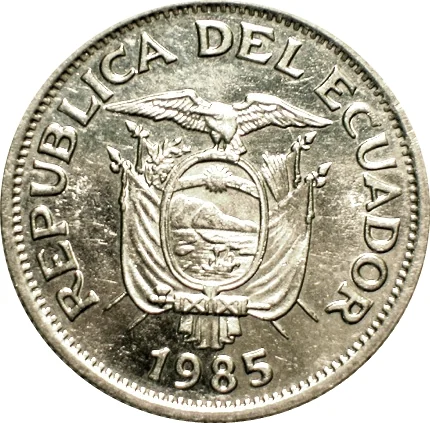
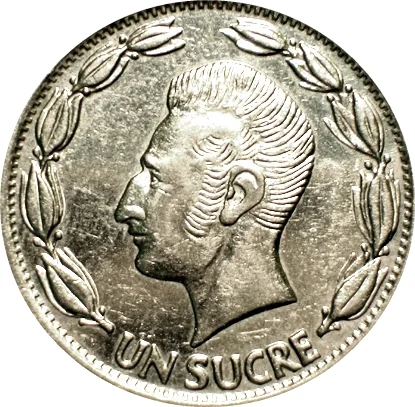
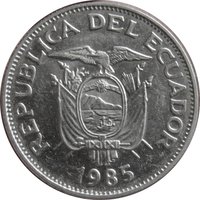
Obverse
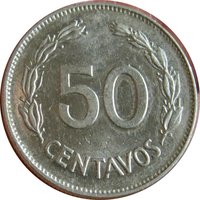
Reverse
Edge
Reeded
Categories
| Symbols> Coat of Arms |
| Person> Politician |
| Symbol> Wreath |
Mints
| Name | Mark |
|---|---|
| Royal Mint | — |
| VDM Metals / Vereinigte Deutsche Metallwerke | — |
Mintings
| Year | Mint Mark | Mintage | Quality | Collection |
|---|---|---|---|---|
| 1985 | — | — | ||
| 1986 | — | — |
Historical background
In 1985, Ecuador was grappling with a severe economic crisis that had been building for over a decade. The nation's currency, the sucre, was under intense pressure due to a combination of factors: a heavy reliance on oil exports (which saw prices collapse in the early 1980s), a massive foreign debt burden, and persistent fiscal deficits. This led to chronic inflation, which reached an annual rate of approximately 30% in 1985, eroding purchasing power and public confidence in the national currency. The government of President León Febres-Cordero, who took office in 1984, faced the difficult task of stabilizing the economy while adhering to austerity measures imposed by the International Monetary Fund (IMF).
The official response was a series of orthodox adjustment policies focused on fiscal discipline, trade liberalization, and attempts to control the money supply. However, these measures failed to halt the sucre's decline. A critical feature of the 1985 currency situation was the existence of a rampant parallel foreign exchange market. While the government maintained an official, overvalued exchange rate, a much weaker black-market rate for the US dollar prevailed in practice, creating a vast gap between the two. This duality encouraged capital flight, distorted trade, and undermined the effectiveness of government economic policy, as most real transactions occurred at the unfavorable parallel rate.
Consequently, the year was marked by a continued and sharp devaluation of the sucre in real terms, despite official efforts to prop it up. The economic instability fueled social unrest, including protests by labor unions and indigenous groups against austerity. The currency turmoil of 1985 was a pivotal chapter in a longer period of monetary instability that would eventually culminate in full-blown hyperinflation and banking collapse in the late 1990s, setting the stage for Ecuador's dramatic decision to adopt the US dollar as its official currency in the year 2000.
The official response was a series of orthodox adjustment policies focused on fiscal discipline, trade liberalization, and attempts to control the money supply. However, these measures failed to halt the sucre's decline. A critical feature of the 1985 currency situation was the existence of a rampant parallel foreign exchange market. While the government maintained an official, overvalued exchange rate, a much weaker black-market rate for the US dollar prevailed in practice, creating a vast gap between the two. This duality encouraged capital flight, distorted trade, and undermined the effectiveness of government economic policy, as most real transactions occurred at the unfavorable parallel rate.
Consequently, the year was marked by a continued and sharp devaluation of the sucre in real terms, despite official efforts to prop it up. The economic instability fueled social unrest, including protests by labor unions and indigenous groups against austerity. The currency turmoil of 1985 was a pivotal chapter in a longer period of monetary instability that would eventually culminate in full-blown hyperinflation and banking collapse in the late 1990s, setting the stage for Ecuador's dramatic decision to adopt the US dollar as its official currency in the year 2000.
🌱 Very Common