

25 pesos (Ibero-American Series) – Argentina
Add to wishlist
Non-circulating coins
Commemoration: 20th Anniversary of the Ibero-American Series
Argentina
Obverse
Description:
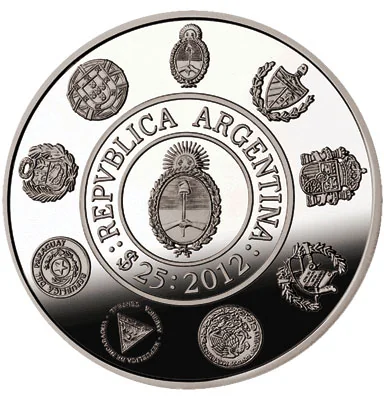
The shared design features Argentina’s national coat of arms, "REPVBLICA ARGENTINA," "$ 25," and "2012" centrally, surrounded by the shields of all participating countries.
Inscription:
:REPVBLICA ARGENTINA:
$25 : 2010
$25 : 2010
Script: Latin
Engraver: Carlos Pedro Rodríguez Dufour
Reverse
Description:
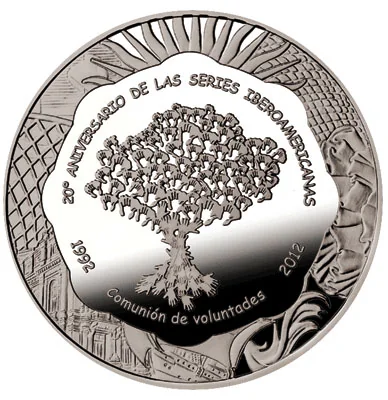
The design centers on two elements: the phrase "Communion of Wills," expressing synergy between nations, and an image of handprints forming a tree. The tree allegorizes the origin, growth, and fruits of the numismatic program. Surrounding text reads "20° ANIVERSARIO DE LAS SERIES IBEROAMERICANAS" above and "1992 COMUNIÓN DE VOLUNTADES 2012" below. The outer rim features motifs from the eight issued series, recalling the country's continuous participation.
Inscription:
20° ANIVERSARIO DE LAS SERIES IBEROAMERICANAS
1992 Comunión de volutades 2012
1992 Comunión de volutades 2012
Translation:
20th Anniversary of the Ibero-American Series
1992 Communion of Wills 2012
1992 Communion of Wills 2012
Script: Latin
Language: Spanish
Engraver: Carlos Pedro Rodríguez Dufour
Edge
Reeded
Mints
| Name | Mark |
|---|---|
| Royal Mint of Madrid | — |
Mintings
| Year | Mint Mark | Mintage | Quality | Collection |
|---|---|---|---|---|
| 2012 | — | 1,500 | Proof |
Historical background
In 2012, Argentina was in the midst of a prolonged currency crisis characterized by strict capital controls and a growing gap between the official and unofficial exchange rates. President Cristina Fernández de Kirchner's administration, seeking to stem capital flight and bolster central bank reserves, had implemented a system known as the "cepo cambiario" (exchange clamp) in late 2011. This policy strictly limited citizens' and businesses' access to US dollars at the official rate, which was artificially maintained by the Central Bank. The goal was to preserve dollars for essential imports and debt payments, but it created immediate distortions in the economy.
As a result, a thriving black market for US dollars, known as the "blue dollar," emerged and rapidly diverged from the official rate. Throughout 2012, the official peso rate was held at approximately 4.5 to the dollar, while the blue rate soared, ending the year near 7.5 pesos per dollar—a premium of over 60%. This disparity reflected widespread public distrust in the peso due to high inflation, which private estimates placed above 25% annually (far above the government's disputed figures). The controls created severe headaches for businesses, discouraging investment and complicating international trade, as importers struggled to access needed foreign currency.
The situation was further strained by ongoing legal battles with international creditors following the country's historic 2001 default. A major ruling by a U.S. court in favor of "holdout" creditors in late 2012 threatened to push Argentina into technical default again, increasing economic uncertainty. Thus, the currency controls of 2012 were a defensive, but ultimately destabilizing, response to deeper issues: rampant inflation, lack of fiscal and monetary discipline, and a loss of investor confidence, setting the stage for even more severe economic challenges in the years to follow.
As a result, a thriving black market for US dollars, known as the "blue dollar," emerged and rapidly diverged from the official rate. Throughout 2012, the official peso rate was held at approximately 4.5 to the dollar, while the blue rate soared, ending the year near 7.5 pesos per dollar—a premium of over 60%. This disparity reflected widespread public distrust in the peso due to high inflation, which private estimates placed above 25% annually (far above the government's disputed figures). The controls created severe headaches for businesses, discouraging investment and complicating international trade, as importers struggled to access needed foreign currency.
The situation was further strained by ongoing legal battles with international creditors following the country's historic 2001 default. A major ruling by a U.S. court in favor of "holdout" creditors in late 2012 threatened to push Argentina into technical default again, increasing economic uncertainty. Thus, the currency controls of 2012 were a defensive, but ultimately destabilizing, response to deeper issues: rampant inflation, lack of fiscal and monetary discipline, and a loss of investor confidence, setting the stage for even more severe economic challenges in the years to follow.
💎 Very Rare