


5 euro (Michelangelo) – Italy
Add to wishlist
Non-circulating coins
Commemoration: 550th Anniversary of the Birth of Michelangelo
Italy
Context
Material


References
KM: #
Numista: #467751
Value
Exchange value: 5 EUR
Bullion value: $40.52
Obverse
Description:
Central: Michelangelo's portrait from Casa Buonarroti Museum. Background: Michelangelo's Piazza del Campidoglio pavement pattern. Arching inscription: "REPUBBLICA ITALIANA". Designer's signature on right: "U.PERNAZZA".
Inscription:
REPUBBLICA
ITALIANA
U. PERNAZZA
ITALIANA
U. PERNAZZA
Script: Latin
Designer: Uliana Pernazza
Reverse
Description:
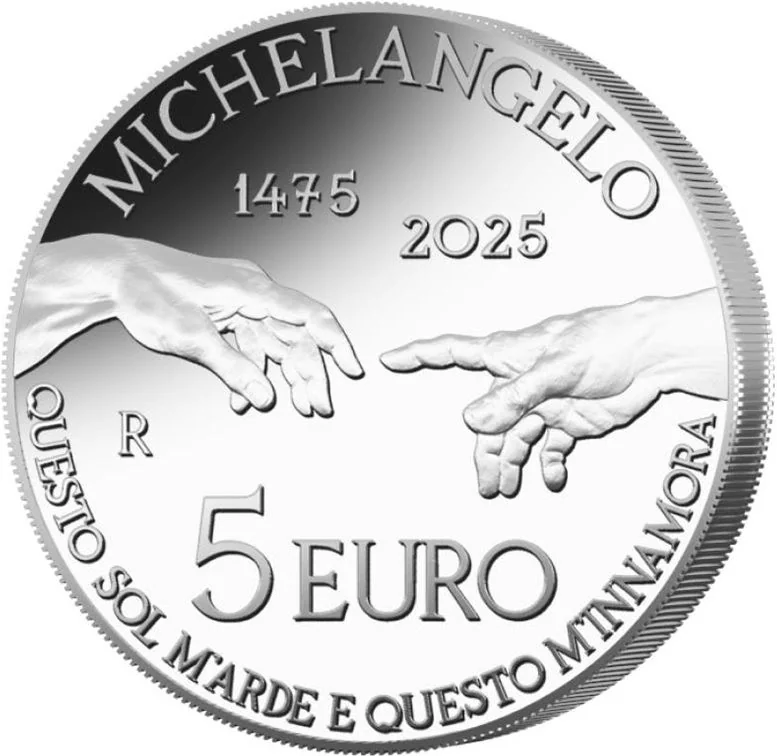
Center: detail from the Sistine Chapel's "Creation of Adam." Arching above: "MICHELANGELO." In field: dates "1475" and "2025." Arching below: inscription "QUESTO SOL M’ARDE E QUESTO M’INNAMORA." At bottom: "5 EURO." On left: "R" for Rome Mint.
Inscription:
MICHELANGELO
1475 2025
R
5 EURO
QUESTO SOL M’ARDE E QUESTO M’INNAMORA
1475 2025
R
5 EURO
QUESTO SOL M’ARDE E QUESTO M’INNAMORA
Script: Latin
Designer: Uliana Pernazza
Edge
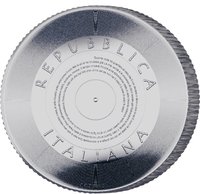
Continuous milled
Mints
| Name | Mark |
|---|---|
| Rome | R |
Mintings
| Year | Mint Mark | Mintage | Quality | Collection |
|---|---|---|---|---|
| 2025 | R | 5,000 | Proof |
Historical background
As of 2025, Italy's currency situation remains firmly within the framework of the Eurozone, with the euro (EUR) as its sole legal tender. The political debates of the previous decade regarding a potential return to a national currency, such as the lira, have significantly diminished. This is largely due to the stabilizing effects of the European Central Bank's (ECB) policy tools, particularly the Transmission Protection Instrument (TPI), which has helped contain sovereign debt spreads within the Eurozone. Italy's financial stability is now more closely tied to the successful implementation of the National Recovery and Resilience Plan (PNRR), funded by the European Union's NextGenerationEU program, which mandates specific economic reforms in exchange for substantial grants and loans.
However, underlying vulnerabilities persist and shape monetary policy discussions. Italy's public debt-to-GDP ratio, while stabilized, remains the second highest in the Eurozone, making the country particularly sensitive to interest rate decisions from the Frankfurt-based ECB. The primary domestic focus in 2025 is not on currency exit but on managing the cost of servicing this debt amidst a climate of cautiously lowered but still restrictive monetary policy. Furthermore, the digital euro project, now in its advanced preparation phase, is a key topic of discussion, with Italian financial institutions actively involved in pilot programs to understand its implications for retail payments and financial sovereignty.
Looking ahead, the currency situation is characterized by a pragmatic acceptance of the euro, coupled with ongoing efforts to strengthen Italy's economic fundamentals within the European framework. The government's ability to meet PNRR milestones and pursue prudent fiscal policies is seen as the most critical factor in maintaining investor confidence and favorable borrowing rates. Consequently, while the euro is not without its domestic critics, the tangible risks and immense complexity of "Italexit" have relegated it to a fringe political discourse, with mainstream efforts focused on leveraging Italy's position within the single currency area to foster growth and competitiveness.
However, underlying vulnerabilities persist and shape monetary policy discussions. Italy's public debt-to-GDP ratio, while stabilized, remains the second highest in the Eurozone, making the country particularly sensitive to interest rate decisions from the Frankfurt-based ECB. The primary domestic focus in 2025 is not on currency exit but on managing the cost of servicing this debt amidst a climate of cautiously lowered but still restrictive monetary policy. Furthermore, the digital euro project, now in its advanced preparation phase, is a key topic of discussion, with Italian financial institutions actively involved in pilot programs to understand its implications for retail payments and financial sovereignty.
Looking ahead, the currency situation is characterized by a pragmatic acceptance of the euro, coupled with ongoing efforts to strengthen Italy's economic fundamentals within the European framework. The government's ability to meet PNRR milestones and pursue prudent fiscal policies is seen as the most critical factor in maintaining investor confidence and favorable borrowing rates. Consequently, while the euro is not without its domestic critics, the tangible risks and immense complexity of "Italexit" have relegated it to a fringe political discourse, with mainstream efforts focused on leveraging Italy's position within the single currency area to foster growth and competitiveness.



✨ Legendary