

¼ Ashraphi – Nepal
Nepal
Context
Year: 1954
Vikram Samvat Year: 2010
Issuer: Nepal 
Ruler: Tribhuvan Bir Bikram Shah
Currency:
Demonetized: Yes
Material
References
KM: #Click to copy to clipboard774
Numista: #466243
Value
Bullion value: $483.52
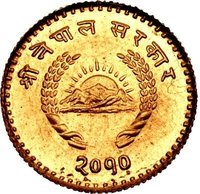
Obverse
Description:
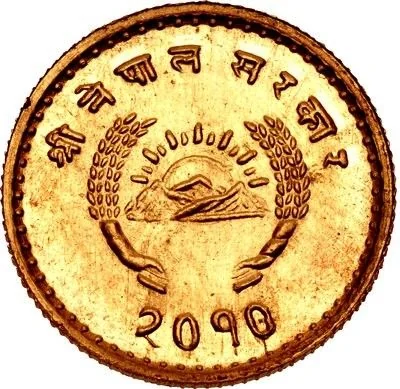
Sun rising behind three mountains, partially ringed by wheat, with text above and date below.
Inscription:
त्रिभुवन वीर विक्रम
2090
2090
Translation:
Tri Bhuvan Veer Vikram
2090
2090
Script: Devanagari
Language: Sanskrit
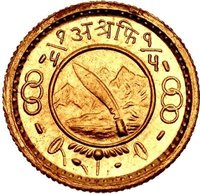
Reverse
Description:
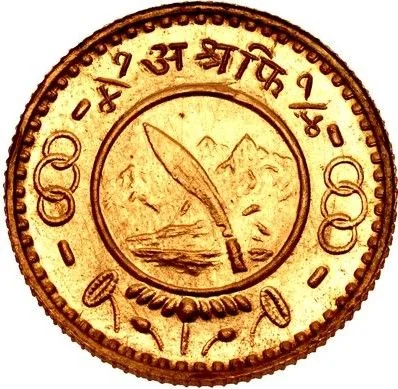
Khukri knife within circle, surrounded by lettering and denomination.
Script: Devanagari
Edge
Mintings
| Year | Mint Mark | Mintage | Quality | Collection |
|---|---|---|---|---|
| 1954 | — | — |
Historical background
In 1954, Nepal's currency situation was characterized by a complex dual-system, heavily influenced by its economic and political ties with India. The Nepalese rupee (NPR) was the official currency, but the Indian rupee (INR) circulated widely and was accepted as legal tender throughout the kingdom. This was a legacy of the 1924 Nepal-India Treaty and the open border, which deeply integrated the two economies. Nepal's own currency, minted by the Nepal Rastra Bank (established just two years prior in 1952), struggled to establish full sovereignty, as transactions, particularly in trade and with Indian migrant laborers, were often conducted in Indian currency.
This dependency created significant monetary management challenges for the nascent central bank. Nepal's foreign exchange reserves were essentially held in Indian rupees, and its trade was overwhelmingly with India, making its economy highly sensitive to Indian monetary policy. There was no independent exchange rate; the Nepalese rupee was pegged at par (1:1) with the Indian rupee. While this peg provided stability, it also meant Nepal had little control over its money supply and was vulnerable to inflationary pressures imported from India. The government's goal was to promote the sole use of the Nepalese rupee, but practical economic reality made this difficult to enforce.
The year 1954 fell within a period of gradual modernization of Nepal's financial system following the end of the Rana regime in 1951. The establishment of Nepal Rastra Bank was a foundational step toward gaining monetary autonomy. However, in 1954, the institution was still in its early stages of developing tools for credit control and promoting a unified national currency. Thus, the currency situation was one of transition—caught between the historical dominance of the Indian rupee and the emerging efforts of a sovereign nation to assert control over its own monetary affairs, a process that would eventually lead to the demonetization of Indian currency in Nepal years later.
This dependency created significant monetary management challenges for the nascent central bank. Nepal's foreign exchange reserves were essentially held in Indian rupees, and its trade was overwhelmingly with India, making its economy highly sensitive to Indian monetary policy. There was no independent exchange rate; the Nepalese rupee was pegged at par (1:1) with the Indian rupee. While this peg provided stability, it also meant Nepal had little control over its money supply and was vulnerable to inflationary pressures imported from India. The government's goal was to promote the sole use of the Nepalese rupee, but practical economic reality made this difficult to enforce.
The year 1954 fell within a period of gradual modernization of Nepal's financial system following the end of the Rana regime in 1951. The establishment of Nepal Rastra Bank was a foundational step toward gaining monetary autonomy. However, in 1954, the institution was still in its early stages of developing tools for credit control and promoting a unified national currency. Thus, the currency situation was one of transition—caught between the historical dominance of the Indian rupee and the emerging efforts of a sovereign nation to assert control over its own monetary affairs, a process that would eventually lead to the demonetization of Indian currency in Nepal years later.
✨ Legendary