

50 baiocchi – Papal States
Add to wishlist
Circulating commemorative coins
Commemoration: San Romualdo
Vatican City
Context
Years: 1832–1834
Country: Vatican City
Issuer: Papal States
Ruler: Gregory XVI
Currency:
(1534—1835)
Demonetized: Yes
Total mintage: 24,552
Material
References
KM: #
Numista: #46520
Value
Bullion value: $30.95
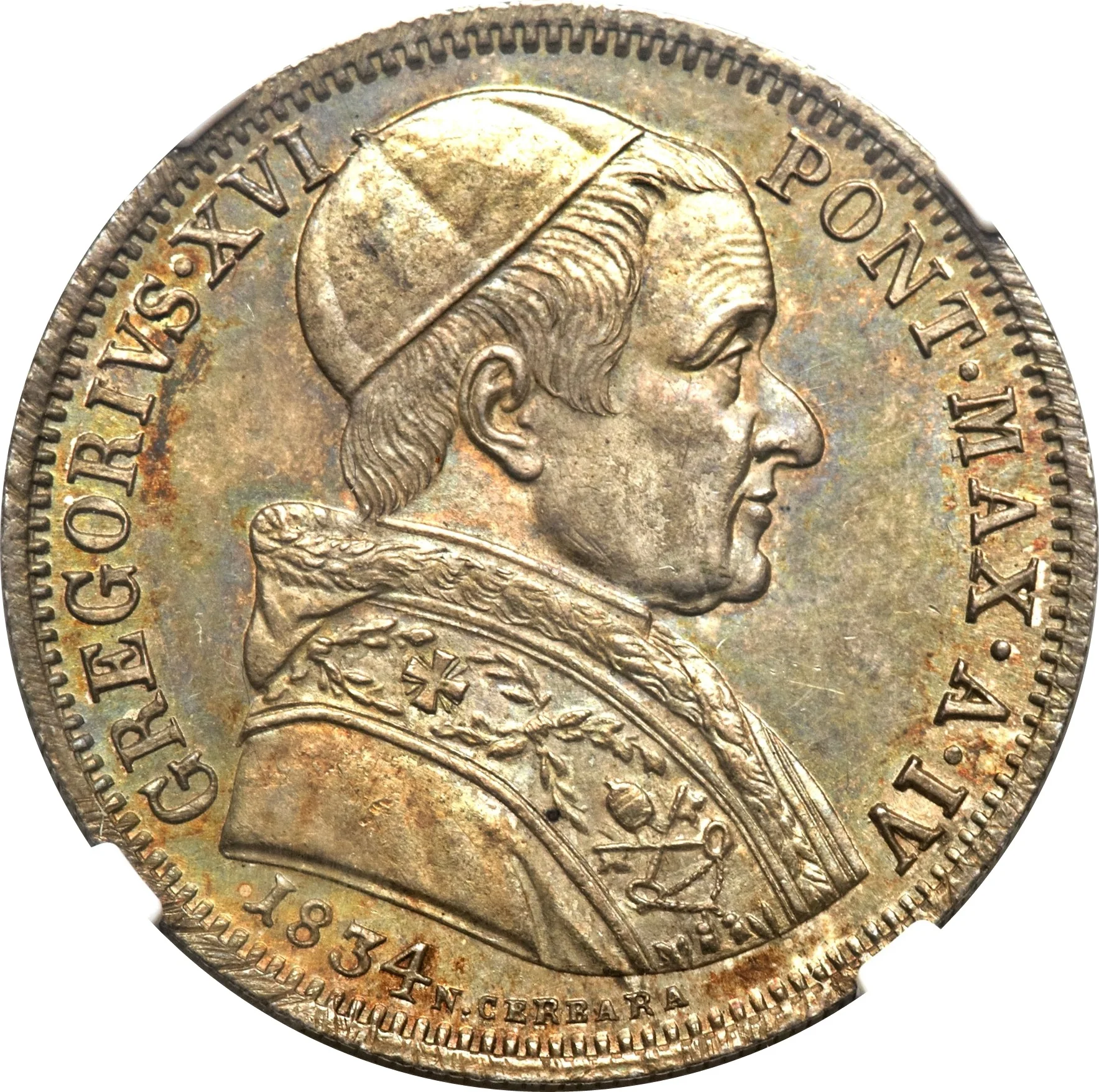
Obverse
Description:
Legend breaker
Inscription:
GREGORIVS.XVI / PONT.MAX.A.IV // 1834 N. CERRARA
Translation:
Gregory XVI, Supreme Pontiff in the fourth year; 1834 N. Cerrara
Script: Latin
Language: Latin
Engraver: Niccolò Cerbara
Reverse
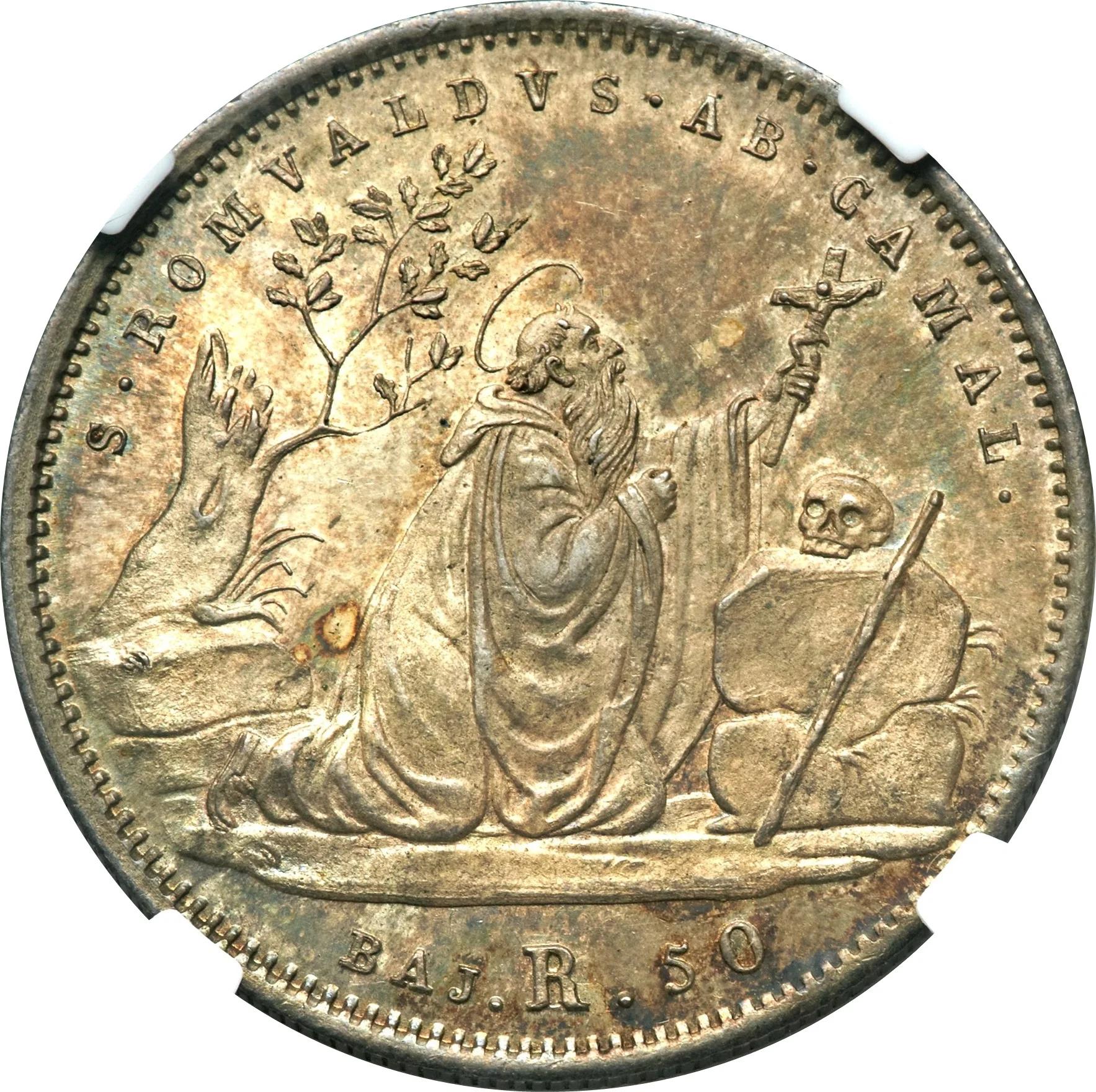
Description:
Kneeling figures over value.
Inscription:
S:ROMVALDVS.AB.CAMAL. // BAJ. R.50
Script: Latin
Engraver: Niccolò Cerbara
Edge
Reeded
Mintings
| Year | Mint Mark | Mintage | Quality | Collection |
|---|---|---|---|---|
| 1832 | B | 6,612 | ||
| 1832 | R | — | ||
| 1834 | R | 17,940 |
Historical background
In 1832, the Papal States faced a complex and deteriorating currency situation, a direct consequence of prolonged fiscal mismanagement and political instability. The state's finances were crippled by a large public debt, heavy reliance on inefficient taxes like the macinato (grist tax), and the costly maintenance of a bloated bureaucracy. To cover deficits, the government increasingly resorted to issuing paper money and debasing coinage, leading to a severe loss of public confidence. By the early 1830s, multiple forms of money circulated at conflicting values: stable foreign coins (like the French franc), older Papal coins with higher silver content, and newer, debased papal scudi and bajocchi, alongside depreciated government-issued paper biglietti di cass.
This monetary chaos created a three-tiered system that crippled daily economic life. Merchants and the public, distrusting the official rates, engaged in widespread hoarding of sound coins (Gresham's Law in action), which drove good money out of circulation. Prices became unpredictable, often quoted in the more stable foreign currencies, while wages paid in depreciating papal money lost real value, sparking social unrest. The confusion was particularly acute in the Legations in the north, which had more advanced economies and greater exposure to stable currencies from neighboring states, widening the economic divide within the Papal territories.
The situation was a significant point of contention during the pontificate of Gregory XVI (1831-1846), whose conservative opposition to economic modernization and reliance on Austrian military support prevented any substantive monetary reform. The currency instability was both a symptom and a cause of the Papal States' broader economic backwardness, contributing to the widespread discontent that fueled revolts in 1831 and would continue to plague the state until its final dissolution in 1870. It underscored the inability of the theocratic government to manage a modern fiscal system, eroding its legitimacy even among its own subjects.
This monetary chaos created a three-tiered system that crippled daily economic life. Merchants and the public, distrusting the official rates, engaged in widespread hoarding of sound coins (Gresham's Law in action), which drove good money out of circulation. Prices became unpredictable, often quoted in the more stable foreign currencies, while wages paid in depreciating papal money lost real value, sparking social unrest. The confusion was particularly acute in the Legations in the north, which had more advanced economies and greater exposure to stable currencies from neighboring states, widening the economic divide within the Papal territories.
The situation was a significant point of contention during the pontificate of Gregory XVI (1831-1846), whose conservative opposition to economic modernization and reliance on Austrian military support prevented any substantive monetary reform. The currency instability was both a symptom and a cause of the Papal States' broader economic backwardness, contributing to the widespread discontent that fueled revolts in 1831 and would continue to plague the state until its final dissolution in 1870. It underscored the inability of the theocratic government to manage a modern fiscal system, eroding its legitimacy even among its own subjects.
💎 Extremely Rare