

3000 Lira (Republic) – Turkey
Non-circulating coins
Commemoration: 60th Anniversary of the Republic
Turkey
Context
Material
References
KM: #Click to copy to clipboard960
Numista: #46518
Value
Exchange value: 3000 TRL
Bullion value: $42.77
Inflation-adjusted value: 1415717021.31 TRL
Obverse
Description:
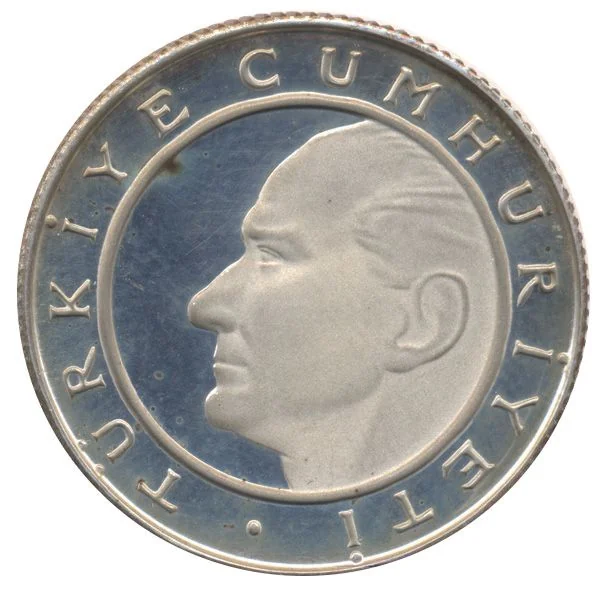
Atatürk's head inside a circle.
Inscription:
TÜRKİYE CUMHURİYETİ
Translation:
REPUBLIC OF TURKEY
Script: Latin
Language: Turkish
Engraver: Suat Özyönüm
Reverse
Description:
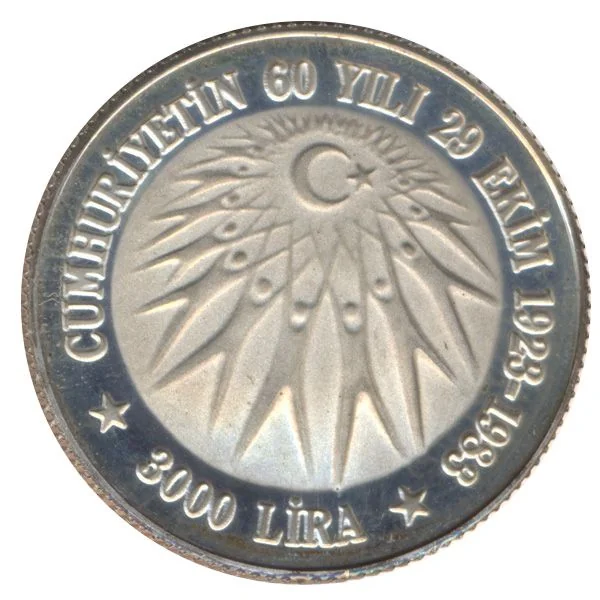
Figures reaching and standing in a circle.
Inscription:
CUMHURİYETİN 60 YILI 29 EKİM 1923-1983
3000 LİRA
3000 LİRA
Translation:
60th Year of the Republic 29 October 1923-1983
3000 Lira
3000 Lira
Script: Latin
Language: Turkish
Engraver: Hakkı Baha Çavuşgil
Edge
Reeded
Mintings
| Year | Mint Mark | Mintage | Quality | Collection |
|---|---|---|---|---|
| 1983 | — | 1,544 | Proof |
Historical background
In 1983, Turkey was emerging from a period of severe economic and political turmoil under the military government that had taken power in the 1980 coup. The preceding years had been marked by hyperinflation, chronic balance of payments crises, and social unrest. In response, the military administration, with Deputy Prime Minister Turgut Özal as its chief economic architect, had initiated a radical stabilization and liberalization program in January 1980. This program aggressively moved Turkey away from its traditional import-substitution industrialization model toward an export-oriented, market-based economy, involving major devaluations, price liberalization, and incentives for exports.
By 1983, the immediate crisis had been stabilized, but the currency situation remained fragile and tightly controlled. The Turkish lira (TL) was not freely convertible, and its value was set by the central bank through a complex system of multiple exchange rates designed to manage foreign exchange scarcity and encourage specific economic activities. While a significant devaluation had been a cornerstone of the 1980 program, bringing the official rate from about 47 TL to the US dollar in 1979 to over 190 TL by 1983, inflation remained stubbornly high, eroding purchasing power and requiring continued administrative management of the currency to prevent a renewed crisis.
The year 1983 itself was a pivotal transition, as general elections were held and Turgut Özal became Prime Minister in November. His ascension solidified the commitment to the ongoing economic transformation. The currency regime of 1983, therefore, was not one of stability but of managed transition—a deliberate, state-controlled mechanism to maintain external competitiveness for exporters while gradually opening the economy. The full liberalization of the foreign exchange regime, including the move toward convertibility and a single exchange rate, would be a central feature of Özal's policies in the coming years, setting the stage for both growth and new vulnerabilities in the Turkish economy.
By 1983, the immediate crisis had been stabilized, but the currency situation remained fragile and tightly controlled. The Turkish lira (TL) was not freely convertible, and its value was set by the central bank through a complex system of multiple exchange rates designed to manage foreign exchange scarcity and encourage specific economic activities. While a significant devaluation had been a cornerstone of the 1980 program, bringing the official rate from about 47 TL to the US dollar in 1979 to over 190 TL by 1983, inflation remained stubbornly high, eroding purchasing power and requiring continued administrative management of the currency to prevent a renewed crisis.
The year 1983 itself was a pivotal transition, as general elections were held and Turgut Özal became Prime Minister in November. His ascension solidified the commitment to the ongoing economic transformation. The currency regime of 1983, therefore, was not one of stability but of managed transition—a deliberate, state-controlled mechanism to maintain external competitiveness for exporters while gradually opening the economy. The full liberalization of the foreign exchange regime, including the move toward convertibility and a single exchange rate, would be a central feature of Özal's policies in the coming years, setting the stage for both growth and new vulnerabilities in the Turkish economy.
✨ Legendary