

1 dollar – Canada
Add to wishlist
Canada
Context
Years: 1987–1989
Issuer: Canada
Ruler: Elizabeth II
Currency:
(since 1858)
Total mintage: 529,560,461
Material
Diameter: 26.5 mm
Weight: 7 g
Thickness: 1.75 mm
Shape: Hendecagonal
Magnetic: Yes
Technique: Milled
Alignment: Medal alignment
flip
References
KM: #
Numista: #465
Value
Exchange value: 1 CAD
Inflation-adjusted value: 2.47 CAD
Obverse
Description:
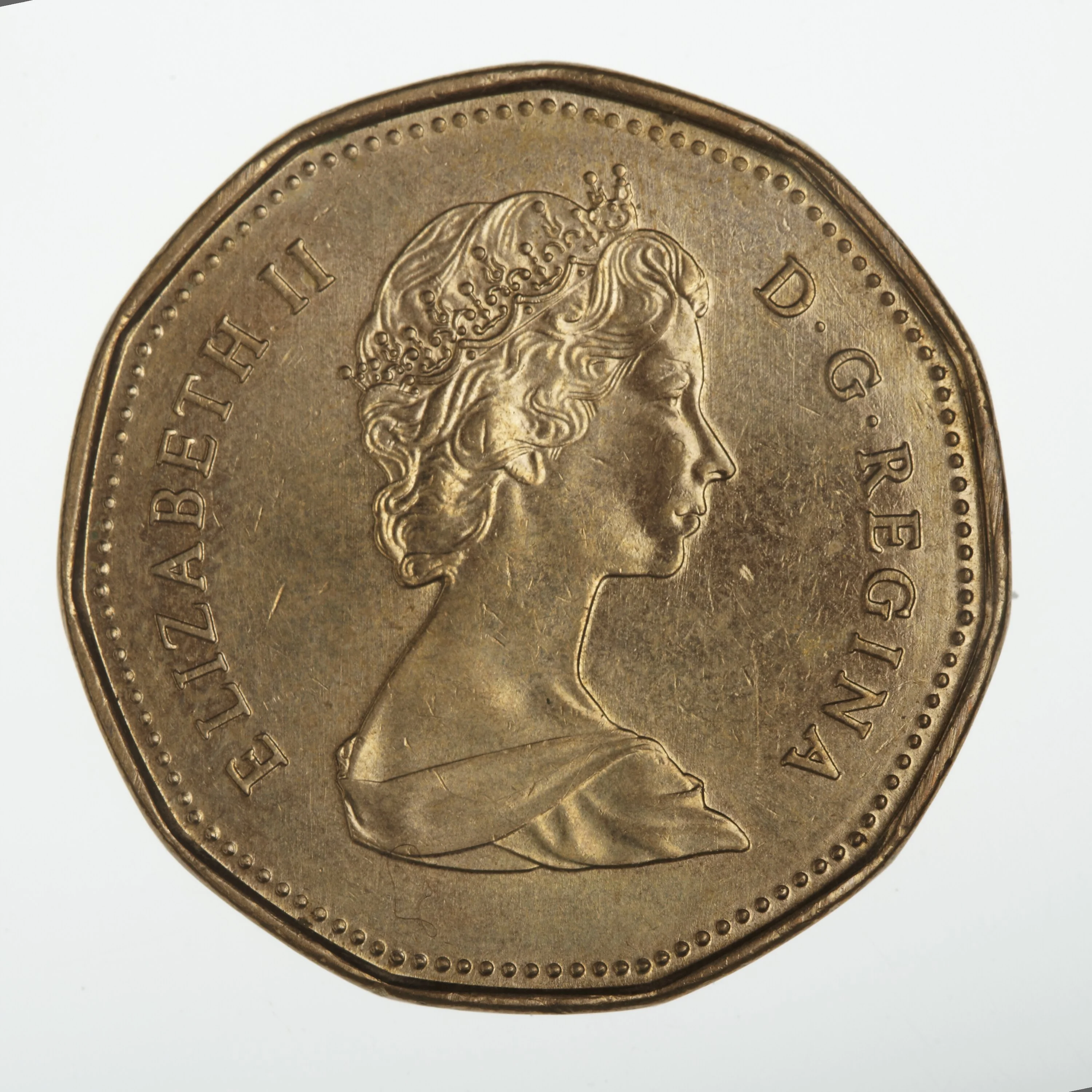
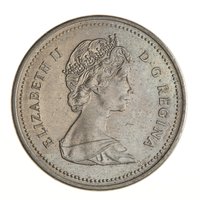
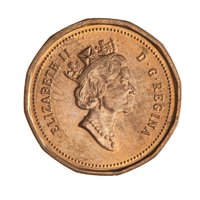
Bust of Queen Elizabeth II at age 37, wearing a tiara and facing right.
Inscription:
ELIZABETH II D·G·REGINA
Translation:
Elizabeth II, by the Grace of God, Queen
Script: Latin
Language: Latin
Engraver: Patrick Brindley
Designer: Arnold Machin
Reverse
Description:
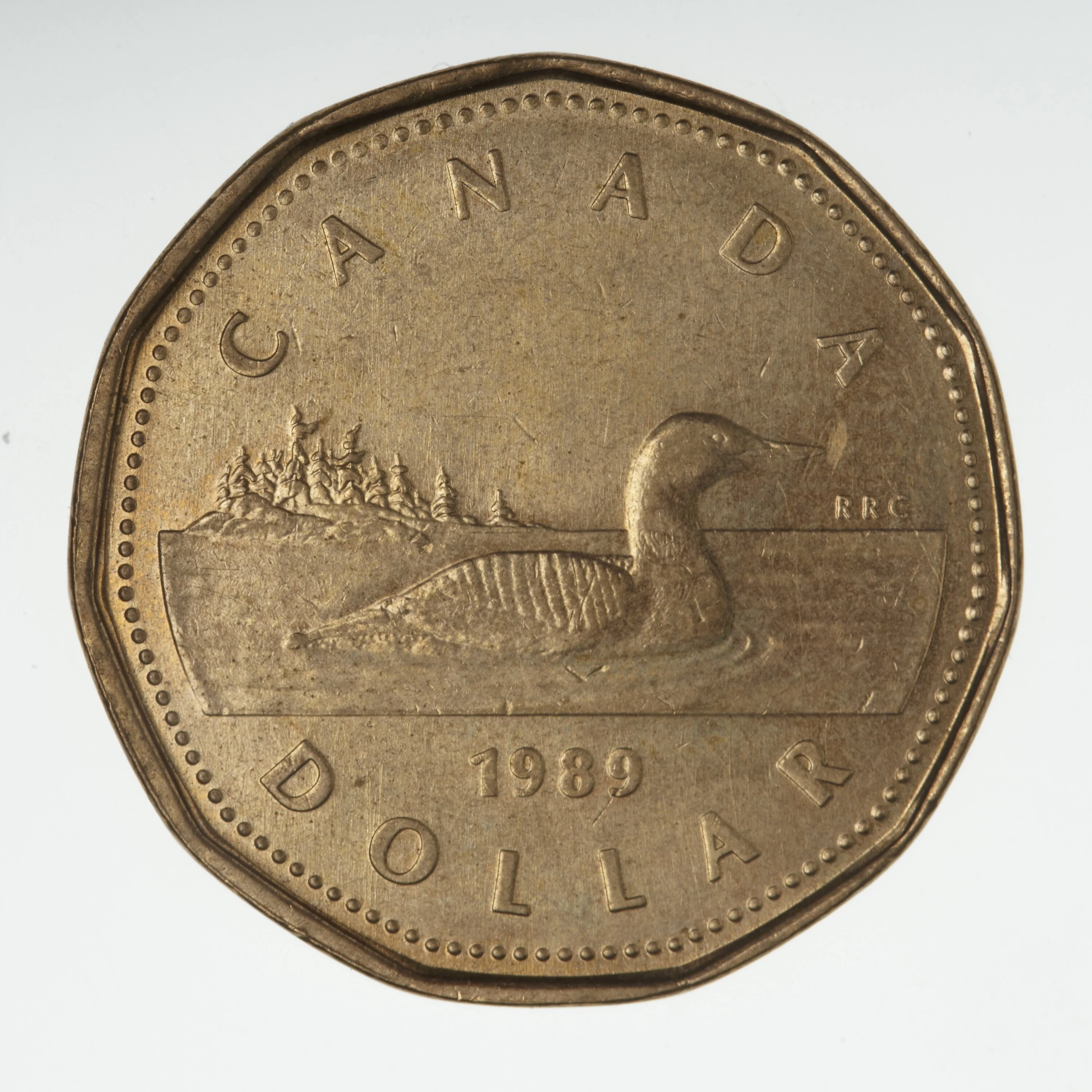
A Canadian loon on a lake, with "CANADA" above and the face value below.
Inscription:
CANADA
1987
DOLLAR
RRC
1987
DOLLAR
RRC
Script: Latin
Engraver: Terry Smith
Designer: Robert-Ralph Carmichael
Edge
Plain
Mints
| Name | Mark |
|---|---|
| Royal Canadian Mint of Winnipeg | — |
Mintings
| Year | Mint Mark | Mintage | Quality | Collection |
|---|---|---|---|---|
| 1987 | — | 205,405,000 | ||
| 1987 | — | 175,259 | Proof | |
| 1988 | — | 154,693 | Proof | |
| 1988 | — | 138,893,539 | ||
| 1988 | — | — | Prooflike | |
| 1989 | — | 184,773,902 | ||
| 1989 | — | — | Prooflike | |
| 1989 | — | 158,068 | Proof |
Historical background
In 1987, Canada's currency situation was characterized by a period of significant volatility and strategic intervention, set against the backdrop of the Plaza and Louvre Accords. Following the 1985 Plaza Accord, where major economies agreed to depreciate the US dollar, the Canadian dollar (CAD) experienced a sharp and rapid appreciation, soaring from historic lows near 69 US cents in 1986 to over 77 cents by early 1987. This surge, driven by strong commodity prices and capital inflows, threatened to undermine the competitiveness of Canadian exports, a critical pillar of the national economy. The Bank of Canada, under Governor John Crow, was thus navigating a complex environment of managing inflationary pressures while mitigating the negative trade impacts of a strong currency.
The pivotal international development was the Louvre Accord of February 1987, where G7 nations, including Canada, agreed to stabilize exchange rates and halt the US dollar's decline. For Canada, this meant committing to intervene in foreign exchange markets to keep the CAD within an undisclosed target range against the US dollar, believed to be roughly between 72 and 78 US cents. Throughout the year, the Bank of Canada actively bought US dollars to curb the CAD's strength, amassing substantial foreign exchange reserves. This period marked a clear, though temporary, shift towards a more managed float, as monetary policy was directly influenced by the exchange rate target alongside domestic inflation goals.
Domestically, the currency volatility in 1987 intersected with rising concerns over inflation and a shift in monetary policy doctrine. Governor Crow began publicly emphasizing price stability as the paramount objective, laying the groundwork for the eventual adoption of explicit inflation targets in 1991. The strong currency helped dampen import prices but also squeezed manufacturers and exporters. Consequently, 1987 stands as a transitional year where Canada actively participated in a coordinated, but ultimately unsustainable, international effort to manage exchange rates, while its own central bank was gradually moving toward a more rigid, inflation-focused mandate that would define monetary policy in the decades to follow.
The pivotal international development was the Louvre Accord of February 1987, where G7 nations, including Canada, agreed to stabilize exchange rates and halt the US dollar's decline. For Canada, this meant committing to intervene in foreign exchange markets to keep the CAD within an undisclosed target range against the US dollar, believed to be roughly between 72 and 78 US cents. Throughout the year, the Bank of Canada actively bought US dollars to curb the CAD's strength, amassing substantial foreign exchange reserves. This period marked a clear, though temporary, shift towards a more managed float, as monetary policy was directly influenced by the exchange rate target alongside domestic inflation goals.
Domestically, the currency volatility in 1987 intersected with rising concerns over inflation and a shift in monetary policy doctrine. Governor Crow began publicly emphasizing price stability as the paramount objective, laying the groundwork for the eventual adoption of explicit inflation targets in 1991. The strong currency helped dampen import prices but also squeezed manufacturers and exporters. Consequently, 1987 stands as a transitional year where Canada actively participated in a coordinated, but ultimately unsustainable, international effort to manage exchange rates, while its own central bank was gradually moving toward a more rigid, inflation-focused mandate that would define monetary policy in the decades to follow.
🌱 Very Common