


25 pounds – Egypt
Add to wishlist
Non-circulating coins
Commemoration: Silver Jubilee of the National Council for Wome
Egypt
Context
Year: 2025
Islamic (Hijri) Year:: 1446
Issuer: Egypt
Period:
(since 1971)
Currency:
(since 1916)
Total mintage: 2,200
Material

References
Numista: #464753
Value
Exchange value: 25 EGP
Bullion value: $40.34
Obverse
Description:
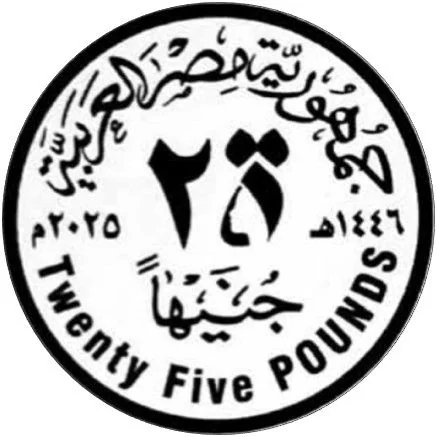
Denomination & Dates
Inscription:
جمهورية مصر العربيه
١٤٤٦ هـ ٢٠٢٥ م
٢٥
جنيهاً
Twenty Five POUNDS
١٤٤٦ هـ ٢٠٢٥ م
٢٥
جنيهاً
Twenty Five POUNDS
Translation:
Arab Republic of Egypt
1446 H 2025 AD
25
POUNDS
1446 H 2025 AD
25
POUNDS
Script: Arabic (naskh)
Language: Arabic
Reverse
Description:
Woman beside a sphinx.
Inscription:
اليوبيل الفضى
م٢۰۰۰ ٢٠٢٥م
المجلس القومى للمرأة
م٢۰۰۰ ٢٠٢٥م
المجلس القومى للمرأة
Translation:
Silver Jubilee
2000 - 2025 AD
National Council for Women
2000 - 2025 AD
National Council for Women
Script: Arabic
Language: Arabic
Designer: Norhan Yehia
Edge
Mints
| Name | Mark |
|---|---|
| Egyptian Mint Authority | — |
Mintings
| Year | Mint Mark | Mintage | Quality | Collection |
|---|---|---|---|---|
| 2025 | — | 2,200 |
Historical background
As of 2025, Egypt's currency situation remains defined by a managed float and persistent pressures, representing a cautious stabilization following years of volatility. The Egyptian pound (EGP) has maintained a relatively stable but weakened official exchange rate against the US dollar, hovering around a new plateau following a series of significant devaluations in 2022 and 2024. This stability is largely underpinned by a landmark $35 billion Ras El-Hekma investment deal with the UAE and a bolstered $8 billion agreement with the International Monetary Fund (IMF), which together provided a critical influx of hard currency, eased the severe foreign exchange shortage, and restored some investor confidence.
However, this stability is fragile and comes at a high economic cost. Inflation, though decelerating from its peak near 40% in 2023, remains stubbornly high in double digits, eroding purchasing power and keeping pressure on the currency's real value. The Central Bank of Egypt (CBE) maintains high interest rates to combat inflation and support the pound, but this simultaneously constrains business growth and increases the government's debt servicing burden. Furthermore, while the parallel market premium has narrowed significantly, a gap with the official rate persists, indicating lingering market skepticism and residual demand for dollars that the formal banking system cannot fully satisfy.
Looking forward, the key challenge for Egyptian authorities in 2025 is transitioning from crisis management to sustainable reform. The success of the currency regime hinges on executing agreed-upon structural reforms, including further state asset sales, reducing the footprint of military-owned enterprises, and fostering a genuinely flexible exchange rate to attract long-term foreign direct investment beyond one-off deals. The government's ability to build foreign reserves through exports and tourism, rather than emergency financing, will be the ultimate test of whether the pound's current stability can evolve into lasting strength.
However, this stability is fragile and comes at a high economic cost. Inflation, though decelerating from its peak near 40% in 2023, remains stubbornly high in double digits, eroding purchasing power and keeping pressure on the currency's real value. The Central Bank of Egypt (CBE) maintains high interest rates to combat inflation and support the pound, but this simultaneously constrains business growth and increases the government's debt servicing burden. Furthermore, while the parallel market premium has narrowed significantly, a gap with the official rate persists, indicating lingering market skepticism and residual demand for dollars that the formal banking system cannot fully satisfy.
Looking forward, the key challenge for Egyptian authorities in 2025 is transitioning from crisis management to sustainable reform. The success of the currency regime hinges on executing agreed-upon structural reforms, including further state asset sales, reducing the footprint of military-owned enterprises, and fostering a genuinely flexible exchange rate to attract long-term foreign direct investment beyond one-off deals. The government's ability to build foreign reserves through exports and tourism, rather than emergency financing, will be the ultimate test of whether the pound's current stability can evolve into lasting strength.



✨ Legendary