

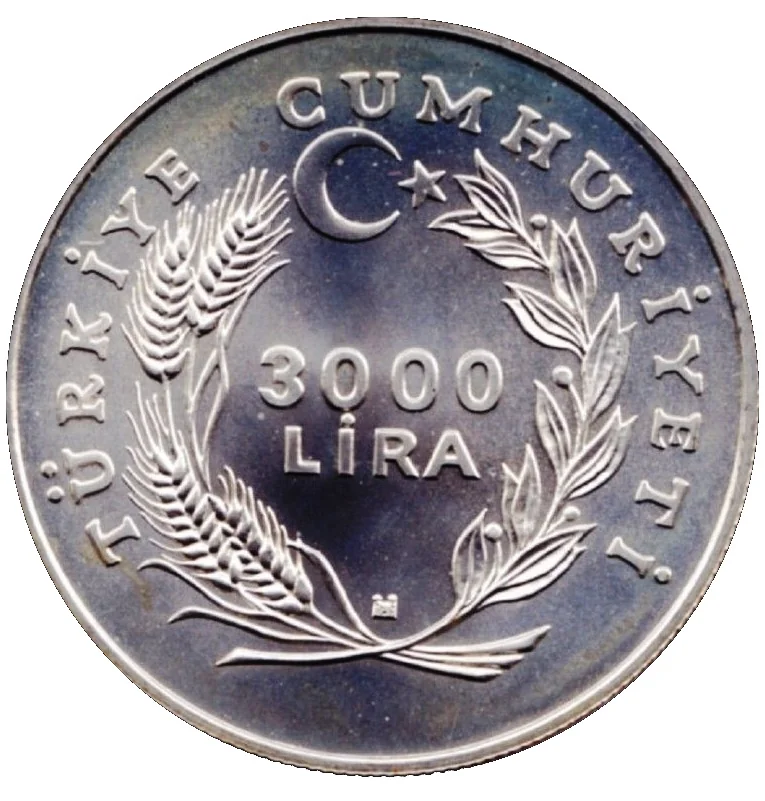
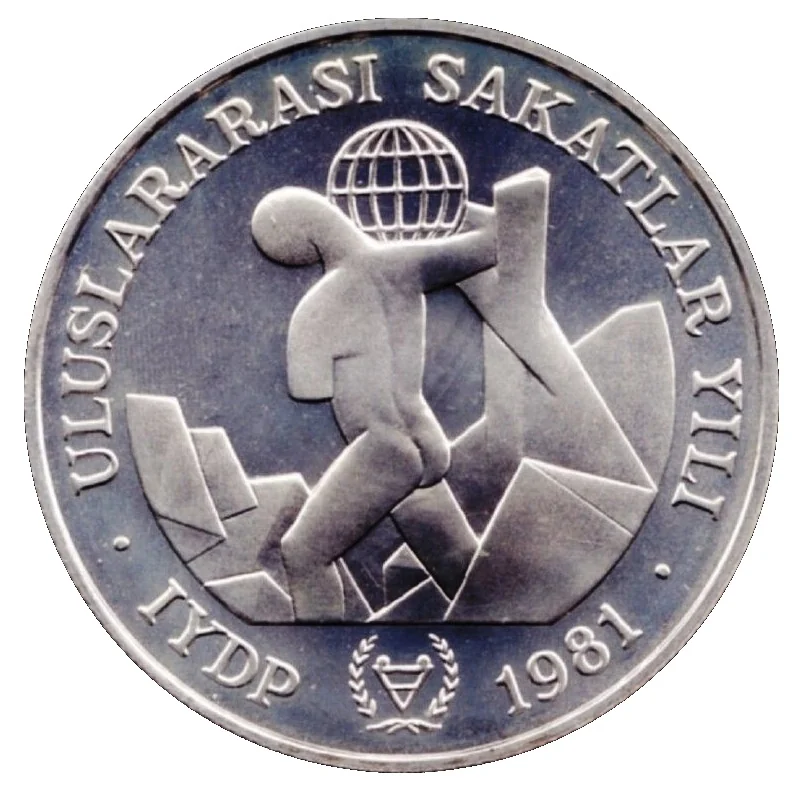
3000 Lira – Turkey
Non-circulating coins
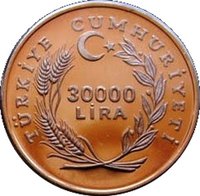
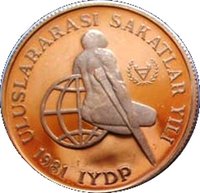
Commemoration: International Year of Disabled Persons
Turkey
Context
Material
References
KM: #Click to copy to clipboard948
Numista: #46383
Value
Exchange value: 3000 TRL
Bullion value: $75.99
Inflation-adjusted value: 2515864404.48 TRL
Obverse
Edge
Reeded
Mintings
| Year | Mint Mark | Mintage | Quality | Collection |
|---|---|---|---|---|
| 1981 | — | 295 | Proof | |
| 1981 | — | 73 |
Historical background
In 1981, Turkey's currency situation was characterized by severe instability and the lingering effects of a profound economic crisis. The Turkish lira was in a state of rapid depreciation, burdened by chronic high inflation that had soared into triple digits in the late 1970s. This period followed the 1979 "January 24 Decisions," a stabilization program implemented under Prime Minister Süleyman Demirel and his deputy Turgut Özal, which aimed to transition Turkey from a heavily protected, import-substitution industrialization model to an export-oriented, market-driven economy. A key feature of this program was a significant devaluation of the lira to boost competitiveness.
The immediate currency environment in 1981 was one of managed adjustment under the military government that took power in September 1980. The authorities maintained a tight grip on the exchange rate as part of a broader austerity package agreed with the International Monetary Fund (IMF). While the strict controls temporarily slowed the lira's freefall, the fundamental pressures of inflation—exceeding 100% annually—meant the currency was steadily losing value both domestically and internationally. The government pursued a policy of frequent, smaller devaluations (a "crawling peg") rather than a single large shock, attempting to align the official rate more closely with economic realities without triggering further social unrest.
This period set the stage for a deeper transformation. The policies enacted in the early 1980s, continuing under Prime Minister Turgut Özal after the 1983 elections, fundamentally restructured the Turkish economy. The focus on export promotion, liberalization of foreign trade, and encouragement of foreign investment began a long-term shift. However, in 1981, the currency situation remained precarious, representing a painful transitional phase where the old economic model's failures were being addressed through harsh stabilization, with the promise of recovery and growth still on the horizon.
The immediate currency environment in 1981 was one of managed adjustment under the military government that took power in September 1980. The authorities maintained a tight grip on the exchange rate as part of a broader austerity package agreed with the International Monetary Fund (IMF). While the strict controls temporarily slowed the lira's freefall, the fundamental pressures of inflation—exceeding 100% annually—meant the currency was steadily losing value both domestically and internationally. The government pursued a policy of frequent, smaller devaluations (a "crawling peg") rather than a single large shock, attempting to align the official rate more closely with economic realities without triggering further social unrest.
This period set the stage for a deeper transformation. The policies enacted in the early 1980s, continuing under Prime Minister Turgut Özal after the 1983 elections, fundamentally restructured the Turkish economy. The focus on export promotion, liberalization of foreign trade, and encouragement of foreign investment began a long-term shift. However, in 1981, the currency situation remained precarious, representing a painful transitional phase where the old economic model's failures were being addressed through harsh stabilization, with the promise of recovery and growth still on the horizon.
💎 Extremely Rare