


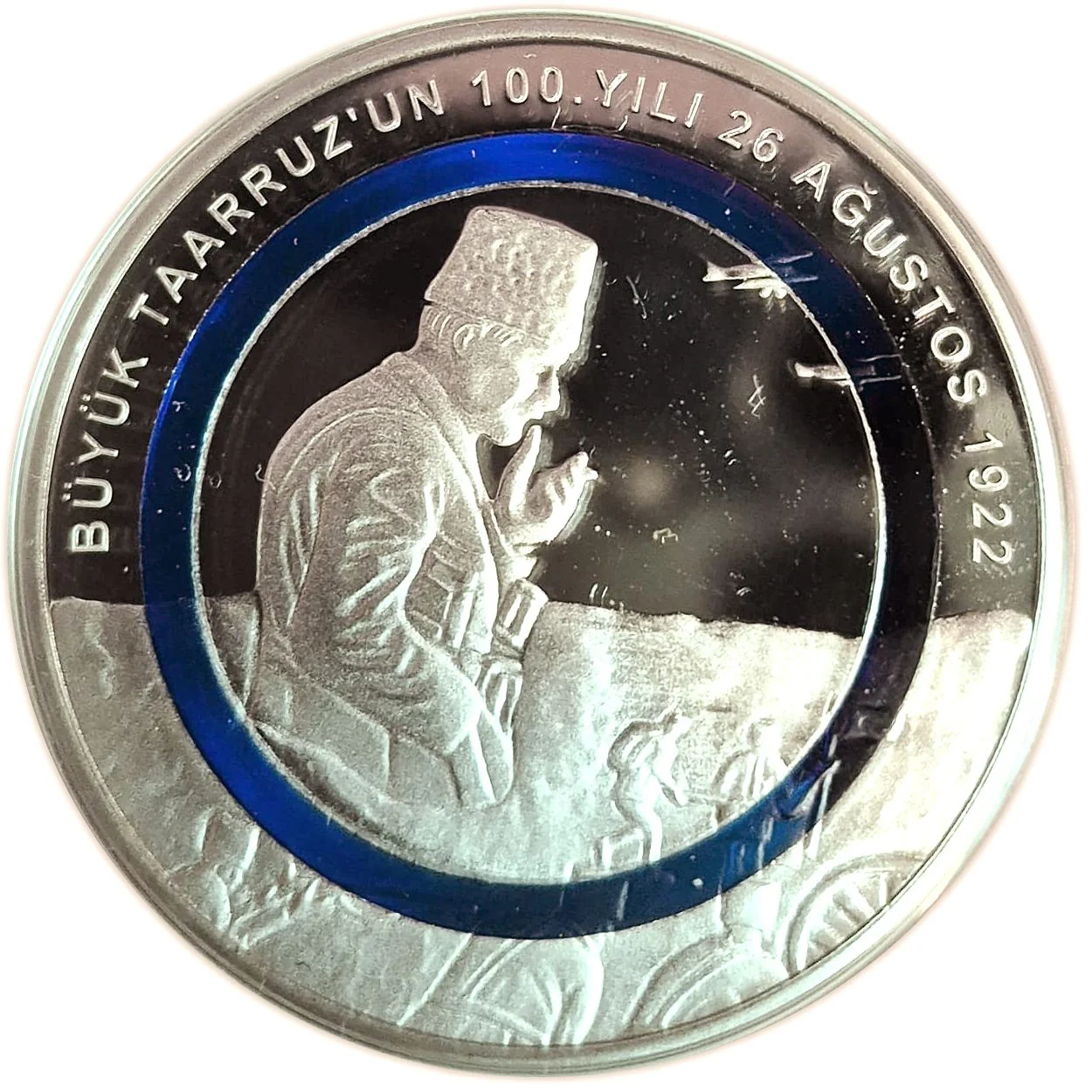
10 lira (Great Offensive) – Turkey
Add to wishlist
Non-circulating coins
Commemoration: Centenary of the Great Offensive
Turkey
Context
Year: 2022
Issuer: Turkey
Issuing organization: Devlet Darphanesi, Istanbul
Period:
(since 1923)
Currency:
(since 2005)
Total mintage: 6,000
Material

References
Numista: #463823
Value
Exchange value: 10 TRY
Inflation-adjusted value: 46.02 TRY
Obverse
Description:
Centenary of the Great Offensive logo with Atatürk's silhouette.
Inscription:
TÜRKİYE CUMHURİYETİ REPUBLIC OF TÜRKİYE
1☪0
BÜYÜK TAARRUZ'UN YÜZÜNCÜ YILI
10 Türk Lirası 2022
1☪0
BÜYÜK TAARRUZ'UN YÜZÜNCÜ YILI
10 Türk Lirası 2022
Translation:
REPUBLIC OF TÜRKİYE
1☪0
THE ONE HUNDREDTH YEAR OF THE GREAT OFFENSIVE
10 Turkish Liras 2022
1☪0
THE ONE HUNDREDTH YEAR OF THE GREAT OFFENSIVE
10 Turkish Liras 2022
Script: Latin
Reverse
Edge
Plain
Categories
| History> War |
| Object> Firearms |
| Person> Military leader |
| Person> Politician |
| Transportation> Aircraft |
Mints
| Name | Mark |
|---|---|
| Turkish State Mint | — |
Mintings
| Year | Mint Mark | Mintage | Quality | Collection |
|---|---|---|---|---|
| 2022 | — | 6,000 | Proof |
Historical background
Turkey's currency crisis in 2022 was the culmination of a long-standing economic vulnerability, dramatically accelerated by an unorthodox monetary policy. For years, the economy relied on cheap foreign capital, leading to high external debt and chronic current account deficits. The situation was severely exacerbated by President Recep Tayyip Erdoğan's steadfast belief in the unconventional theory that high interest rates cause inflation, rather than curb it. Despite soaring inflation, he pressured the central bank to repeatedly cut its policy rate throughout 2021 and into 2022, triggering a loss of investor confidence and a flight from the Turkish lira.
The consequences were severe and directly impacted the population. The lira lost over 40% of its value against the U.S. dollar in 2022 alone, following a 44% loss in 2021. This collapse fueled an inflationary spiral, with official consumer price inflation peaking at over 85% in October, though independent estimates suggested even higher figures. The soaring costs of imported energy and goods eroded household savings and purchasing power, pushing many into poverty and triggering widespread social discontent.
In response, the government deployed a heavily state-managed "liraization" strategy to stabilize the currency, involving costly market interventions and a scheme protecting certain lira deposits from forex losses. While these measures provided temporary relief for the lira later in the year, they placed enormous strain on central bank reserves and created contingent liabilities for the treasury. The overall policy framework prioritized currency stability and credit growth over disinflation, leaving Turkey with a deeply imbalanced economy characterized by depleted buffers, entrenched inflation, and a heavily managed financial system as it entered 2023.
The consequences were severe and directly impacted the population. The lira lost over 40% of its value against the U.S. dollar in 2022 alone, following a 44% loss in 2021. This collapse fueled an inflationary spiral, with official consumer price inflation peaking at over 85% in October, though independent estimates suggested even higher figures. The soaring costs of imported energy and goods eroded household savings and purchasing power, pushing many into poverty and triggering widespread social discontent.
In response, the government deployed a heavily state-managed "liraization" strategy to stabilize the currency, involving costly market interventions and a scheme protecting certain lira deposits from forex losses. While these measures provided temporary relief for the lira later in the year, they placed enormous strain on central bank reserves and created contingent liabilities for the treasury. The overall policy framework prioritized currency stability and credit growth over disinflation, leaving Turkey with a deeply imbalanced economy characterized by depleted buffers, entrenched inflation, and a heavily managed financial system as it entered 2023.



✨ Legendary