

100 euro – Slovakia
Add to wishlist
Non-circulating coins
Commemoration: Blue-dyeing
Slovakia
Context
Year: 2024
Issuer: Slovakia
Issuing organization: National Bank of Slovakia
Period:
(since 1993)
Currency:
(since 2009)
Total mintage: 5,600
Material
References
KM: #
Numista: #463801
Value
Exchange value: 100 EUR
Bullion value: $1303.49
Inflation-adjusted value: 105.95 EUR
Obverse
Description:
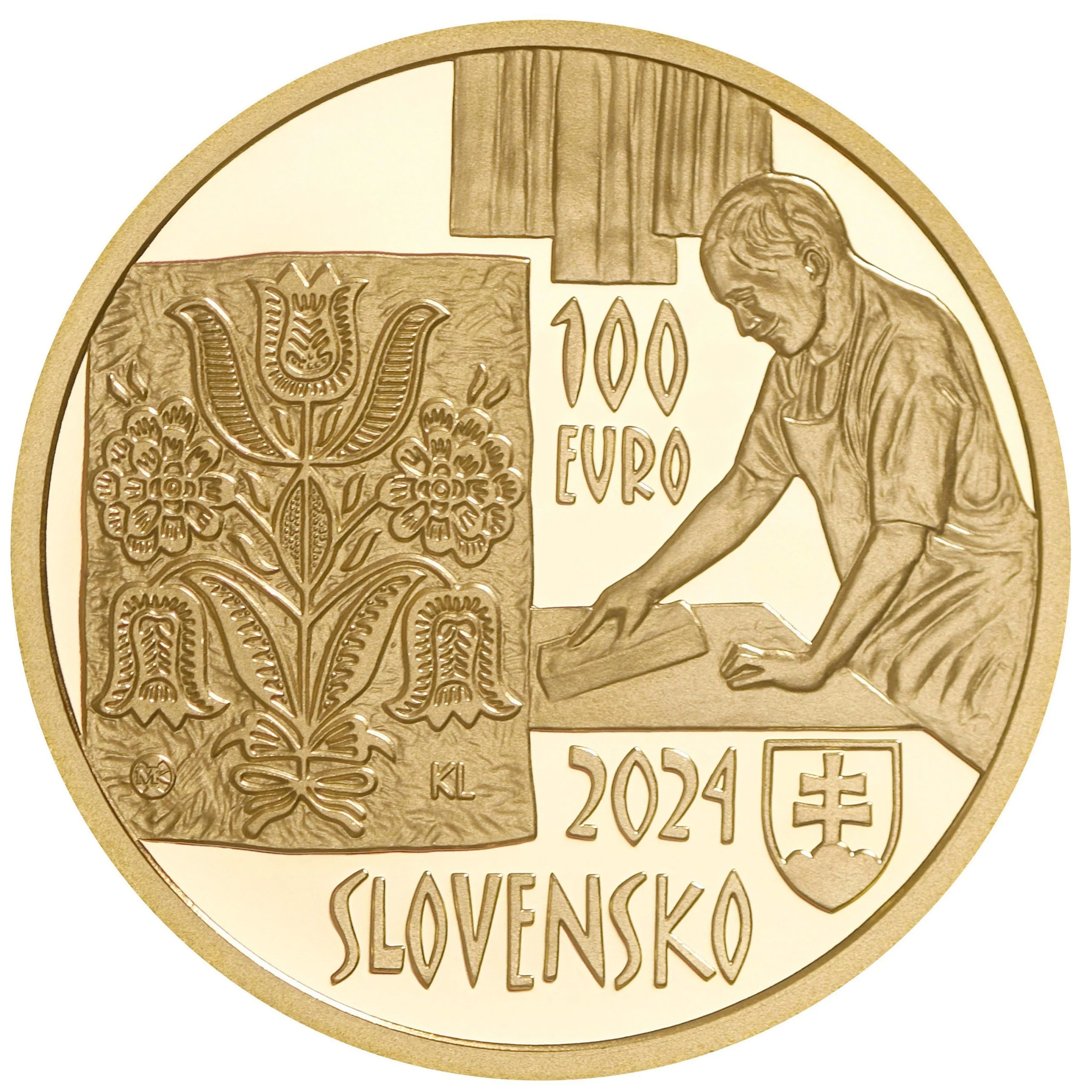
The obverse shows a craftsman using a wooden block to pattern fabric for blue-dyeing. To the left is a floral block pattern, and above, three fabrics hang to dry. Between these elements are the denomination '100 EURO'. Below are the year '2024' and the Slovak coat of arms, with 'SLOVENSKO' at the bottom. The mint mark 'MK' and designer's initials 'KL' appear in the lower corners.
Inscription:
100
EURO
MK KL
2024
SLOVENSKO
EURO
MK KL
2024
SLOVENSKO
Translation:
ONE HUNDRED EURO
MK KL
2024
SLOVAKIA
MK KL
2024
SLOVAKIA
Script: Latin
Engraver: Dalibor Schmidt
Designer: Karol Ličko
Reverse
Description:
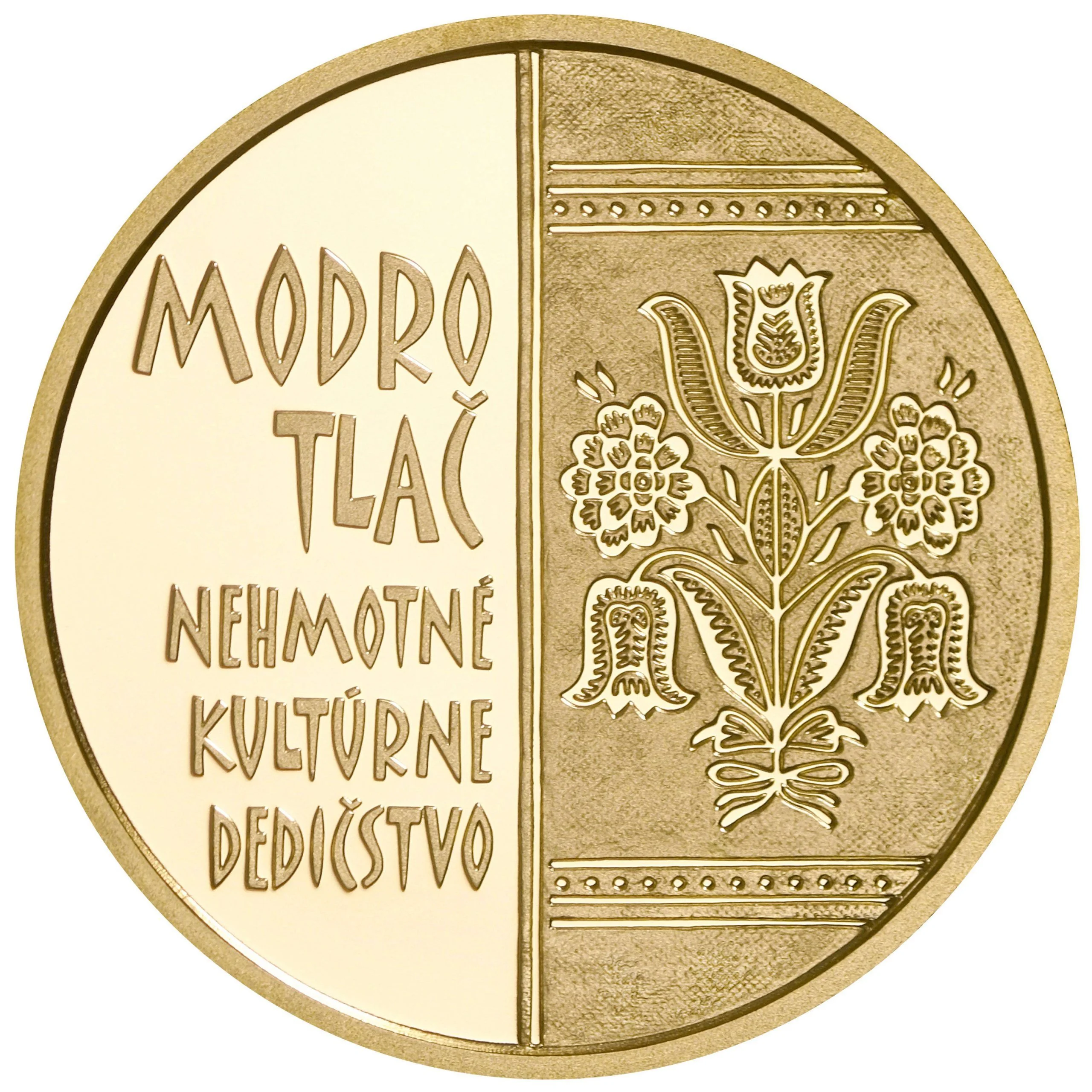
The reverse is split vertically. The left side features the Slovak word "MODROTLAČ" (blue-dying) at the top, with "NEHMOTNÉ KULTÚRNE DEDIČSTVO" (intangible cultural heritage) below. The right side shows a hanging blue-dyed fabric with the same floral pattern as the obverse, framed by additional horizontal decorations.
Inscription:
MODRO
TLAČ
NEHMOTNÉ
KULTÚRNE
DEDIČSTVO
TLAČ
NEHMOTNÉ
KULTÚRNE
DEDIČSTVO
Translation:
Mint
Intangible
Cultural
Heritage
Intangible
Cultural
Heritage
Script: Latin
Language: Slovak
Engraver: Dalibor Schmidt
Designer: Karol Ličko
Edge
Reeded
Mints
| Name | Mark |
|---|---|
| Kremnica | (MK) |
Mintings
| Year | Mint Mark | Mintage | Quality | Collection |
|---|---|---|---|---|
| 2024 | MK | 5,600 | Proof |
Historical background
In 2024, Slovakia's currency situation is defined by its nearly two-decade membership in the Eurozone, having adopted the euro in 2009. As a result, the country does not have an independent monetary policy; its interest rates and broader monetary conditions are set by the European Central Bank (ECB) to suit the needs of the entire euro area. This framework provides Slovakia with significant benefits, including eliminated exchange rate risk within the Eurozone, enhanced trade and investment stability, and a historically strong anchor against inflation. However, it also means the Slovak economy must adjust to ECB policies that may not always align perfectly with its specific cyclical needs, such as differing inflation or growth rates compared to the Eurozone core.
The primary domestic focus in 2024 is on managing inflation's aftermath and supporting economic growth. After the significant inflationary surge of 2022-2023, driven by energy prices and supply chain issues, inflation in Slovakia has been gradually decelerating in line with the Eurozone trend. The ECB's restrictive monetary policy, maintained for much of 2023, aimed to curb this inflation, but also contributed to tighter financial conditions and higher borrowing costs for Slovak businesses and households. The key question for 2024 is the timing and pace of ECB interest rate cuts, which Slovakia anticipates to ease economic pressures and stimulate investment.
Looking ahead, Slovakia's currency stability is intrinsically linked to the euro's performance and the ECB's policy trajectory. Domestically, the government's fiscal policy and its ability to implement reforms under the EU's Recovery and Resilience Facility are crucial for maintaining investor confidence and economic competitiveness. Challenges remain, including a need for deeper economic convergence with Western Eurozone members and managing public debt. Nevertheless, the euro provides a stable monetary foundation, allowing national efforts to focus on structural reforms, energy security, and enhancing productivity to ensure long-term prosperity within the single currency union.
The primary domestic focus in 2024 is on managing inflation's aftermath and supporting economic growth. After the significant inflationary surge of 2022-2023, driven by energy prices and supply chain issues, inflation in Slovakia has been gradually decelerating in line with the Eurozone trend. The ECB's restrictive monetary policy, maintained for much of 2023, aimed to curb this inflation, but also contributed to tighter financial conditions and higher borrowing costs for Slovak businesses and households. The key question for 2024 is the timing and pace of ECB interest rate cuts, which Slovakia anticipates to ease economic pressures and stimulate investment.
Looking ahead, Slovakia's currency stability is intrinsically linked to the euro's performance and the ECB's policy trajectory. Domestically, the government's fiscal policy and its ability to implement reforms under the EU's Recovery and Resilience Facility are crucial for maintaining investor confidence and economic competitiveness. Challenges remain, including a need for deeper economic convergence with Western Eurozone members and managing public debt. Nevertheless, the euro provides a stable monetary foundation, allowing national efforts to focus on structural reforms, energy security, and enhancing productivity to ensure long-term prosperity within the single currency union.
✨ Legendary