

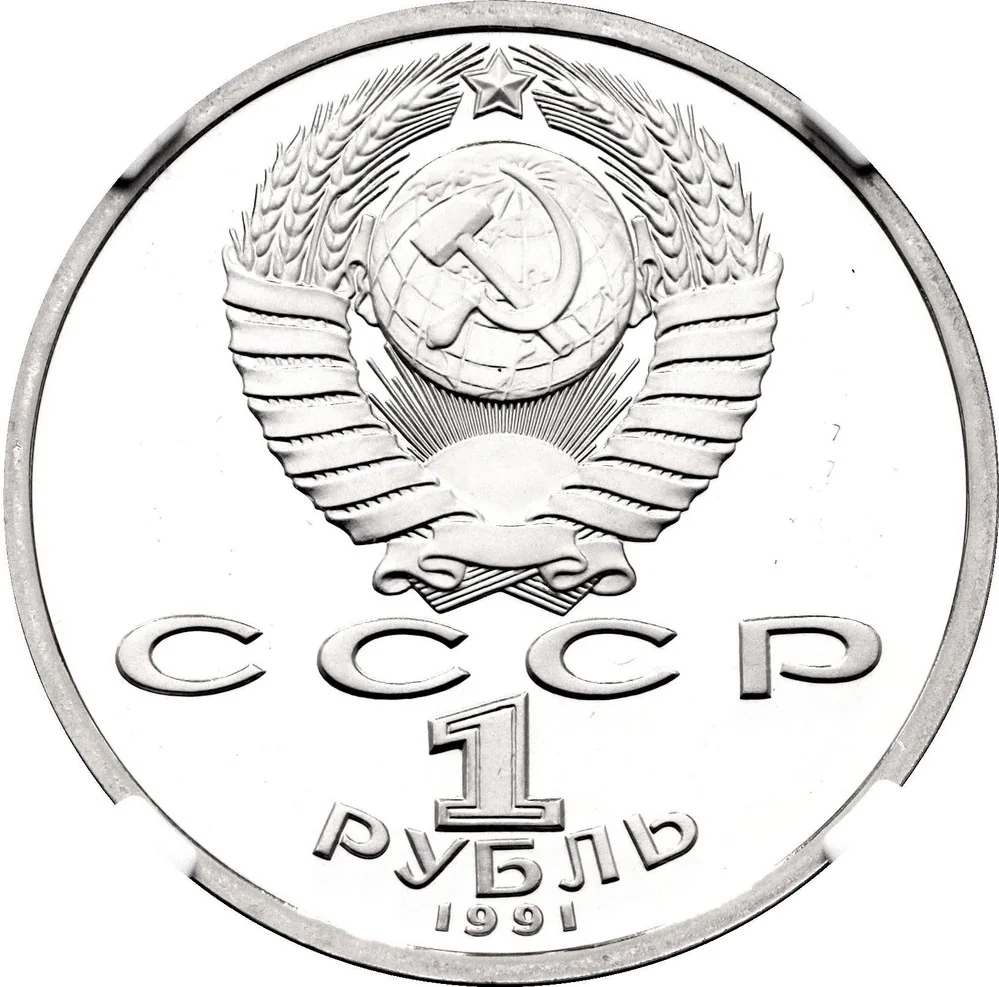
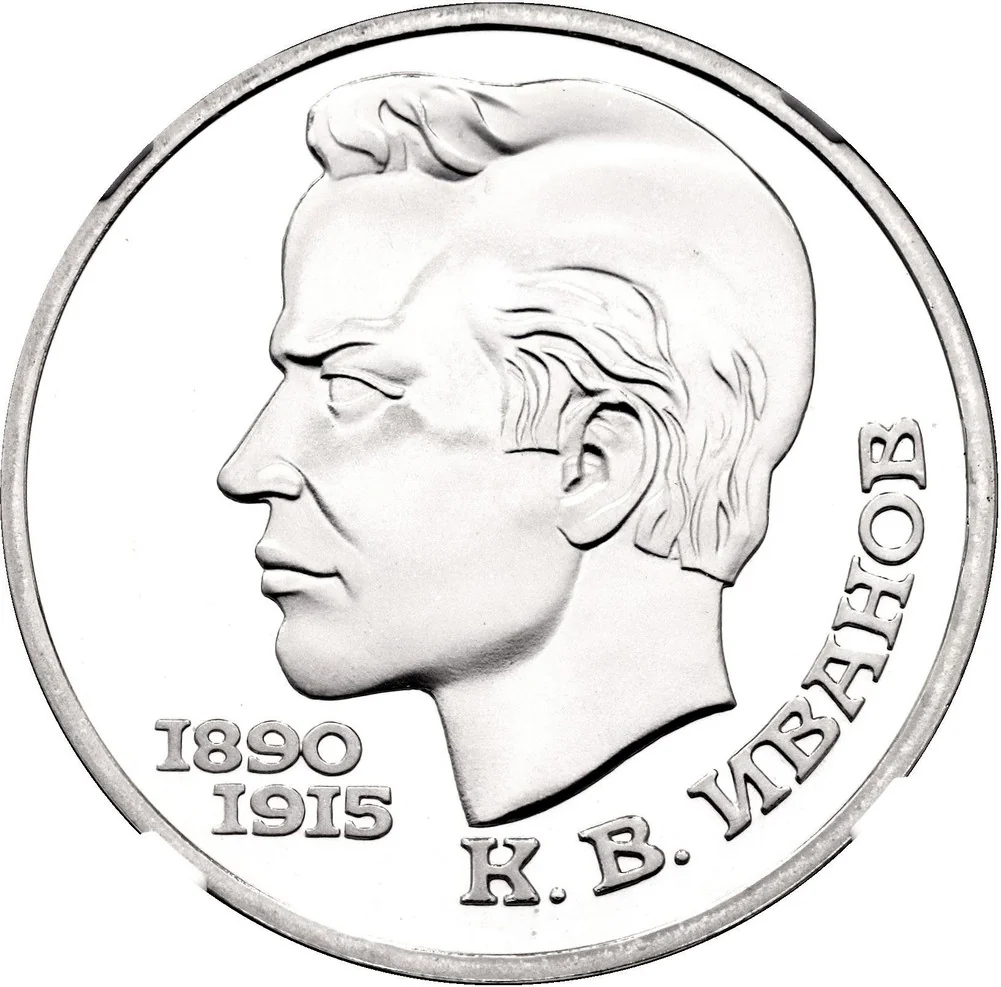
1 Ruble – Soviet Union
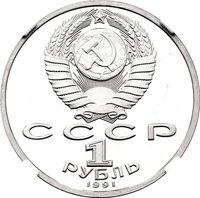
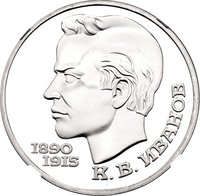
Circulating commemorative coins
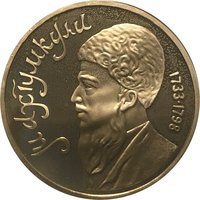
Commemoration: Konstantin Vasilyevich Ivanov
Russia
Context
Year: 1991
Country: Russia 
Issuer: Soviet Union 
Period:
(1922—1991)
Currency:
(1961—1991)
Demonetization: 1991
Total mintage: 3,500,000
Material
Diameter: 31 mm
Weight: 12.8 g
Thickness: 2.3 mm
Shape: Round
Composition: Copper-nickel
Technique: Milled
Alignment: Medal alignment
flip
References
Y: #Click to copy to clipboard282
Numista: #4622
Value
Exchange value: 1 SUR
Obverse
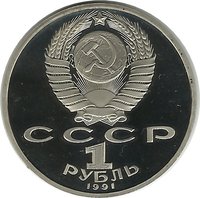
Reverse
Edge
Smooth with the inscription
Legend:
ОДИН РУБЛЬ • ОДИН РУБЛЬ •
Translation:
ONE RUBLE • ONE RUBLE •
Language: Russian
Categories
| Art> Literature |
| Event> Birth anniversary |
Mints
| Name | Mark |
|---|---|
| Saint Petersburg | — |
Mintings
| Year | Mint Mark | Mintage | Quality | Collection |
|---|---|---|---|---|
| 1991 | — | 3,150,000 | ||
| 1991 | — | — | BU | |
| 1991 | — | 350,000 | Proof |
Historical background
By 1991, the Soviet Union's currency system was in a state of advanced collapse, a direct reflection of the disintegration of the state itself. The root cause was the catastrophic failure of central economic planning, which had led to severe shortages of consumer goods. With vast amounts of rubles in circulation but little to purchase, "monetary overhang" created immense inflationary pressure. The authority of the USSR State Bank (Gosbank) was fatally undermined as individual Soviet republics, seeking sovereignty, began issuing their own credit and planning to introduce parallel currencies, further fragmenting the unified monetary space.
The situation culminated in the so-called "Pavlov Reform," named after Prime Minister Valentin Pavlov. In January 1991, in a desperate and poorly conceived attempt to mop up excess cash and crush the black market, the state abruptly withdrew 50 and 100 ruble notes from circulation, giving citizens only three days to exchange limited amounts. This move destroyed public trust in the ruble entirely, accelerating the flight from cash into hoarded goods or stable foreign currencies. For ordinary citizens, it was a definitive act of confiscation, eroding the last vestiges of the social contract and pushing the economy deeper into a barter system.
In the final months of 1991, the ruble ceased to function as a meaningful national currency. Hyperinflation took hold, wiping out savings as the newly independent Russian Federation, under acting Prime Minister Yegor Gaidar, embarked on radical "shock therapy" price liberalization in January 1992. The Soviet ruble's final demise was formalized in July 1993 when Russia conducted another confiscatory cash reform, replacing old Soviet-era rubles with new Russian ones. Thus, the monetary chaos of 1991 was both a symptom and a catalyst of the USSR's dissolution, marking a violent transition from a planned economy to a chaotic market reality.
The situation culminated in the so-called "Pavlov Reform," named after Prime Minister Valentin Pavlov. In January 1991, in a desperate and poorly conceived attempt to mop up excess cash and crush the black market, the state abruptly withdrew 50 and 100 ruble notes from circulation, giving citizens only three days to exchange limited amounts. This move destroyed public trust in the ruble entirely, accelerating the flight from cash into hoarded goods or stable foreign currencies. For ordinary citizens, it was a definitive act of confiscation, eroding the last vestiges of the social contract and pushing the economy deeper into a barter system.
In the final months of 1991, the ruble ceased to function as a meaningful national currency. Hyperinflation took hold, wiping out savings as the newly independent Russian Federation, under acting Prime Minister Yegor Gaidar, embarked on radical "shock therapy" price liberalization in January 1992. The Soviet ruble's final demise was formalized in July 1993 when Russia conducted another confiscatory cash reform, replacing old Soviet-era rubles with new Russian ones. Thus, the monetary chaos of 1991 was both a symptom and a catalyst of the USSR's dissolution, marking a violent transition from a planned economy to a chaotic market reality.
🌱 Common