

24 Skilling – Norway
Norway
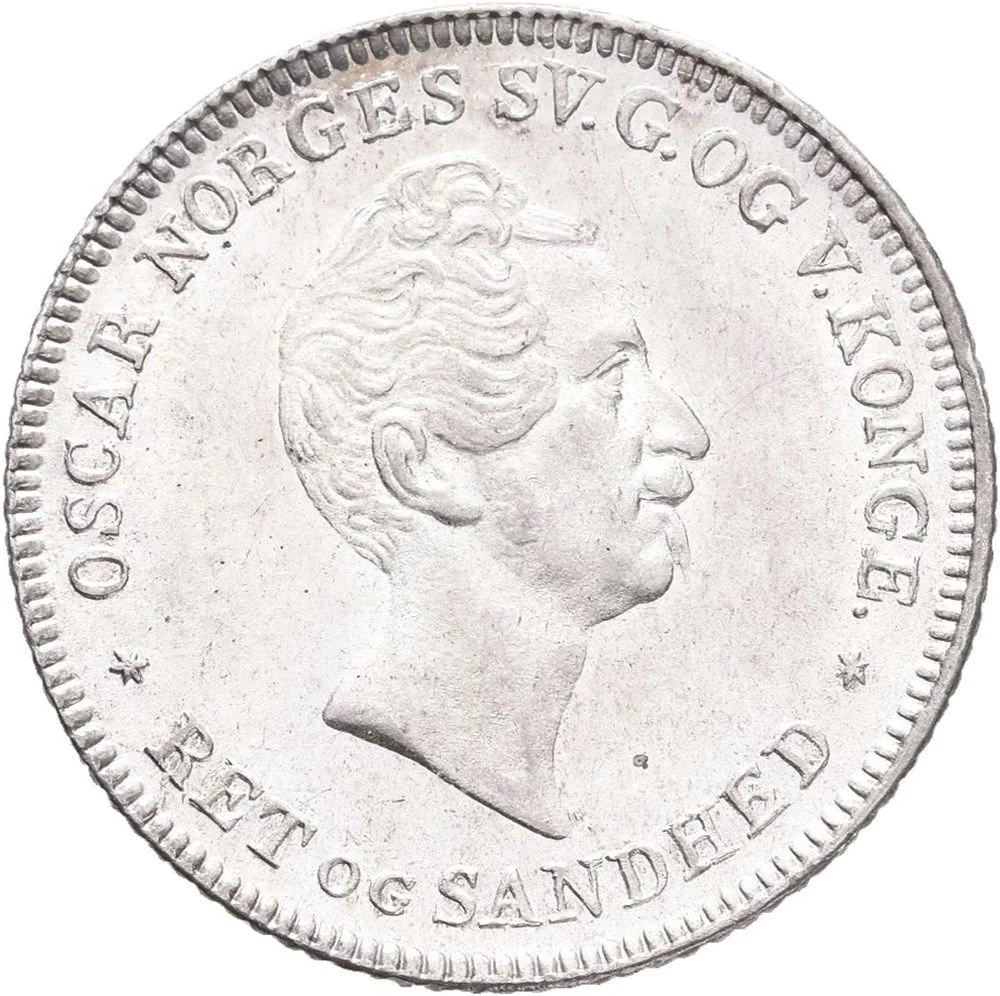
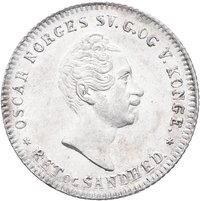
Obverse
Description:
Bust of King Oscar facing right within inscription. Beaded ring on rim.
Inscription:
OSCAR NORGES SV. G. OG V. KONGE.
✶ RET OG SANDHED ✶
✶ RET OG SANDHED ✶
Translation:
✶ JUSTICE AND TRUTH ✶ OSCAR NORWAY'S S.G. AND V. KING.
Script: Latin
Language: Norwegian
Engraver: Ludwig Persson Lundgren
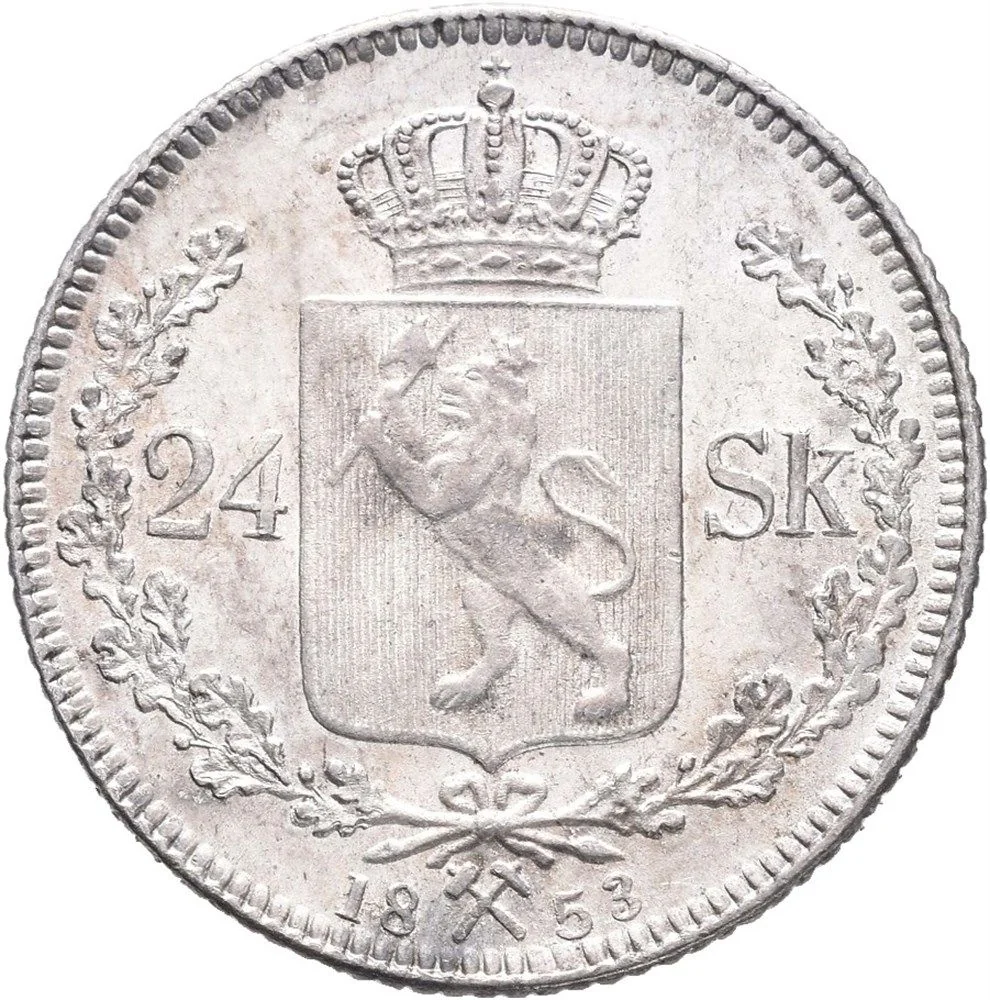
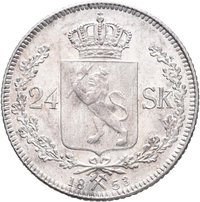
Reverse
Description:
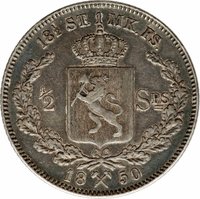
Crowned shield with Norwegian lion holding a halberd, on vertical lines. Value flanking shield, within wreath. Date below, split by mintmark. Beaded rim.
Inscription:
24 | SK
18 ⚒ 53
18 ⚒ 53
Script: Latin
Engraver: Ludwig Persson Lundgren
Edge
Reeded
Mints
| Name | Mark |
|---|---|
| Norwegian Mint | — |
Mintings
| Year | Mint Mark | Mintage | Quality | Collection |
|---|---|---|---|---|
| 1845 | — | 358,700 | ||
| 1846 | — | 382,600 | ||
| 1847 | — | 216,800 | ||
| 1848 | — | 150,300 | ||
| 1850 | — | 101,500 | ||
| 1852 | — | 253,600 | ||
| 1853 | — | 226,800 | ||
| 1854 | — | 212,200 | ||
| 1855 | — | 204,000 |
Historical background
In 1845, Norway found itself in a complex monetary situation, operating under a dual-currency system that was both cumbersome and a hindrance to trade. Officially, the country was on a silver standard, with the speciedaler as the primary unit. However, a parallel system of "bank money" existed, where the riksbankdaler, issued by Norges Bank (founded in 1816), circulated at a discounted rate against the silver coin. This created confusion, as prices and contracts often had to be specified in one currency or the other, with constant calculation of the fluctuating exchange rate between them.
This instability was rooted in the economic aftermath of the Napoleonic Wars. Norway's separation from Denmark in 1814 and its subsequent union with Sweden had left it with a depleted silver reserve and a heavy debt burden, forcing reliance on paper money. While the 1842 Monetary Act had aimed to stabilize the system by defining the speciedaler in silver and making banknotes redeemable, full convertibility was not yet a reality. The public's trust in paper money remained tentative, and the discount between metal and paper persisted, reflecting underlying concerns about the value of the currency.
Consequently, the period around 1845 was one of transition and debate. Mercantile and political forces were increasingly advocating for a simpler, more modern monetary system to facilitate commerce and integration into the growing international economy. The dual system was widely seen as an obstacle to progress. This pressure would culminate just a few years later in the significant monetary reform of 1848, which finally established a stable silver standard with a unified currency, laying the foundation for Norway's modern financial system.
This instability was rooted in the economic aftermath of the Napoleonic Wars. Norway's separation from Denmark in 1814 and its subsequent union with Sweden had left it with a depleted silver reserve and a heavy debt burden, forcing reliance on paper money. While the 1842 Monetary Act had aimed to stabilize the system by defining the speciedaler in silver and making banknotes redeemable, full convertibility was not yet a reality. The public's trust in paper money remained tentative, and the discount between metal and paper persisted, reflecting underlying concerns about the value of the currency.
Consequently, the period around 1845 was one of transition and debate. Mercantile and political forces were increasingly advocating for a simpler, more modern monetary system to facilitate commerce and integration into the growing international economy. The dual system was widely seen as an obstacle to progress. This pressure would culminate just a few years later in the significant monetary reform of 1848, which finally established a stable silver standard with a unified currency, laying the foundation for Norway's modern financial system.
⭐ Rare