

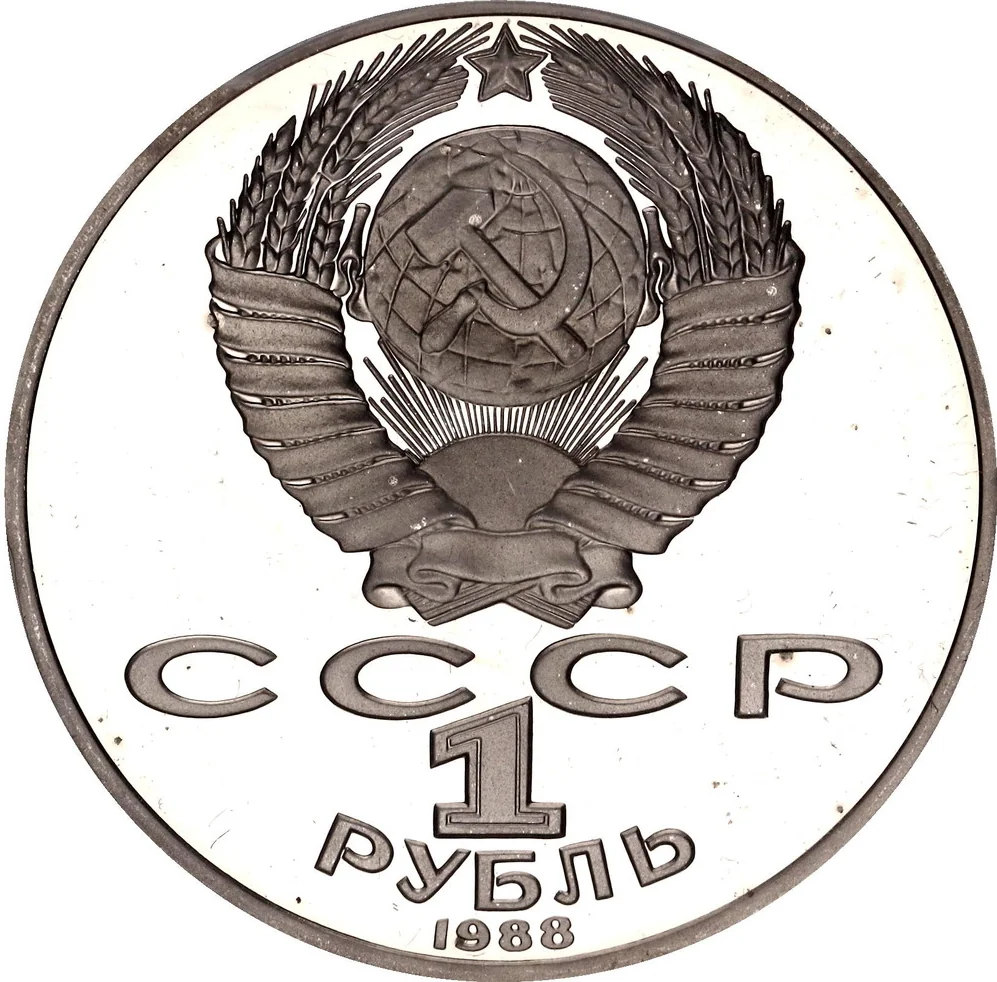
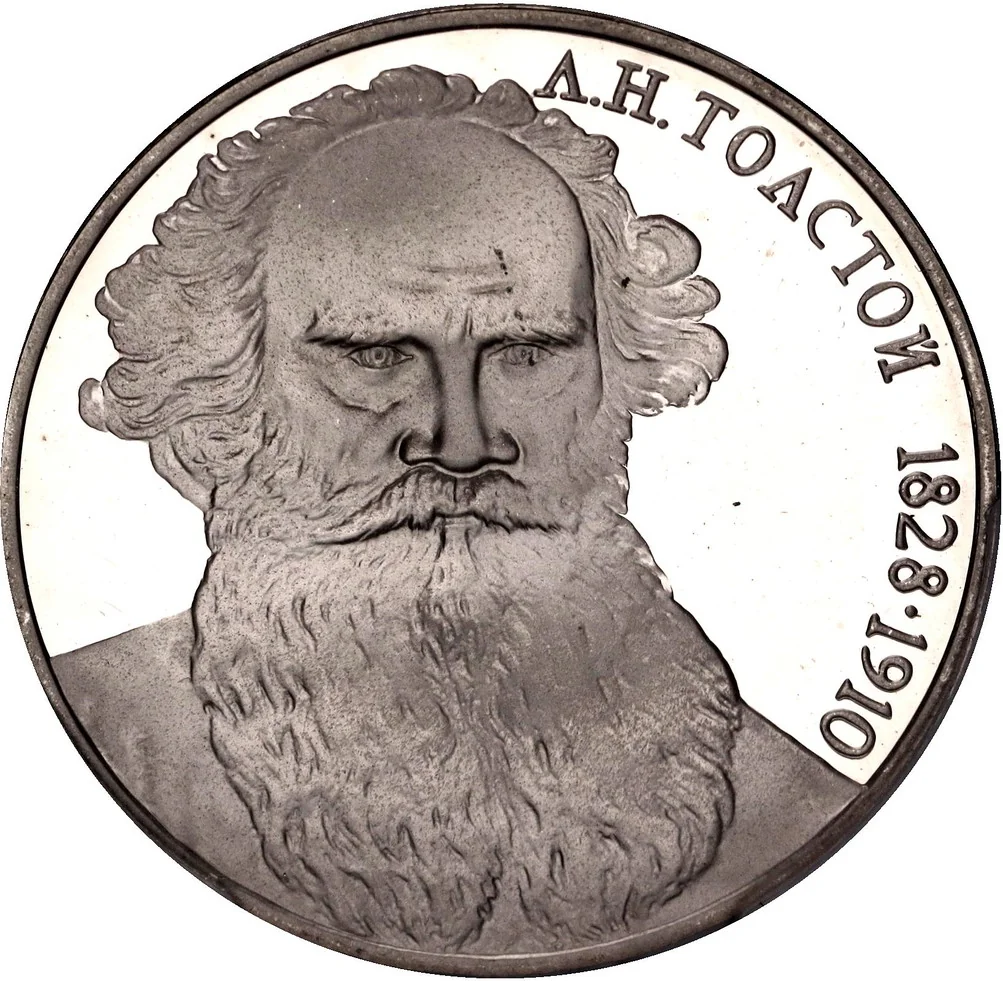
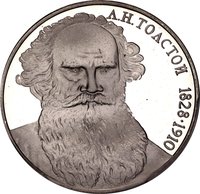
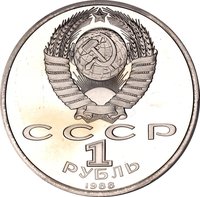
1 Ruble (Leo Tolstoy) – Soviet Union
Circulating commemorative coins
Commemoration: 160th Anniversary of the Birth of Leo Tolstoy
Russia
Context
Year: 1988
Country: Russia 
Issuer: Soviet Union 
Period:
(1922—1991)
Currency:
(1961—1991)
Demonetization: 1991
Total mintage: 4,000,000
Material
Diameter: 31 mm
Weight: 12.8 g
Thickness: 2.3 mm
Shape: Round
Composition: Copper-nickel
Technique: Milled
Alignment: Medal alignment
flip
References
Y: #Click to copy to clipboard216
Numista: #4616
Value
Exchange value: 1 SUR
Obverse
Reverse
Edge
Smooth with the inscription
Legend:
ОДИН РУБЛЬ • ОДИН РУБЛЬ •
Translation:
ONE RUBLE • ONE RUBLE •
Language: Russian
Categories
| Art> Literature |
| Event> Birth anniversary |
Mints
| Name | Mark |
|---|---|
| Saint Petersburg | — |
Mintings
| Year | Mint Mark | Mintage | Quality | Collection |
|---|---|---|---|---|
| 1988 | — | 3,775,000 | ||
| 1988 | — | 225,000 | Proof |
Historical background
By 1988, the Soviet Union's currency situation was characterized by a profound and worsening contradiction between an overabundance of rubles in circulation and a severe shortage of goods to purchase with them. This "monetary overhang" was the direct result of decades of central planning, which set prices administratively with little relation to supply or demand. While the state kept prices for basic necessities artificially low, it simultaneously paid wages to a largely unproductive workforce and ran massive budget deficits, primarily financed by printing money. The result was that citizens accumulated rubles they could not spend, as shelves emptied of desirable goods, forcing savings into unproductive channels or the black market.
The economic reforms of Perestroika, initiated by Mikhail Gorbachev, inadvertently exacerbated these monetary pressures. Policies like the 1987 Law on State Enterprise, which gave factories more autonomy but without introducing market mechanisms, led managers to raise wages without corresponding increases in output. The anti-alcohol campaign also severely slashed a key source of state revenue. Meanwhile, the legalization of small private cooperatives in 1988 began to introduce goods at market prices, but this only highlighted the absurdity of the official price system and further drained rubles from the population, deepening the imbalance.
Consequently, the ruble was becoming increasingly meaningless as a unit of value. Confidence in the currency collapsed, as citizens preferred to hold hard currency or tangible assets. A thriving black market, where the ruble traded at a fraction of its official exchange rate, became a more accurate gauge of its worth. This monetary crisis was a critical symptom of the broader systemic failure of the command economy. By 1988, the growing overhang created a ticking time bomb, setting the stage for the desperate and poorly planned price reforms of the early 1990s that would culminate in hyperinflation and the ruble's effective demise.
The economic reforms of Perestroika, initiated by Mikhail Gorbachev, inadvertently exacerbated these monetary pressures. Policies like the 1987 Law on State Enterprise, which gave factories more autonomy but without introducing market mechanisms, led managers to raise wages without corresponding increases in output. The anti-alcohol campaign also severely slashed a key source of state revenue. Meanwhile, the legalization of small private cooperatives in 1988 began to introduce goods at market prices, but this only highlighted the absurdity of the official price system and further drained rubles from the population, deepening the imbalance.
Consequently, the ruble was becoming increasingly meaningless as a unit of value. Confidence in the currency collapsed, as citizens preferred to hold hard currency or tangible assets. A thriving black market, where the ruble traded at a fraction of its official exchange rate, became a more accurate gauge of its worth. This monetary crisis was a critical symptom of the broader systemic failure of the command economy. By 1988, the growing overhang created a ticking time bomb, setting the stage for the desperate and poorly planned price reforms of the early 1990s that would culminate in hyperinflation and the ruble's effective demise.
🌱 Very Common