

¼ dollar – United States
Add to wishlist
Non-circulating coins
Commemoration: United States Mint's 50 State Quarters® Program
United States
Context
Year: 2004
Issuer: United States
Period:
(since 1776)
Currency:
(since 1785)
Subdivision: ¼ dollar = 25 Cents
Total mintage: 1,781,810
Material
References
KM: #
Numista: #14810
Value
Exchange value: ¼ USD = $0.25
Bullion value: $14.12
Inflation-adjusted value: 0.44 USD
Obverse
Description:
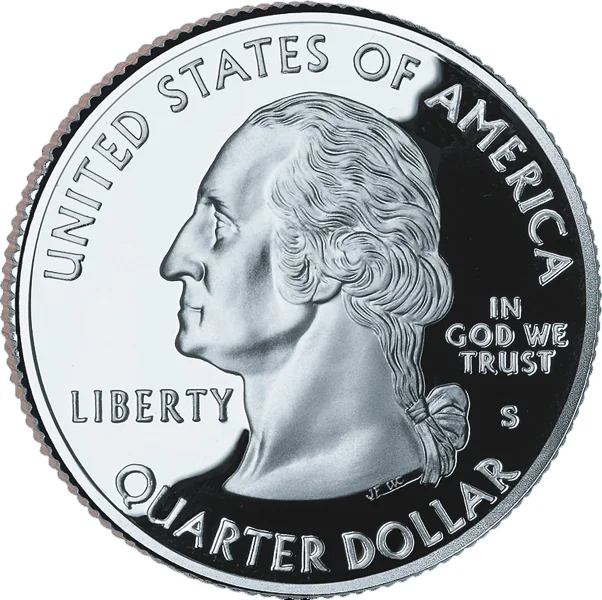
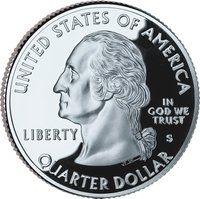
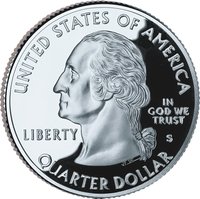
Left-profile portrait of George Washington with "IN GOD WE TRUST" and "LIBERTY," surrounded by the face value and "UNITED STATES OF AMERICA."
Inscription:
UNITED STATES OF AMERICA
IN
GOD WE
TRUST
LIBERTY
S
QUARTER DOLLAR
IN
GOD WE
TRUST
LIBERTY
S
QUARTER DOLLAR
Script: Latin
Engraver: John Flanagan
Reverse
Description:
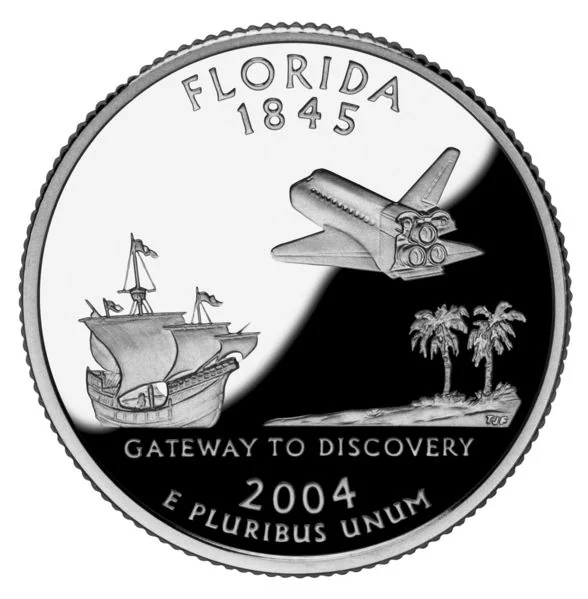
A 16th-century Spanish galleon, a space shuttle, and Sabal palms on a strip of land, with the inscription "Gateway to Discovery."
Inscription:
FLORIDA
1845
TJF
GATEWAY TO DISCOVERY
2004
E PLURIBUS UNUM
1845
TJF
GATEWAY TO DISCOVERY
2004
E PLURIBUS UNUM
Translation:
FLORIDA
1845
TJF
GATEWAY TO DISCOVERY
2004
OUT OF MANY, ONE
1845
TJF
GATEWAY TO DISCOVERY
2004
OUT OF MANY, ONE
Script: Latin
Engraver: Thomas James Ferrell
Edge
Reeded
Categories
| Plant> Tree |
| Space |
| Transportation> Watercraft |
Mints
| Name | Mark |
|---|---|
| United States Mint of San Francisco | S |
Mintings
| Year | Mint Mark | Mintage | Quality | Collection |
|---|---|---|---|---|
| 2004 | S | 1,781,810 | Proof |
Historical background
In 2004, the United States dollar was in a period of significant depreciation, continuing a trend that had begun in 2002. The dollar's trade-weighted index fell approximately 9% against a basket of major currencies for the year, with particularly sharp declines against the euro, which reached new record highs. This weakness was driven by a confluence of factors, most notably the growing U.S. current account and budget deficits, which raised concerns among international investors about long-term economic imbalances. The Federal Reserve, under Chairman Alan Greenspan, maintained a historically low federal funds rate of 1% until mid-year, which, while supporting domestic recovery, also reduced the yield attractiveness of dollar-denominated assets.
The economic context was one of robust recovery from the 2001 recession, fueled by tax cuts, increased defense spending, and a booming housing market. However, this growth was accompanied by what then-Fed Chairman Greenspan termed a "conundrum" – long-term interest rates remained surprisingly low even as the Fed began a gradual tightening cycle, raising the federal funds rate to 1.25% in June and to 2.25% by year's end. This environment of easy credit and a cheap dollar helped boost exports but also sowed the seeds for future instability in the housing and financial sectors. Policymakers largely viewed the dollar's decline as an orderly and necessary adjustment to reduce the massive trade deficit.
Internationally, the dollar's status as the world's primary reserve currency was unchallenged, but its decline prompted diversification murmurs among some central banks, particularly in Asia. Major U.S. trading partners, especially Japan and China, engaged heavily in currency intervention, buying dollars to prevent their own currencies from appreciating too rapidly, which would hurt their export-driven economies. This massive accumulation of dollar reserves by Asian central banks helped finance the U.S. current account deficit and placed the global economy in a state of fragile interdependence, later described as "Bretton Woods II." Thus, 2004 was a year where the dollar's weakness highlighted underlying global imbalances, even as it supported a strong domestic recovery.
The economic context was one of robust recovery from the 2001 recession, fueled by tax cuts, increased defense spending, and a booming housing market. However, this growth was accompanied by what then-Fed Chairman Greenspan termed a "conundrum" – long-term interest rates remained surprisingly low even as the Fed began a gradual tightening cycle, raising the federal funds rate to 1.25% in June and to 2.25% by year's end. This environment of easy credit and a cheap dollar helped boost exports but also sowed the seeds for future instability in the housing and financial sectors. Policymakers largely viewed the dollar's decline as an orderly and necessary adjustment to reduce the massive trade deficit.
Internationally, the dollar's status as the world's primary reserve currency was unchallenged, but its decline prompted diversification murmurs among some central banks, particularly in Asia. Major U.S. trading partners, especially Japan and China, engaged heavily in currency intervention, buying dollars to prevent their own currencies from appreciating too rapidly, which would hurt their export-driven economies. This massive accumulation of dollar reserves by Asian central banks helped finance the U.S. current account deficit and placed the global economy in a state of fragile interdependence, later described as "Bretton Woods II." Thus, 2004 was a year where the dollar's weakness highlighted underlying global imbalances, even as it supported a strong domestic recovery.
🌱 Fairly Common