

250 rupiah (Independence) – Indonesia
Add to wishlist
Non-circulating coins
Commemoration: 25th Anniversary of Independence
Indonesia
Context
Material
References
KM: #
Numista: #45529
Value
Exchange value: 250 IDR
Bullion value: $24.91
Inflation-adjusted value: 42184.72 IDR
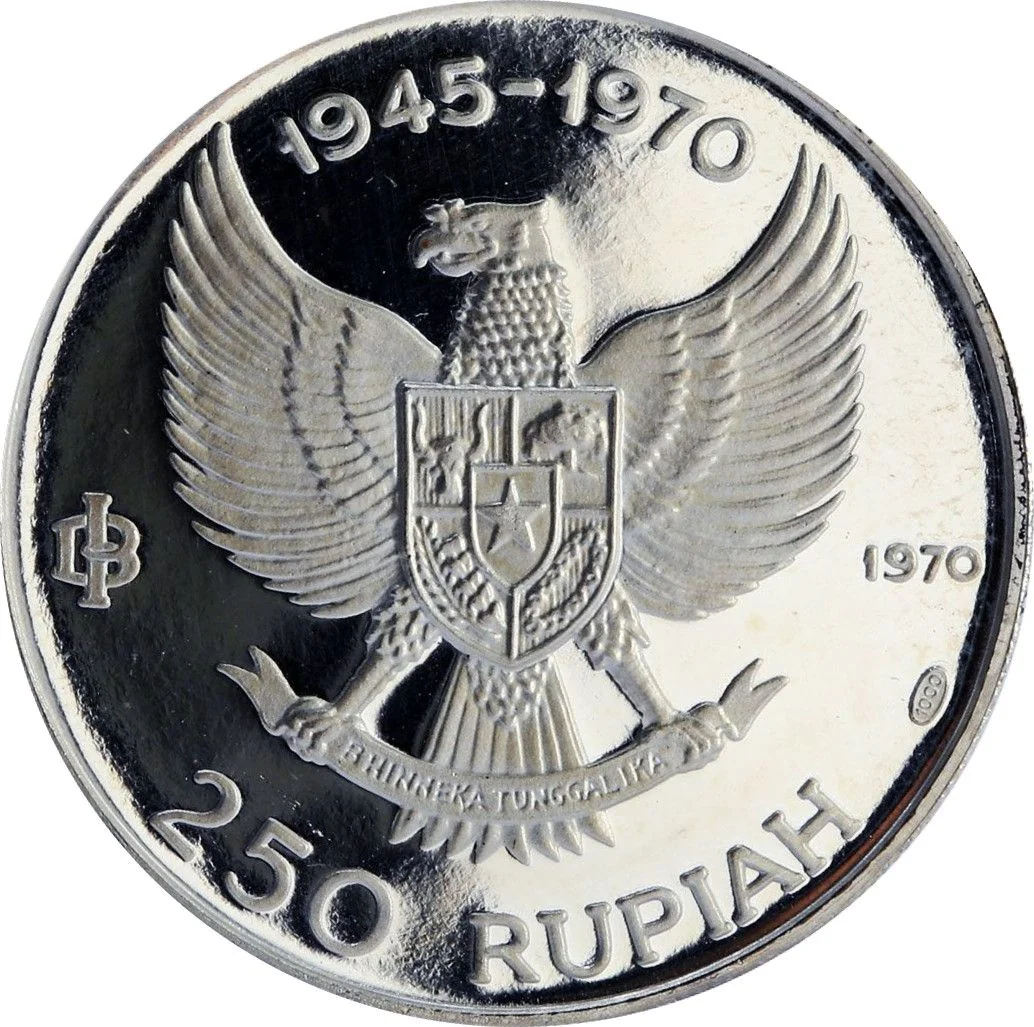
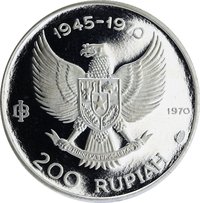
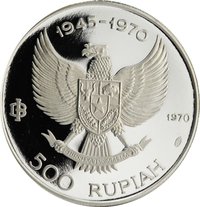
Obverse
Description:
National symbol
Inscription:
1945-1970
IB 1970
250 RUPIAH
IB 1970
250 RUPIAH
Translation:
1945-1970
IB 1970
250 RUPIAH
IB 1970
250 RUPIAH
Script: Latin
Languages: English, Indonesian
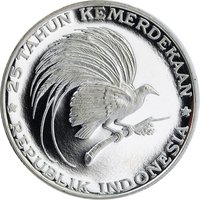
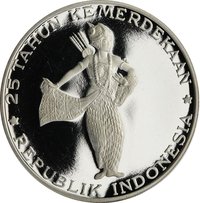
Reverse
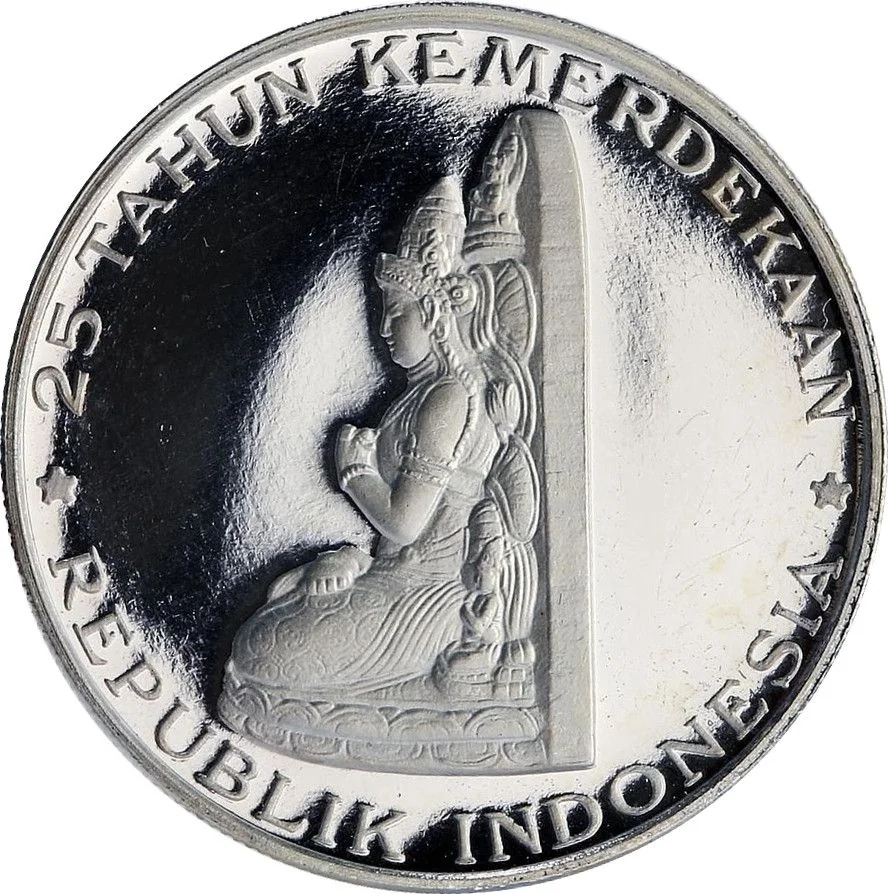
Description:
Manjusri statue, Tumpang Temple.
Inscription:
25 TAHUN KEMERDEKAAN
REPUBLIK INDONESIA
REPUBLIK INDONESIA
Translation:
25 Years of Independence
Republic of Indonesia
Republic of Indonesia
Script: Latin
Language: Indonesian
Edge
Reeded
Categories
| Event> Independence |
Mintings
| Year | Mint Mark | Mintage | Quality | Collection |
|---|---|---|---|---|
| 1970 | — | 5,000 | Proof |
Historical background
In 1970, Indonesia was in the early stages of a long and difficult economic recovery under President Suharto's New Order government. The preceding years had been marked by hyperinflation, which peaked at an staggering 635% in 1966, crippling the value of the Rupiah (IDR) and devastating public trust in the currency. A critical stabilization program, launched in 1966 with advice from Western economists, had begun to tame this inflation through severe fiscal austerity, balanced budgets, and the welcoming of foreign investment and aid. By 1970, these harsh measures were showing results, with inflation reduced to a single-digit rate, providing a fragile but essential foundation for monetary stability.
The currency regime itself was complex and tightly controlled. Indonesia operated a fixed but multiple exchange rate system, a legacy of the Sukarno era designed to manage foreign exchange for different types of transactions. There was an official rate for vital government imports and debt servicing, and a more depreciated "export bonus" rate for commodity exporters like oil and rubber to incentivize earnings. However, a thriving black market for foreign exchange persisted, reflecting a gap between government-set rates and market reality. The Rupiah's value was thus administratively determined rather than market-driven, with the government prioritizing control over currency flows to rebuild depleted foreign reserves.
Looking forward, 1970 represented a calm before a significant shift. The economic team, known as the "Berkeley Mafia," continued to consolidate the gains of stabilization. The situation would transform dramatically later in the decade following the 1973 oil crisis. The surge in oil prices, as Indonesia was a member of OPEC, flooded the country with petrodollars, strengthening the Rupiah and state revenues but also introducing new economic distortions. Therefore, the currency situation in 1970 was one of controlled, post-crisis stabilization, setting the stage for the oil-fueled growth and subsequent challenges of the 1970s.
The currency regime itself was complex and tightly controlled. Indonesia operated a fixed but multiple exchange rate system, a legacy of the Sukarno era designed to manage foreign exchange for different types of transactions. There was an official rate for vital government imports and debt servicing, and a more depreciated "export bonus" rate for commodity exporters like oil and rubber to incentivize earnings. However, a thriving black market for foreign exchange persisted, reflecting a gap between government-set rates and market reality. The Rupiah's value was thus administratively determined rather than market-driven, with the government prioritizing control over currency flows to rebuild depleted foreign reserves.
Looking forward, 1970 represented a calm before a significant shift. The economic team, known as the "Berkeley Mafia," continued to consolidate the gains of stabilization. The situation would transform dramatically later in the decade following the 1973 oil crisis. The surge in oil prices, as Indonesia was a member of OPEC, flooded the country with petrodollars, strengthening the Rupiah and state revenues but also introducing new economic distortions. Therefore, the currency situation in 1970 was one of controlled, post-crisis stabilization, setting the stage for the oil-fueled growth and subsequent challenges of the 1970s.
💎 Extremely Rare