

2 euro (Dominique-Vivant Denon) – France
Add to wishlist
Non-circulating coins
Commemoration: 200th Anniversary of Death of Dominique-Vivant Denon.
France
Context
Material
References
KM: #
Numista: #455096
Value
Exchange value: 2 EUR
Obverse
Description:
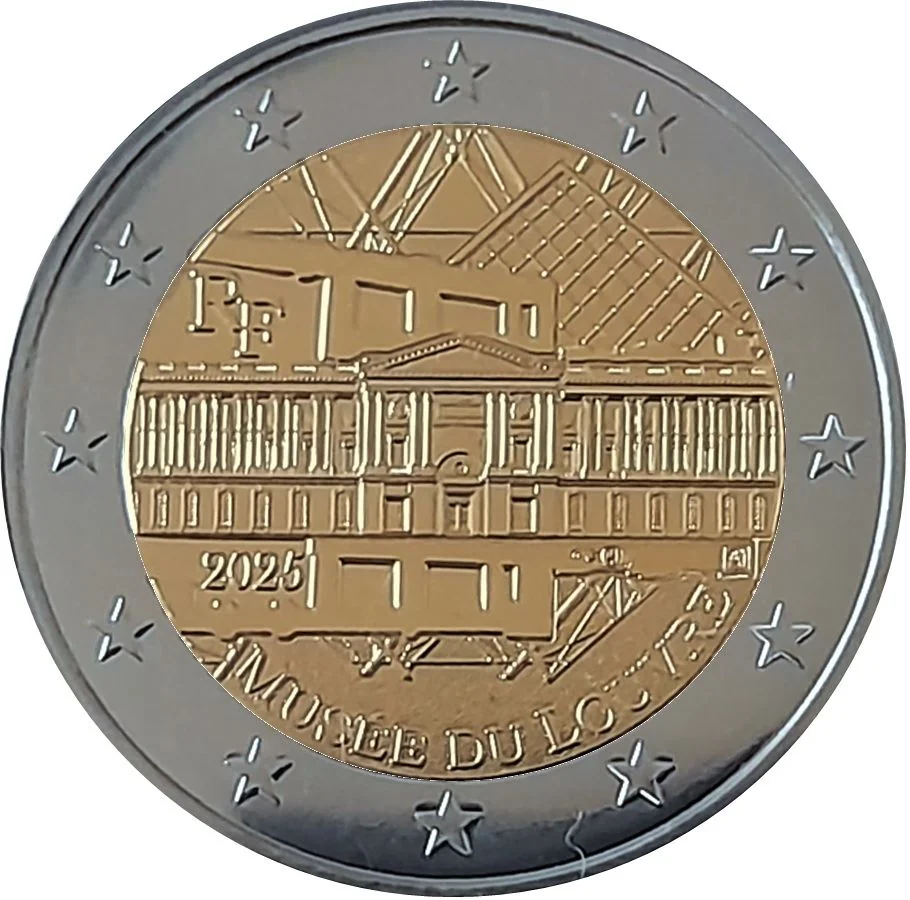
Perrault's Colonnade, the Louvre's eastern façade, frames the museum's "RF" insignia, year, and mint mark. The Louvre Pyramid is visible in the background, all within the ring of twelve European stars.
Inscription:
RF
2025
MUSÉE DU LOUVRE
2025
MUSÉE DU LOUVRE
Translation:
Museum of the Louvre
Script: Latin
Language: French
Reverse
Edge
Legend:
2 ★ ★2 ★ ★2 ★ ★2 ★ ★2 ★ ★2 ★ ★
Categories
| Building> Museum |
| Map |
| Event> Death anniversary |
Mints
| Name | Mark |
|---|---|
| Monnaie de Paris | — |
Mintings
| Year | Mint Mark | Mintage | Quality | Collection |
|---|---|---|---|---|
| 2025 | — | 300,000 | ||
| 2025 | — | 10,000 | Proof |
Historical background
In 2025, France finds itself navigating a complex and somewhat bifurcated currency landscape, firmly within the Eurozone but grappling with the persistent political and social debate over monetary sovereignty. The euro remains the sole legal tender, managed by the European Central Bank (ECB), with France advocating within the Governing Council for policies balancing inflation control with targeted support for green investments and economic stimulus. However, the digital euro project, in its advanced pilot stages, has become a focal point of both technical preparation and public discourse, raising questions about privacy, financial inclusion, and the role of traditional banks.
Domestically, the currency "situation" is less about a dual currency and more about the rise of alternative payment systems and the state's push for financial digitalization. The government continues to promote a France Numérique agenda, encouraging cashless transactions while also legislating to protect cash access as a public service. Parallel to this, a vibrant ecosystem of local complementary currencies (like the Eusko in the Basque Country or La Gonette in Lyon) persists, often tied to regional identity and sustainable development goals, though they operate at a marginal economic scale compared to the euro.
The underlying tension stems from broader European and geopolitical pressures. As the EU deepens Economic and Monetary Union, discussions on a potential "digital franc" as a sovereign complement have been quietly explored in policy circles, though officially secondary to the ECB-led digital euro. Furthermore, global currency volatility and the weaponization of financial systems have reinforced the French establishment's commitment to the euro as a pillar of strategic autonomy, even as fringe political movements on both the left and right continue to voice nostalgia for a return to the franc, framing it as a tool for regaining control over fiscal and social policy.
Domestically, the currency "situation" is less about a dual currency and more about the rise of alternative payment systems and the state's push for financial digitalization. The government continues to promote a France Numérique agenda, encouraging cashless transactions while also legislating to protect cash access as a public service. Parallel to this, a vibrant ecosystem of local complementary currencies (like the Eusko in the Basque Country or La Gonette in Lyon) persists, often tied to regional identity and sustainable development goals, though they operate at a marginal economic scale compared to the euro.
The underlying tension stems from broader European and geopolitical pressures. As the EU deepens Economic and Monetary Union, discussions on a potential "digital franc" as a sovereign complement have been quietly explored in policy circles, though officially secondary to the ECB-led digital euro. Furthermore, global currency volatility and the weaponization of financial systems have reinforced the French establishment's commitment to the euro as a pillar of strategic autonomy, even as fringe political movements on both the left and right continue to voice nostalgia for a return to the franc, framing it as a tool for regaining control over fiscal and social policy.


🌱 Common