

5 Euro (Italian Republic) – Italy
Non-circulating coins
Commemoration: 60th Anniversary of the birth of Italian Republic
Italy
Context
Material
References
KM: #Click to copy to clipboard281
Numista: #45322
Value
Exchange value: 5 EUR = $5.91
Bullion value: $48.38
Inflation-adjusted value: 7.13 EUR
Obverse
Description:
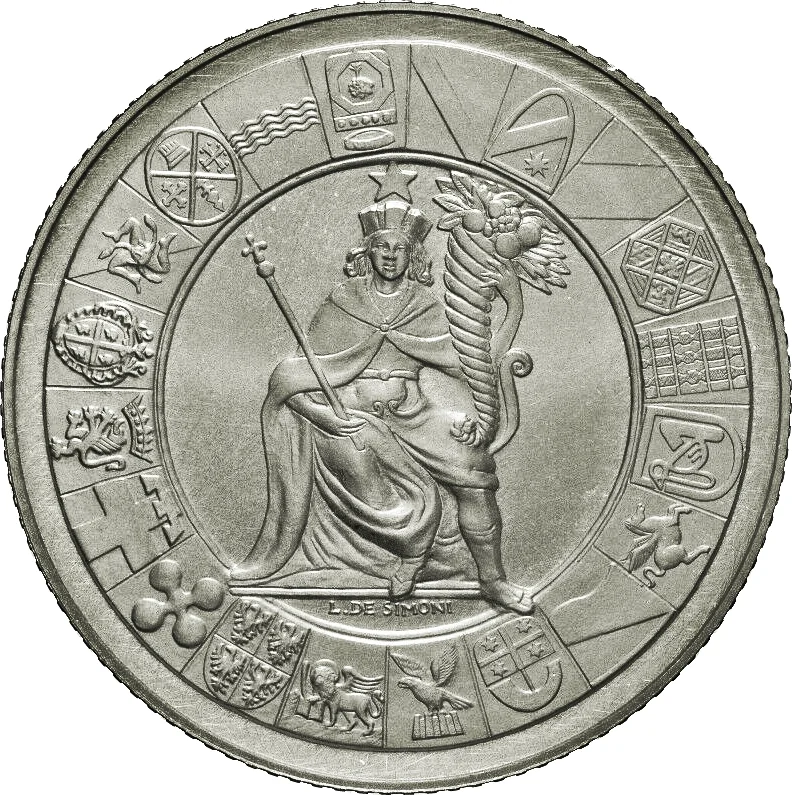
Allegory of Italy: a crowned, enthroned woman holding a scepter and cornucopia, encircled by the arms of Italy's regions.
Inscription:
L. DE SIMONI
Script: Latin
Engraver: Luciana De Simoni
Reverse
Description:
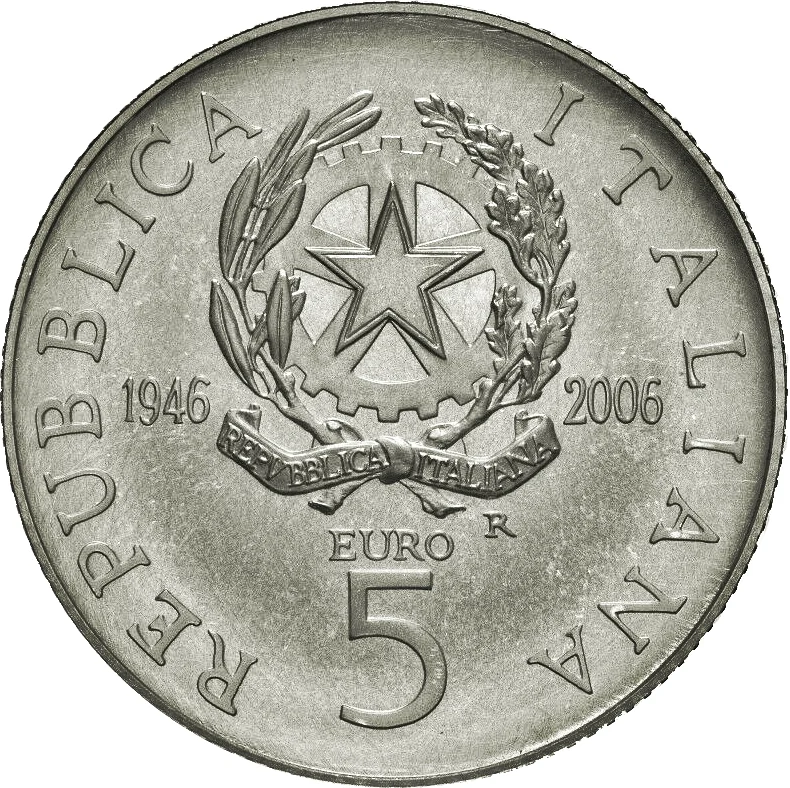
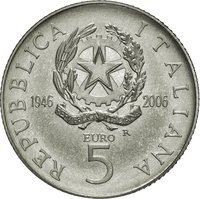
Italy's coat of arms (a cogwheel, star, and olive-oak wreath) splits the anniversary date. Value below.
Inscription:
REPUBBLICA ITALIANA
1946 2006
REPVBBLICA ITALIANA
R
EURO
5
1946 2006
REPVBBLICA ITALIANA
R
EURO
5
Translation:
Italian Republic
1946 2006
Italian Republic
R
EURO
5
1946 2006
Italian Republic
R
EURO
5
Script: Latin
Language: Italian
Engraver: Luciana De Simoni
Edge
Reeded
Mints
| Name | Mark |
|---|---|
| Rome | R |
Historical background
In 2006, Italy's currency situation was defined by its four-year membership in the Eurozone, having adopted the euro as its physical currency in 2002. The period was marked by a complex public sentiment: while the euro facilitated trade and travel within the EU and was seen as a symbol of European integration, many Italians nostalgically recalled the former lira. This "euro nostalgia" was fueled by a widespread perception that the conversion had led to a sharp, unacknowledged increase in the cost of living, often summarized by the phrase "everything doubled in price," even if official statistics showed more moderate inflation.
Economically, the country was grappling with the constraints of the single currency. As a member of the Eurozone, Italy had ceded control of its monetary policy to the European Central Bank (ECB), which set interest rates for the entire bloc. This presented a significant challenge as Italy's economy, characterized by low growth, high public debt (over 100% of GDP), and weakening competitiveness, often required different policy stimuli than the stronger economies of Northern Europe. The inability to devalue its own currency to boost exports highlighted structural issues in its economy, including rigid labor markets and sluggish productivity growth.
The political landscape reflected this tension. The centre-left government of Romano Prodi, which narrowly won elections in April 2006, faced the difficult task of stimulating the stagnant economy while adhering to the EU's Stability and Growth Pact rules to reduce budget deficits. Public discontent over purchasing power was a major political issue, with unions demanding higher wages to compensate for perceived euro-induced inflation. Thus, in 2006, Italy's currency situation was a balancing act between the irreversible reality of euro membership and the ongoing economic and social adjustments it necessitated.
Economically, the country was grappling with the constraints of the single currency. As a member of the Eurozone, Italy had ceded control of its monetary policy to the European Central Bank (ECB), which set interest rates for the entire bloc. This presented a significant challenge as Italy's economy, characterized by low growth, high public debt (over 100% of GDP), and weakening competitiveness, often required different policy stimuli than the stronger economies of Northern Europe. The inability to devalue its own currency to boost exports highlighted structural issues in its economy, including rigid labor markets and sluggish productivity growth.
The political landscape reflected this tension. The centre-left government of Romano Prodi, which narrowly won elections in April 2006, faced the difficult task of stimulating the stagnant economy while adhering to the EU's Stability and Growth Pact rules to reduce budget deficits. Public discontent over purchasing power was a major political issue, with unions demanding higher wages to compensate for perceived euro-induced inflation. Thus, in 2006, Italy's currency situation was a balancing act between the irreversible reality of euro membership and the ongoing economic and social adjustments it necessitated.
⭐ Rare