

21 ECUs – Gibraltar
Circulating commemorative coins
Commemoration: Agreement of Cooperation between Russia and the European Union
United Kingdom
Context
Year: 1995
Country: United Kingdom 
Issuer: Gibraltar 
Ruler: Elizabeth II
Currency:
(1990—1996)
Demonetized: Yes
Total mintage: 15,000
Material
References
KM: #Click to copy to clipboard499
Numista: #453211
Value
Bullion value: $50.49
Obverse
Description:
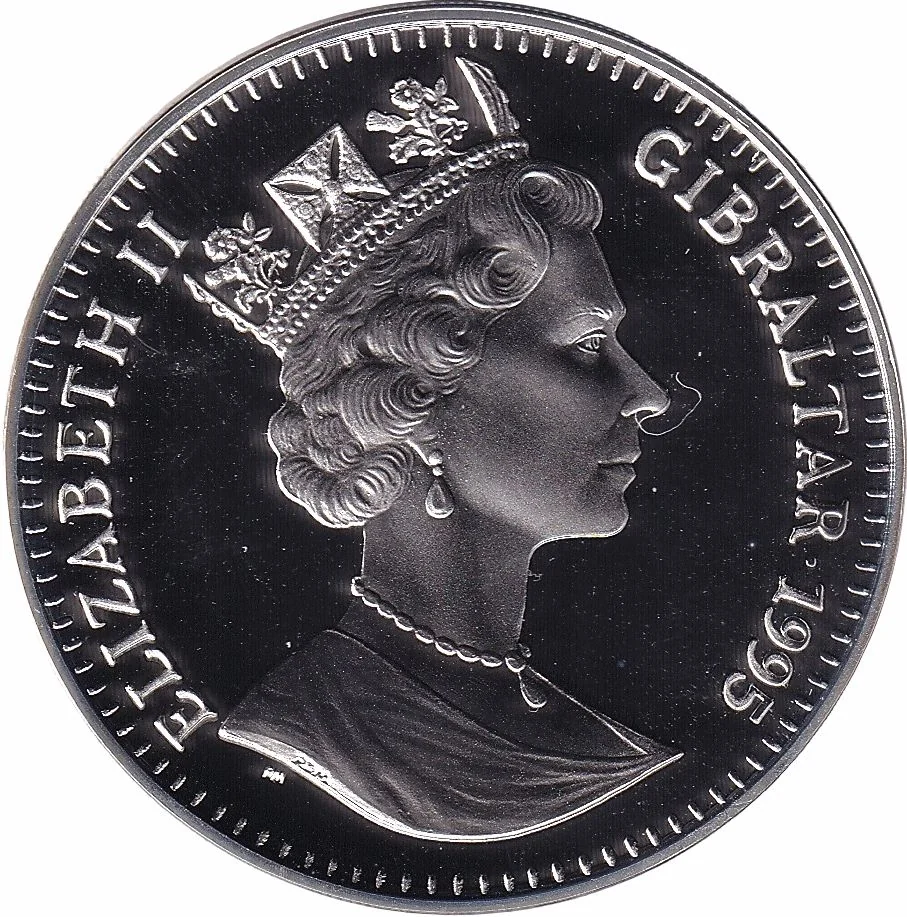
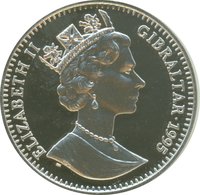
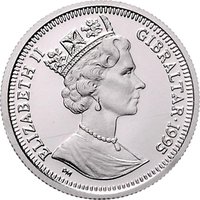
Queen Elizabeth II facing right, wearing the George IV State Diadem, surrounded by legend and date.
Inscription:
ELIZABETH II GIBRALTAR · 1995
RDM
PM
RDM
PM
Script: Latin
Designer: Raphael David Maklouf
Reverse
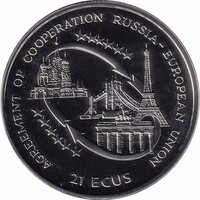
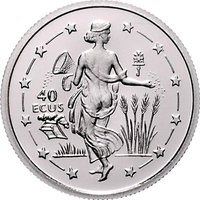
Description:
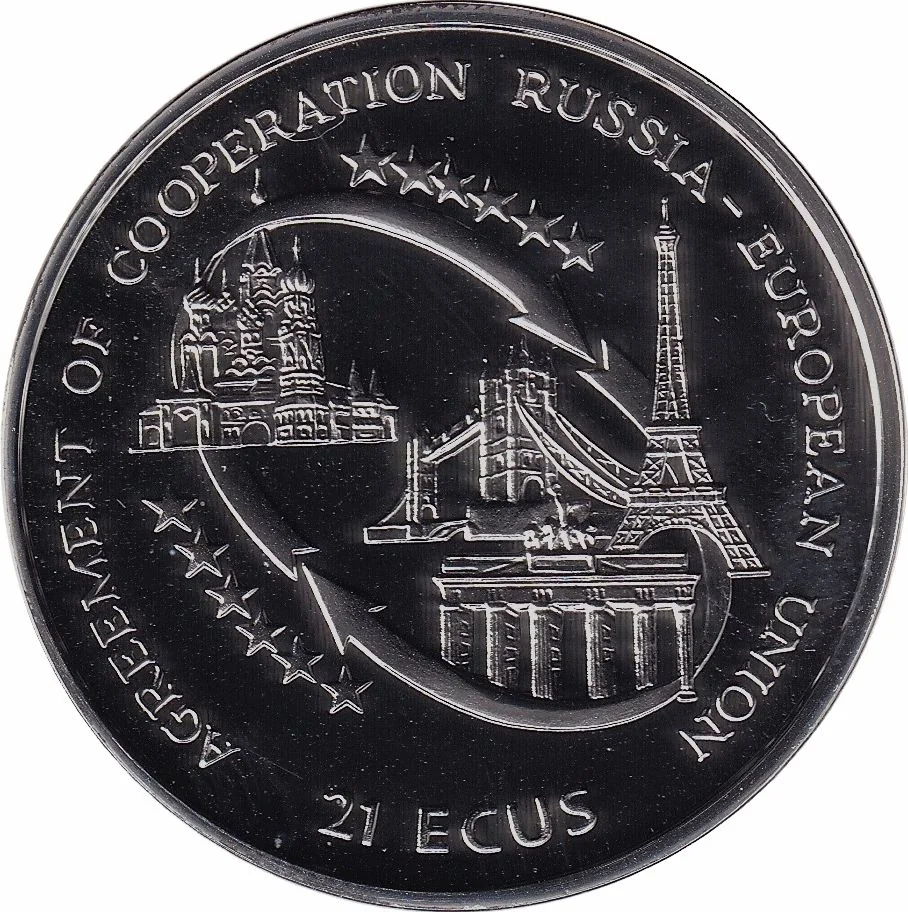
European landmarks, two arrows, and two groups of six stars.
Inscription:
AGREEMENT OF COOPERATION RUSSIA - EUROPEAN UNION
21 ECUS
21 ECUS
Script: Latin
Edge
Reeded
Mints
| Name | Mark |
|---|---|
| Pobjoy Mint | PM |
Mintings
| Year | Mint Mark | Mintage | Quality | Collection |
|---|---|---|---|---|
| 1995 | PM | 15,000 |
Historical background
In 1995, Gibraltar's currency situation was defined by a unique and practical dual-currency system, with both the Gibraltar pound (GIP) and the British pound sterling (GBP) circulating as legal tender at par value (1:1). The Gibraltar pound, issued by the Government of Gibraltar, was not legal tender in the United Kingdom, but the British pound was fully accepted in Gibraltar. This arrangement underscored Gibraltar's status as a British Overseas Territory while facilitating seamless economic activity with its closest neighbour, Spain, where the Spanish peseta was also widely used in daily transactions, especially in retail.
The system functioned effectively due to a Currency Board arrangement, which required the Gibraltar government to hold sterling reserves to fully back the local note issue. This provided confidence in the Gibraltar pound's parity with sterling and ensured monetary stability. Economically, this framework supported Gibraltar's key sectors of tourism, offshore banking, and shipping, by eliminating exchange rate risk with its primary economic partner, the UK. However, it also meant Gibraltar had no independent monetary policy, as its currency was essentially a sterling proxy.
This period preceded the major changes brought by the UK's adoption of the Euro debate and the future introduction of euro notes and coins in 2002. In 1995, while the peseta was physically common, the prospect of Spain adopting the euro introduced a future consideration for cross-border trade. Thus, the currency landscape of 1995 was one of stable hybridity, firmly pegged to British sterling but pragmatically accommodating the realities of Gibraltar's geographical and economic position at the mouth of the Mediterranean.
The system functioned effectively due to a Currency Board arrangement, which required the Gibraltar government to hold sterling reserves to fully back the local note issue. This provided confidence in the Gibraltar pound's parity with sterling and ensured monetary stability. Economically, this framework supported Gibraltar's key sectors of tourism, offshore banking, and shipping, by eliminating exchange rate risk with its primary economic partner, the UK. However, it also meant Gibraltar had no independent monetary policy, as its currency was essentially a sterling proxy.
This period preceded the major changes brought by the UK's adoption of the Euro debate and the future introduction of euro notes and coins in 2002. In 1995, while the peseta was physically common, the prospect of Spain adopting the euro introduced a future consideration for cross-border trade. Thus, the currency landscape of 1995 was one of stable hybridity, firmly pegged to British sterling but pragmatically accommodating the realities of Gibraltar's geographical and economic position at the mouth of the Mediterranean.
✨ Legendary