

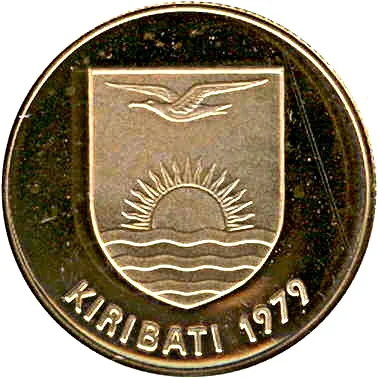
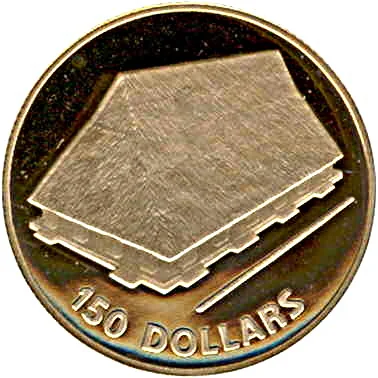
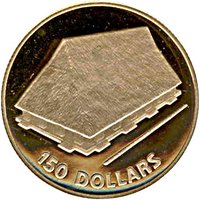
150 Dollars – Kiribati
Non-circulating coins
Commemoration: Independence
Kiribati
Context
Material
References
KM: #Click to copy to clipboard9
Numista: #45058
Value
Bullion value: $2438.64
Obverse
Reverse
Edge
Reeded
Mints
| Name | Mark |
|---|---|
| Royal Mint | — |
Mintings
| Year | Mint Mark | Mintage | Quality | Collection |
|---|---|---|---|---|
| 1979 | — | 422 | ||
| 1979 | — | 386 | Proof |
Historical background
In 1979, the newly independent Republic of Kiribati faced a complex currency situation, inheriting the monetary system of its colonial administrator, the United Kingdom. Upon gaining independence on July 12, 1979, Kiribati did not immediately issue its own national currency. Instead, the nation continued to use the Australian dollar (AUD) as its official legal tender, a arrangement established in 1966 when the Australian pound was decimalized and the Australian dollar was introduced across many British territories in the Pacific, including the Gilbert Islands (which became Kiribati).
This reliance on the Australian dollar was a pragmatic choice for a small, dispersed atoll nation with limited financial infrastructure and a economy heavily dependent on exports like phosphate (from Banaba Island, which was nearing depletion) and copra. Adopting a separate, sovereign currency would have been administratively challenging and economically risky, potentially leading to instability. The use of the strong, stable Australian dollar provided immediate monetary credibility, facilitated trade with its major economic partner, and avoided the costs and complexities of establishing a central bank and managing an independent exchange rate.
Consequently, 1979 was not a year of monetary revolution but of continuity. The foundational decision was to maintain the status quo of Australian dollar circulation, overseen by the government in cooperation with Australian banking authorities. This set the stage for Kiribati's long-term monetary policy, which would later be formalized with the issuance of distinctive Kiribati coinage (which are legal tender but circulate at par with Australian coins and notes) while the Australian dollar remained, and still remains, the nation's paper currency.
This reliance on the Australian dollar was a pragmatic choice for a small, dispersed atoll nation with limited financial infrastructure and a economy heavily dependent on exports like phosphate (from Banaba Island, which was nearing depletion) and copra. Adopting a separate, sovereign currency would have been administratively challenging and economically risky, potentially leading to instability. The use of the strong, stable Australian dollar provided immediate monetary credibility, facilitated trade with its major economic partner, and avoided the costs and complexities of establishing a central bank and managing an independent exchange rate.
Consequently, 1979 was not a year of monetary revolution but of continuity. The foundational decision was to maintain the status quo of Australian dollar circulation, overseen by the government in cooperation with Australian banking authorities. This set the stage for Kiribati's long-term monetary policy, which would later be formalized with the issuance of distinctive Kiribati coinage (which are legal tender but circulate at par with Australian coins and notes) while the Australian dollar remained, and still remains, the nation's paper currency.

✨ Legendary