

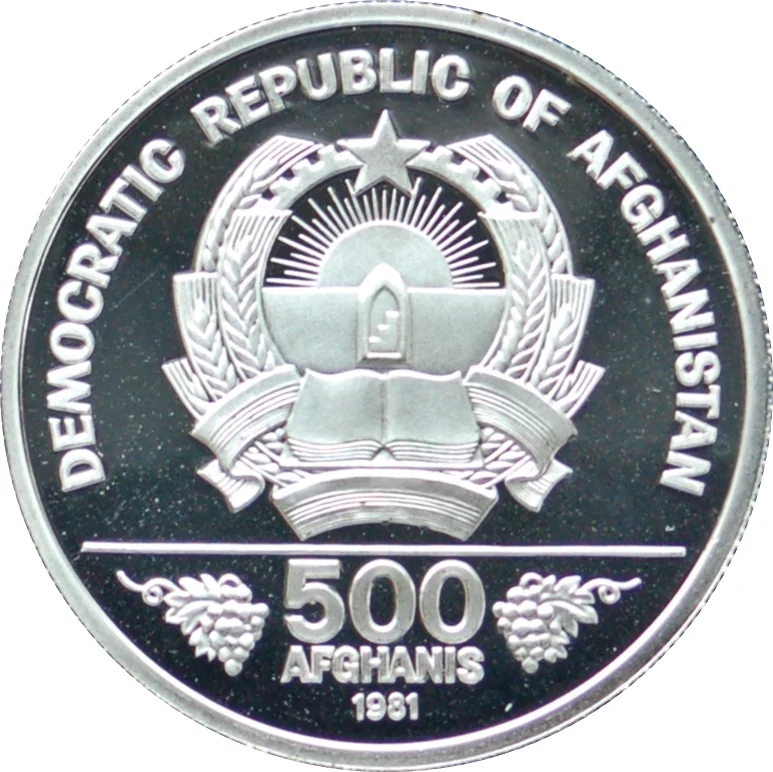
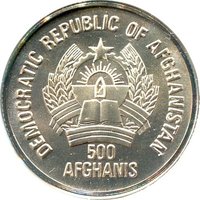
500 Afghanis – Afghanistan
Non-circulating coins
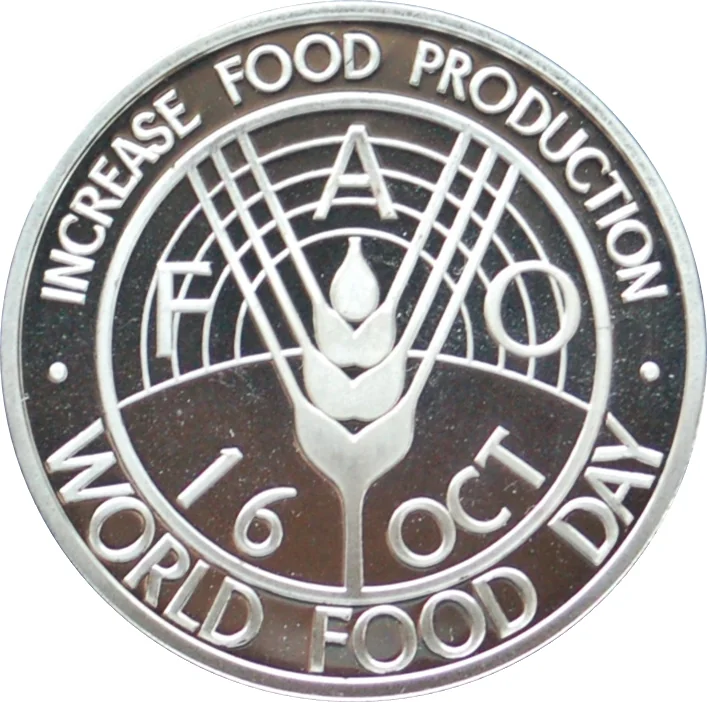
Commemoration: FAO - World Food Day
Afghanistan
Context
Year: 1981
Issuer: Afghanistan 
Period:
(1978—1992)
Currency:
(1923—2003)
Demonetized: Yes
Total mintage: 12,000
Material
References
KM: #Click to copy to clipboard1002
Numista: #45019
Value
Exchange value: 500 AFA
Bullion value: $23.18
Obverse
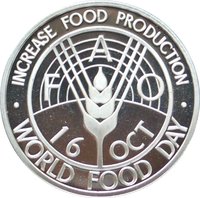
Reverse
Description:
FAO emblem encircled by legend.
Inscription:
INCREASE FOOD PRODUCTION
WORLD FOOD DAY
F A O
16 OCT
WORLD FOOD DAY
F A O
16 OCT
Script: Latin
Edge
Reeded
Categories
| Organization> FAO |
Mints
| Name | Mark |
|---|---|
| Saint Petersburg | — |
Mintings
| Year | Mint Mark | Mintage | Quality | Collection |
|---|---|---|---|---|
| 1981 | — | 12,000 | Proof |
Historical background
In 1981, Afghanistan's currency situation was deeply unstable and reflective of the country's escalating conflict. The Soviet-backed Democratic Republic of Afghanistan (DRA) government, which had taken power in 1978 and faced a widespread mujahideen insurgency following the 1979 Soviet invasion, controlled the official currency, the Afghani (AFA). However, its economic authority was severely undermined by war. The government financed its military efforts through massive money printing at the State Bank of Afghanistan, leading to rampant inflation and a sharp decline in the Afghani's value on the limited official market. This economic mismanagement eroded public confidence in the currency and the state's financial institutions.
Parallel to the official economy, a vibrant black market for foreign exchange, particularly US dollars, thrived. This market, operating in urban bazaars, became the real benchmark for the Afghani's value, with exchange rates far worse than the government's artificially set official rate. The disparity between the two rates created major distortions, incentivizing corruption as those with access to official channels could profit massively. Furthermore, the rural economy began to fragment, with barter and the use of older banknotes or Pakistani rupees becoming more common in areas outside government control, as the insurgency disrupted normal trade and banking.
Ultimately, the currency chaos of 1981 was a direct symptom of a state at war with itself. The DRA government's reliance on monetary expansion to fund the war destroyed the Afghani's purchasing power for ordinary citizens, while the black market underscored the regime's lack of real economic sovereignty. This financial deterioration exacerbated the humanitarian crisis, contributing to capital flight, shortages of essential goods, and the further impoverishment of the population, setting a pattern of monetary instability that would persist for decades.
Parallel to the official economy, a vibrant black market for foreign exchange, particularly US dollars, thrived. This market, operating in urban bazaars, became the real benchmark for the Afghani's value, with exchange rates far worse than the government's artificially set official rate. The disparity between the two rates created major distortions, incentivizing corruption as those with access to official channels could profit massively. Furthermore, the rural economy began to fragment, with barter and the use of older banknotes or Pakistani rupees becoming more common in areas outside government control, as the insurgency disrupted normal trade and banking.
Ultimately, the currency chaos of 1981 was a direct symptom of a state at war with itself. The DRA government's reliance on monetary expansion to fund the war destroyed the Afghani's purchasing power for ordinary citizens, while the black market underscored the regime's lack of real economic sovereignty. This financial deterioration exacerbated the humanitarian crisis, contributing to capital flight, shortages of essential goods, and the further impoverishment of the population, setting a pattern of monetary instability that would persist for decades.
⭐ Somewhat Rare