

1 taka – Bangladesh
Add to wishlist
Circulating commemorative coins
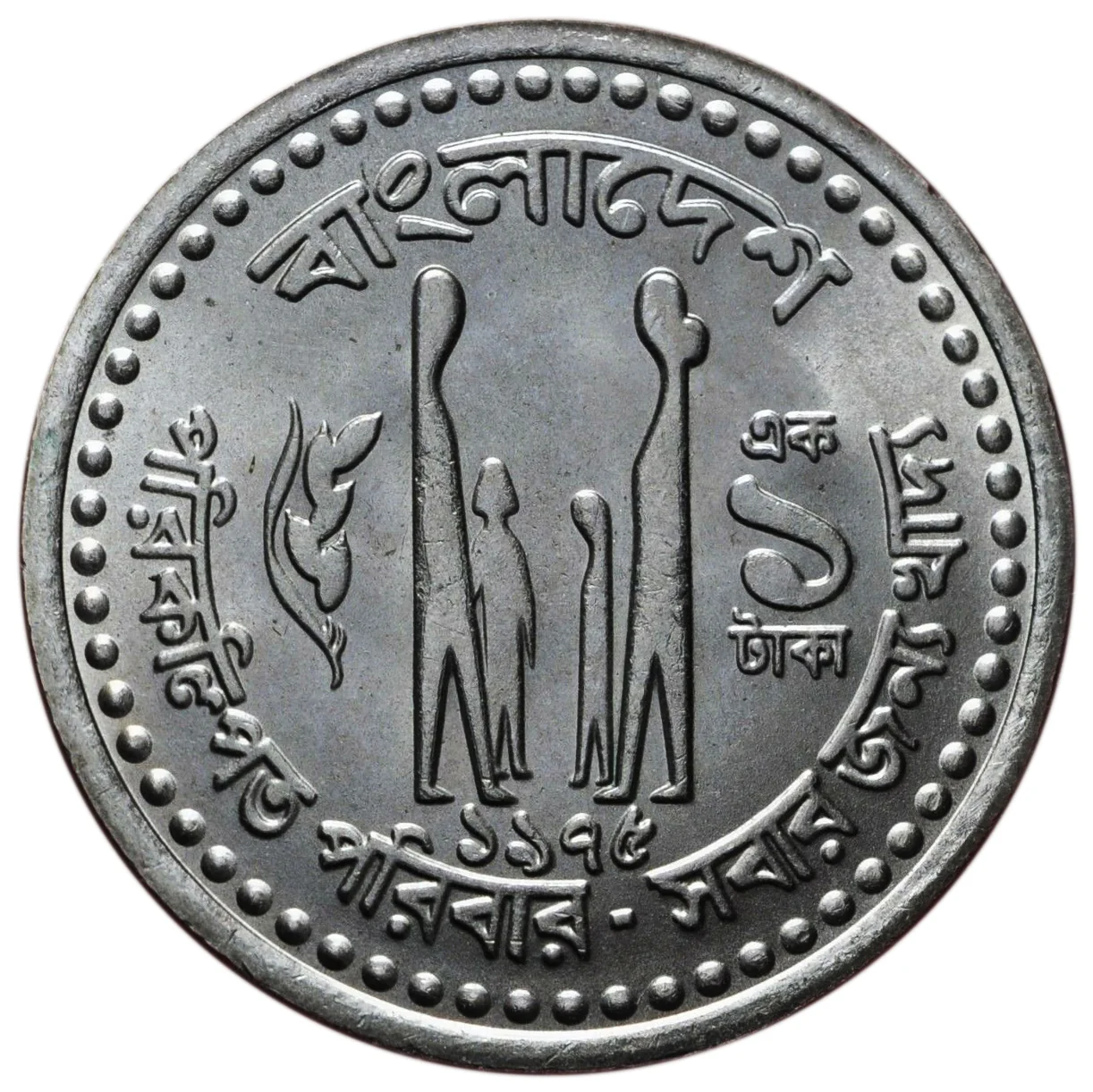
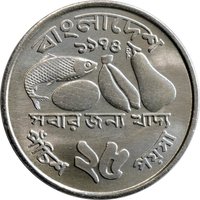
Commemoration: FAO - family planning
Bangladesh
Context
Years: 1975–1977
Issuer: Bangladesh
Period:
(since 1971)
Currency:
(since 1972)
Total mintage: 4,000,000
Material
Diameter: 26 mm
Weight: 6 g
Shape: Round
Composition: Copper-nickel
Technique: Milled
Alignment: Medal alignment
flip
References
KM: #
Numista: #14760
Value
Exchange value: 1 BDT
Obverse
Description:
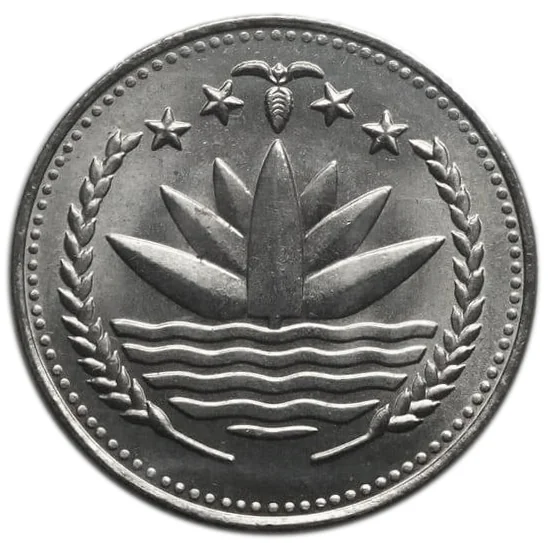
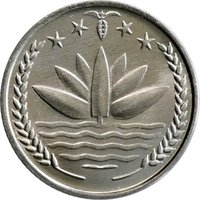
Bangladesh's national emblem features a water lily flanked by rice sheaves. Above are three tea leaves and four stars symbolizing the 1972 constitutional principles: nationalism, secularism, socialism, and democracy.
Reverse
Edge
Reeded
Categories
| Organization> FAO |
| Plants> Flower |
| Symbols> Coat of Arms |
Mintings
| Year | Mint Mark | Mintage | Quality | Collection |
|---|---|---|---|---|
| 1975 | — | 2,000,000 | ||
| 1976 | — | 1,000,000 | ||
| 1977 | — | 1,000,000 |
Historical background
In 1975, Bangladesh's currency situation was deeply troubled, reflecting the severe economic and political crises following independence in 1971. The war had devastated infrastructure, disrupted production, and left the new nation with minimal foreign reserves. The government, under Sheikh Mujibur Rahman, financed massive reconstruction and a growing public sector through deficit spending, leading to rampant money printing. This resulted in high inflation, a sharp depreciation of the Taka on the black market, and a critical shortage of essential imports, creating a "currency overhang" where too much money chased too few goods.
Politically, the year was one of catastrophic upheaval. The assassination of Sheikh Mujib in August and subsequent coups created a power vacuum and policy paralysis, further eroding confidence in the currency and the economy. The socialist-leaning policies of the immediate post-independence period, including nationalizations and strict import controls, had stifled growth and formal foreign exchange earnings. By late 1975, the official exchange rate was vastly overvalued, but the new military-led government under Ziaur Rahman had not yet implemented the decisive reforms that would come later.
Consequently, a dual exchange rate system effectively existed: an unrealistic official rate for government transactions and a thriving black market where the Taka's value was significantly lower. This disparity encouraged corruption and hoarding of foreign currency. The situation laid bare the urgent need for structural adjustment, setting the stage for the economic liberalization, devaluation, and shift towards a market-oriented economy that the subsequent regime would pursue in the late 1970s to stabilize the Taka.
Politically, the year was one of catastrophic upheaval. The assassination of Sheikh Mujib in August and subsequent coups created a power vacuum and policy paralysis, further eroding confidence in the currency and the economy. The socialist-leaning policies of the immediate post-independence period, including nationalizations and strict import controls, had stifled growth and formal foreign exchange earnings. By late 1975, the official exchange rate was vastly overvalued, but the new military-led government under Ziaur Rahman had not yet implemented the decisive reforms that would come later.
Consequently, a dual exchange rate system effectively existed: an unrealistic official rate for government transactions and a thriving black market where the Taka's value was significantly lower. This disparity encouraged corruption and hoarding of foreign currency. The situation laid bare the urgent need for structural adjustment, setting the stage for the economic liberalization, devaluation, and shift towards a market-oriented economy that the subsequent regime would pursue in the late 1970s to stabilize the Taka.
🌱 Common