

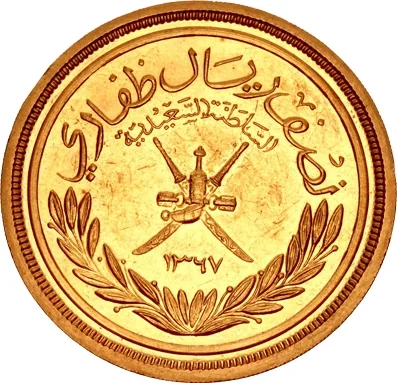
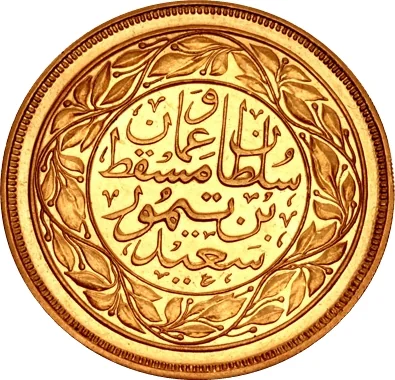
½ rial – Dhofar Governorate
Add to wishlist
Oman
Context
Year: 1948
Islamic (Hijri) Year:: 1367
Country: Oman
Issuer: Dhofar Governorate
Ruler: Said bin Taimur
Currency:
(1940—1970)
Demonetized: Yes
Total mintage: 2
Material
References
KM: #
Numista: #102954
Value
Bullion value: $3359.43
Obverse
Reverse
Edge
Reeded
Categories
| Object> Cold weapons |
| Symbols> Coat of Arms |
| Symbol> Wreath |
Mints
| Name | Mark |
|---|---|
| Royal Mint (Tower Hill) | — |
Mintings
| Year | Mint Mark | Mintage | Quality | Collection |
|---|---|---|---|---|
| 1948 | — | 2 | Proof |
Historical background
In 1948, the currency situation in Dhofar Governorate, part of the Sultanate of Muscat and Oman, was complex and reflected the region's unique political and economic position. Unlike the interior of Oman, which was under the firm control of Sultan Said bin Taimur, Dhofar maintained a high degree of autonomy under its local tribal leaders. This autonomy, coupled with its historical trade connections across the Indian Ocean and its geographic separation from Muscat by the vast Empty Quarter, meant that the Sultan's currency did not circulate as sovereign tender. Instead, the monetary landscape was a patchwork of various foreign silver coins.
The primary currency in daily use was the Maria Theresa Thaler (MT$). This large silver coin, first minted in 1751, was valued throughout the Arabian Peninsula and the Horn of Africa for its consistent weight and silver content. Its stability made it the preferred medium for significant transactions, including the region's important trade in livestock, incense, and other goods. Alongside the Thaler, the Indian Rupee was also widely circulated, a legacy of British Indian influence on the maritime trade routes of the Arabian Sea. The rupee was particularly important for trade with merchants from Gujarat and Sindh, who were active in Salalah's port.
This multi-currency system operated without a formal banking infrastructure. Exchange rates between the Thaler, Rupee, and other minor coins like the British sovereign and Gulf rupees were set by market traders and merchants based on silver weight and daily demand. The absence of a central monetary authority underscored Dhofar's economic detachment from Muscat. This situation would persist until the discovery of oil and the subsequent unification of Oman under Sultan Qaboos in the 1970s, which led to the introduction of a single, national currency.
The primary currency in daily use was the Maria Theresa Thaler (MT$). This large silver coin, first minted in 1751, was valued throughout the Arabian Peninsula and the Horn of Africa for its consistent weight and silver content. Its stability made it the preferred medium for significant transactions, including the region's important trade in livestock, incense, and other goods. Alongside the Thaler, the Indian Rupee was also widely circulated, a legacy of British Indian influence on the maritime trade routes of the Arabian Sea. The rupee was particularly important for trade with merchants from Gujarat and Sindh, who were active in Salalah's port.
This multi-currency system operated without a formal banking infrastructure. Exchange rates between the Thaler, Rupee, and other minor coins like the British sovereign and Gulf rupees were set by market traders and merchants based on silver weight and daily demand. The absence of a central monetary authority underscored Dhofar's economic detachment from Muscat. This situation would persist until the discovery of oil and the subsequent unification of Oman under Sultan Qaboos in the 1970s, which led to the introduction of a single, national currency.
✨ Legendary