

½ pound – South Africa
Add to wishlist
South Africa
Context
Year: 1952
Issuer: South Africa
Ruler: George VI
Currency:
(1825—1961)
Demonetization: 31 March 1961
Total mintage: 16,002
Material
References
KM: #
Numista: #44915
Value
Bullion value: $569.44
Obverse
Description:
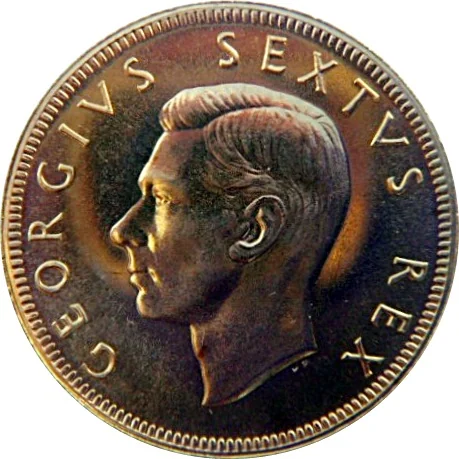
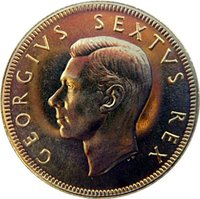
King George VI left-facing portrait, legend around, engraver's initials below.
Inscription:
GEORGIVS SEXTVS REX
HP
HP
Translation:
George the Sixth King
HP
HP
Script: Latin
Language: Latin
Engraver: Thomas Humphrey Paget
Reverse
Description:
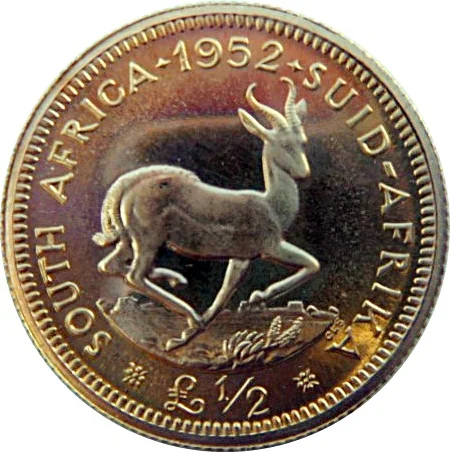
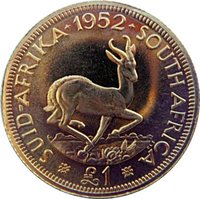
Springbok running right, surrounded by legend, date above, denomination below, engraver's initials at lower right.
Inscription:
SOUTH AFRICA - 1952 - SUID-AFRIKA
CLS
£½
CLS
£½
Script: Latin
Engraver: Coert Laurens Steynberg
Edge
Reeded
Mints
| Name | Mark |
|---|---|
| Pretoria | — |
Mintings
| Year | Mint Mark | Mintage | Quality | Collection |
|---|---|---|---|---|
| 1952 | — | 12,000 | Proof | |
| 1952 | — | 4,002 | Prooflike |
Historical background
In 1952, South Africa’s currency situation was defined by its position within the Sterling Area and the legacy of the 1949 devaluation. As a member of the Sterling Area, the South African pound was pegged to the British pound sterling, and its reserves were held predominantly in London. This linkage meant that the country’s monetary policy and currency stability were heavily influenced by Britain’s post-war economic fortunes and the broader strength of sterling on the global stage.
The pivotal event shaping the 1952 context was the September 1949 devaluation, when the South African government, following the UK's lead, devalued the South African pound by 30.5% against the US dollar. By 1952, the immediate turbulence of this devaluation had subsided, but its effects were deeply felt. The primary goal—to boost the profitability of the crucial gold mining sector and improve the balance of payments by making exports cheaper—was being realized. Gold production and revenue were strong, providing a solid foundation for the currency and the economy amidst the political upheavals of the early apartheid era.
However, this reliance on gold and sterling also created vulnerabilities. Political tensions, including the Defiance Campaign launched that year, introduced elements of uncertainty, though they had not yet precipitated a capital flight severe enough to destabilize the currency. The system functioned, but it was inherently exposed to shifts in British economic policy and global commodity prices. Consequently, in 1952, the South African currency was stable but operating within a framework that was increasingly questioned, foreshadowing the eventual establishment of an independent central bank and the introduction of the Rand in 1961.
The pivotal event shaping the 1952 context was the September 1949 devaluation, when the South African government, following the UK's lead, devalued the South African pound by 30.5% against the US dollar. By 1952, the immediate turbulence of this devaluation had subsided, but its effects were deeply felt. The primary goal—to boost the profitability of the crucial gold mining sector and improve the balance of payments by making exports cheaper—was being realized. Gold production and revenue were strong, providing a solid foundation for the currency and the economy amidst the political upheavals of the early apartheid era.
However, this reliance on gold and sterling also created vulnerabilities. Political tensions, including the Defiance Campaign launched that year, introduced elements of uncertainty, though they had not yet precipitated a capital flight severe enough to destabilize the currency. The system functioned, but it was inherently exposed to shifts in British economic policy and global commodity prices. Consequently, in 1952, the South African currency was stable but operating within a framework that was increasingly questioned, foreshadowing the eventual establishment of an independent central bank and the introduction of the Rand in 1961.
💎 Very Rare