

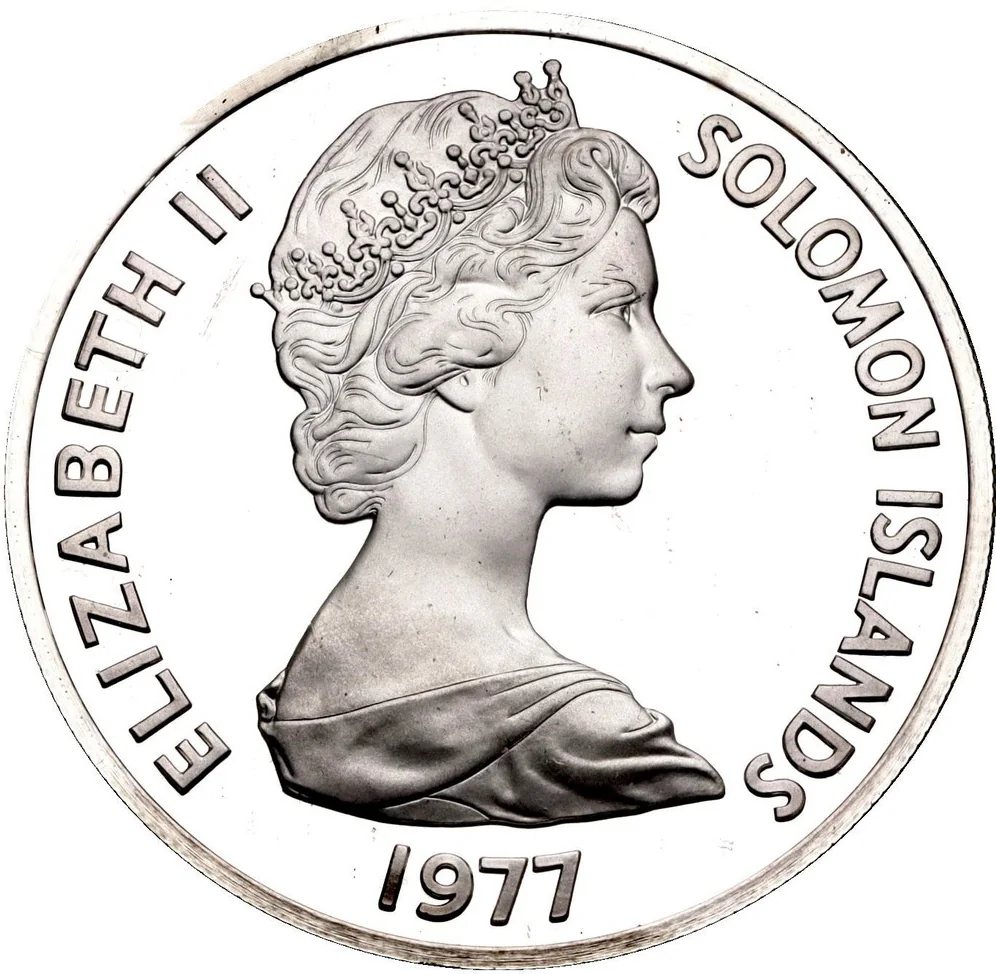
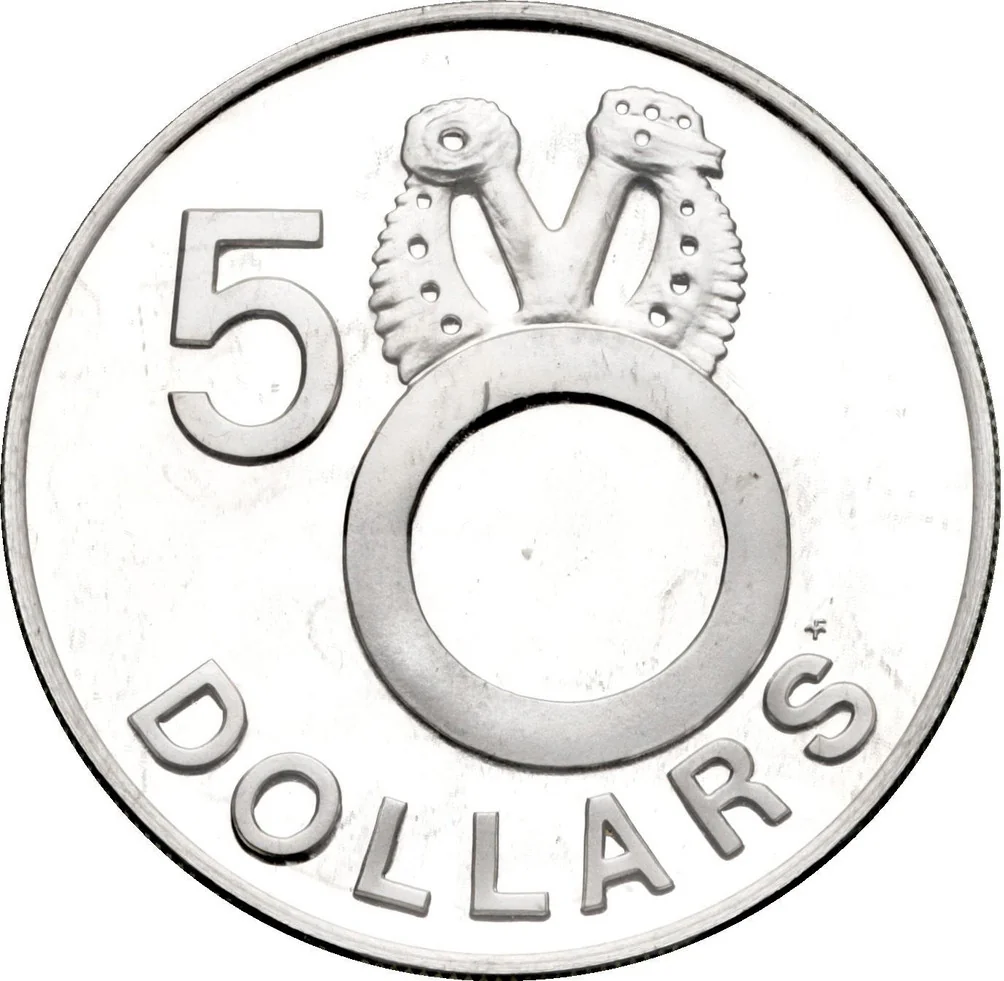
5 dollars – Solomon Islands
Solomon Islands
Context
Years: 1977–1983
Issuer: Solomon Islands 
Ruler: Elizabeth II
Currency:
(since 1977)
Total mintage: 25,011
Material
References
KM: #Click to copy to clipboard7
Numista: #44807
Value
Exchange value: 5 SBD
Bullion value: $78.98
Obverse
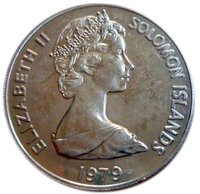
Description:
Youthful profile portrait
Inscription:
ELIZABETH II SOLOMON ISLANDS
1978
1978
Translation:
ELIZABETH II SOLOMON ISLANDS
1978
1978
Script: Latin
Engraver: Arnold Machin
Reverse
Edge
Mints
| Name | Mark |
|---|---|
| Franklin Mint | (FM) |
Mintings
| Year | Mint Mark | Mintage | Quality | Collection |
|---|---|---|---|---|
| 1977 | FM | 15,000 | Proof | |
| 1977 | FM | 200 | Special Uncirculated | |
| 1978 | FM | 5,148 | Proof | |
| 1979 | FM | 2,845 | Proof | |
| 1980 | FM | 1,031 | Proof | |
| 1981 | FM | 448 | Proof | |
| 1983 | FM | 339 | Proof |
Historical background
In 1977, the currency situation in Solomon Islands was defined by a period of transition and consolidation following the nation's move toward self-government. The official currency remained the Australian dollar, a legacy of the British Solomon Islands Protectorate's close economic and administrative ties with Australia. This arrangement provided stability and facilitated trade, but it also symbolised a lingering colonial dependency as the country prepared for full independence, which would be achieved just one year later in 1978.
A key development in 1977 was the legislative groundwork being laid for a national currency. The government, led by Chief Minister Peter Kenilorea, was actively preparing to introduce the Solomon Islands dollar (SBD) to replace the Australian dollar. This was a point of national pride and a crucial step in asserting monetary sovereignty. The Central Bank of Solomon Islands Act was passed in 1976, and by 1977, the newly established central bank was finalising plans for the currency's design, security features, and issuance schedule.
The economic context for this change was challenging. The country's economy was narrowly based on exports of copra, timber, and fish, making it vulnerable to global price fluctuations. There were concerns about managing inflation and ensuring sufficient foreign reserves to back the new currency. Therefore, the 1977 currency situation was one of cautious preparation, balancing the symbolic importance of a national currency with the practical necessities of maintaining economic stability during a pivotal historical moment.
A key development in 1977 was the legislative groundwork being laid for a national currency. The government, led by Chief Minister Peter Kenilorea, was actively preparing to introduce the Solomon Islands dollar (SBD) to replace the Australian dollar. This was a point of national pride and a crucial step in asserting monetary sovereignty. The Central Bank of Solomon Islands Act was passed in 1976, and by 1977, the newly established central bank was finalising plans for the currency's design, security features, and issuance schedule.
The economic context for this change was challenging. The country's economy was narrowly based on exports of copra, timber, and fish, making it vulnerable to global price fluctuations. There were concerns about managing inflation and ensuring sufficient foreign reserves to back the new currency. Therefore, the 1977 currency situation was one of cautious preparation, balancing the symbolic importance of a national currency with the practical necessities of maintaining economic stability during a pivotal historical moment.
🌟 Limited