

5 rand – South Africa
Add to wishlist
Circulating commemorative coins
Commemoration: Nelson Mandela
South Africa
Context
Year: 2000
Issuer: South Africa
Period:
(since 1961)
Currency:
(since 1961)
Total mintage: 6,240,000
Material
References
KM: #
Numista: #14740
Value
Exchange value: 5 ZAR
Inflation-adjusted value: 18.13 ZAR
Obverse
Description:
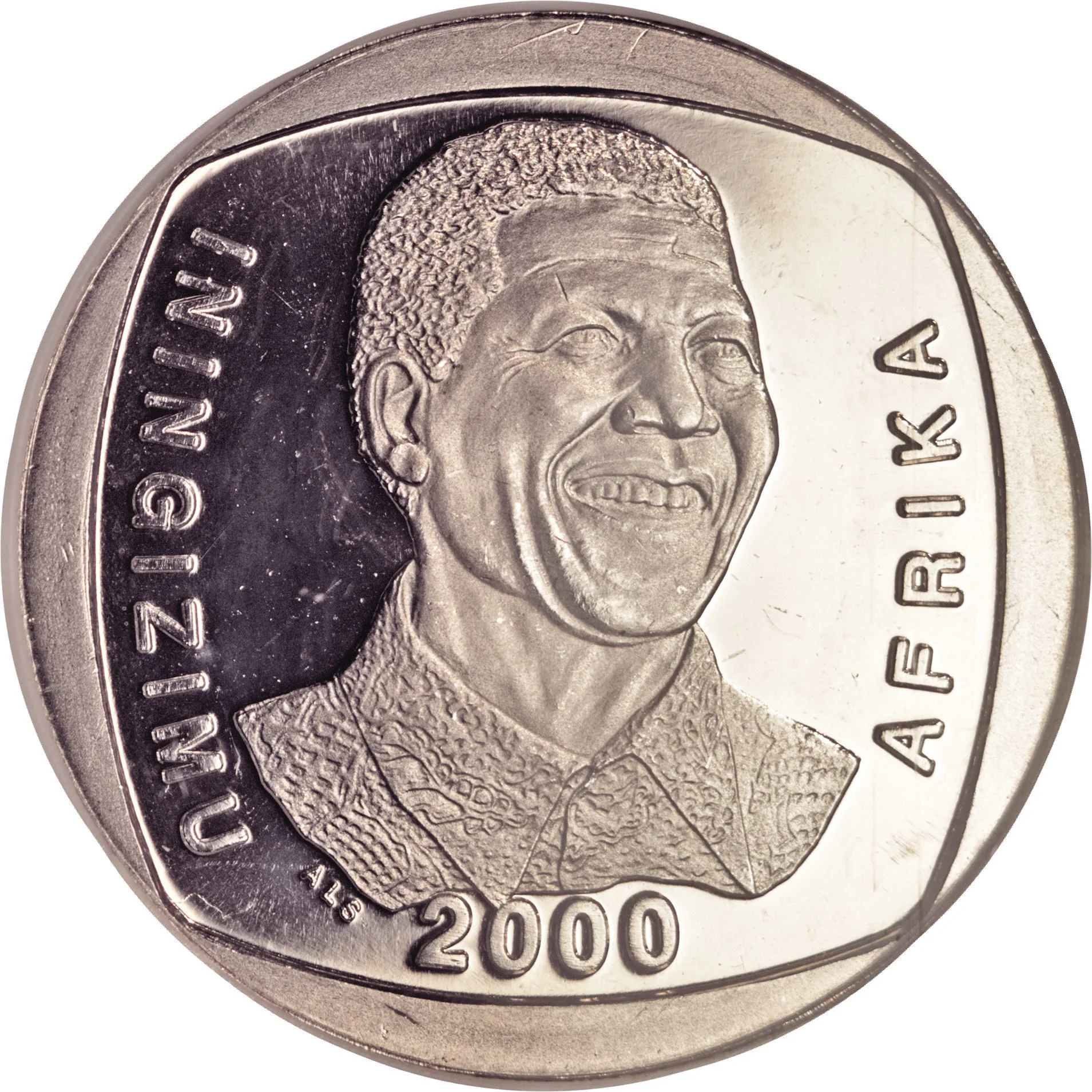
Nelson Mandela, 1/4 right. Date beneath.
Inscription:
ININGIZIMU
AFRIKA
ALS
2000
AFRIKA
ALS
2000
Translation:
SOUTH
AFRICA
ALS
2000
AFRICA
ALS
2000
Script: Latin
Engraver: Arthur Sutherland
Reverse
Edge
Alternating segments of smooth and reeded parts
Categories
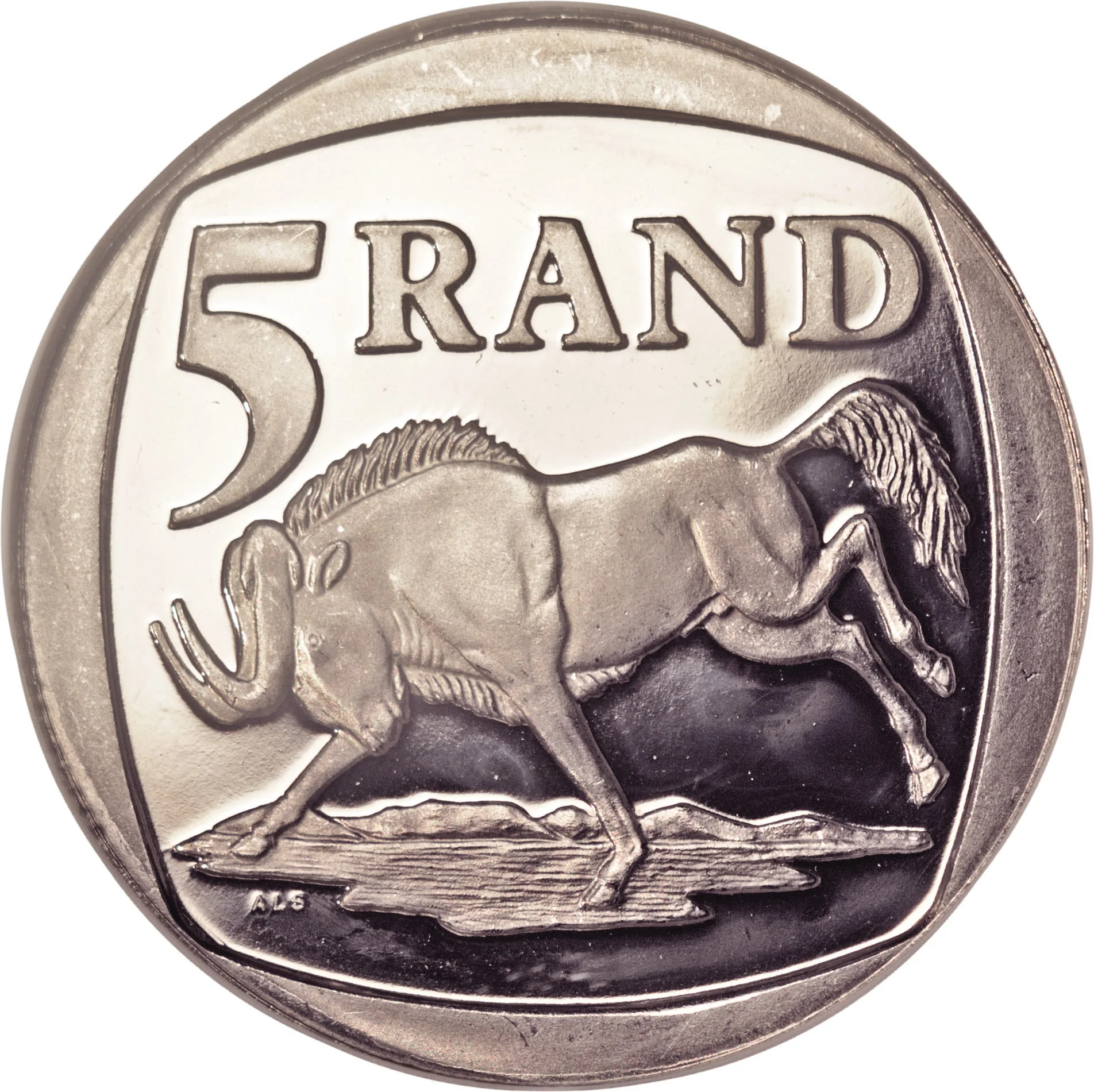
| Animal> Cow |
| Person> Politician |
Mintings
| Year | Mint Mark | Mintage | Quality | Collection |
|---|---|---|---|---|
| 2000 | — | 6,200,000 | ||
| 2000 | — | — | Proof | |
| 2000 | — | 40,000 | Prooflike |
Historical background
In 2000, South Africa's currency, the rand, was in a period of significant vulnerability and transition. The country was still grappling with the economic legacy of apartheid, including high unemployment, inequality, and the need to attract foreign investment. The rand's value was highly sensitive to both domestic policy and global sentiment, operating in a managed float system where the South African Reserve Bank (SARB) intervened to curb excessive volatility but did not target a specific exchange rate. This period followed the gradual relaxation of strict exchange controls in the 1990s, which had begun integrating South Africa into the global financial system but also exposed the currency to market forces.
The year was marked by pronounced weakness for the rand, driven by a combination of internal and external pressures. Domestically, concerns over the pace of structural reforms, the government's handling of the HIV/AIDS crisis, and political uncertainty contributed to negative investor sentiment. Externally, the rand was heavily impacted by a strong US dollar and emerging market volatility. A pivotal moment came in late 2001, but the pressures were building throughout 2000, as the currency steadily depreciated, raising alarms about potential inflationary consequences due to the increased cost of imports.
In response, the South African Reserve Bank, under Governor Tito Mboweni, maintained a focus on inflation targeting, which had been formally adopted in February 2000. Monetary policy was tightened, with interest rates raised to support the currency and contain inflation, even at the risk of slowing economic growth. This period underscored the difficult trade-offs facing policymakers: managing a volatile currency while trying to stimulate an economy struggling with deep socio-economic challenges. The currency situation of 2000 set the stage for the more severe rand crisis that would follow in late 2001.
The year was marked by pronounced weakness for the rand, driven by a combination of internal and external pressures. Domestically, concerns over the pace of structural reforms, the government's handling of the HIV/AIDS crisis, and political uncertainty contributed to negative investor sentiment. Externally, the rand was heavily impacted by a strong US dollar and emerging market volatility. A pivotal moment came in late 2001, but the pressures were building throughout 2000, as the currency steadily depreciated, raising alarms about potential inflationary consequences due to the increased cost of imports.
In response, the South African Reserve Bank, under Governor Tito Mboweni, maintained a focus on inflation targeting, which had been formally adopted in February 2000. Monetary policy was tightened, with interest rates raised to support the currency and contain inflation, even at the risk of slowing economic growth. This period underscored the difficult trade-offs facing policymakers: managing a volatile currency while trying to stimulate an economy struggling with deep socio-economic challenges. The currency situation of 2000 set the stage for the more severe rand crisis that would follow in late 2001.
🌱 Fairly Common