

5 Shillings (Union of South Africa) – South Africa
Circulating commemorative coins
Commemoration: 50 Years of the Union of South Africa.
South Africa
Context
Year: 1960
Issuer: South Africa 
Ruler: Elizabeth II
Currency:
(1825—1961)
Demonetization: 31 March 1961
Total mintage: 421,624
Material
References
KM: #Click to copy to clipboard55
Numista: #14733
Value
Bullion value: $40.20
Obverse
Description:
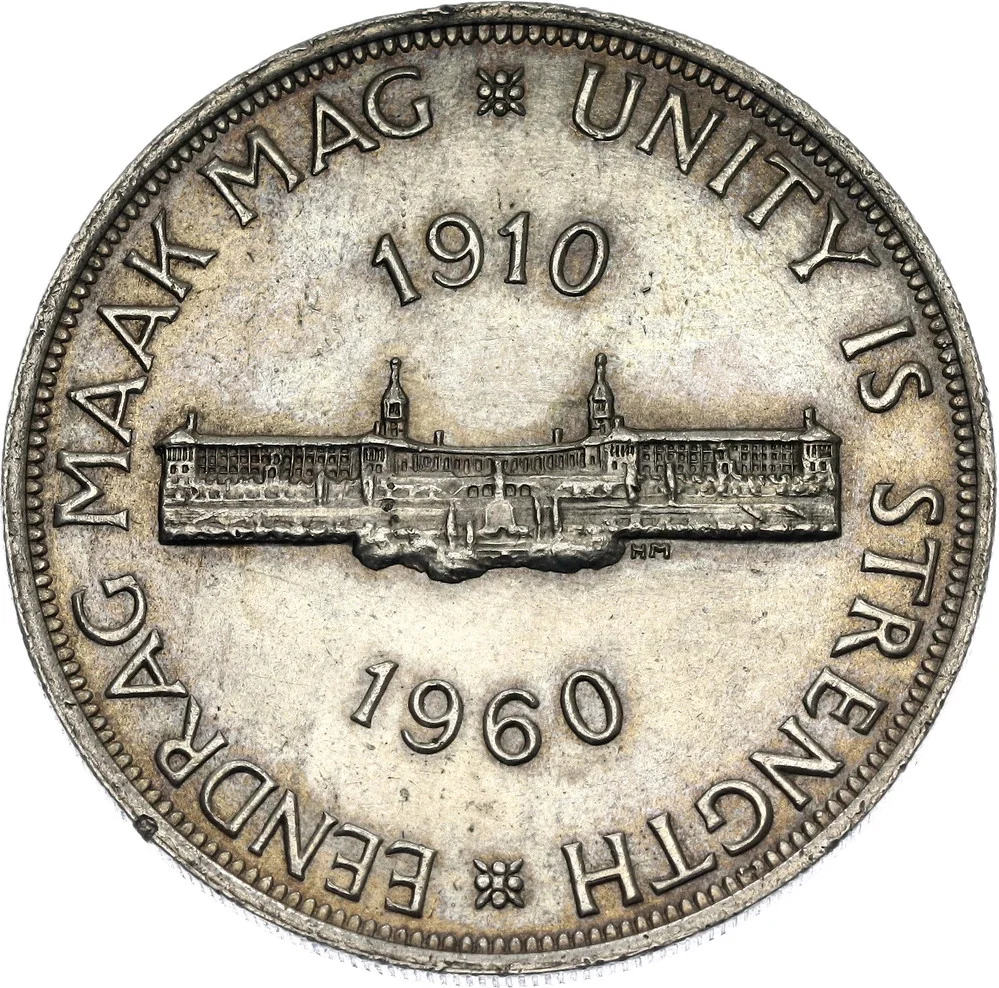
Image of the Union Buildings in Pretoria, encircled by a legend and flanked by dates.
Inscription:
EENDRAG MAAK MAG UNITY IS STRENGTH
1910
HM
1960
1910
HM
1960
Translation:
UNITY IS STRENGTH
1910
HM
1960
1910
HM
1960
Script: Latin
Designer: Hilda Mason
Reverse
Description:
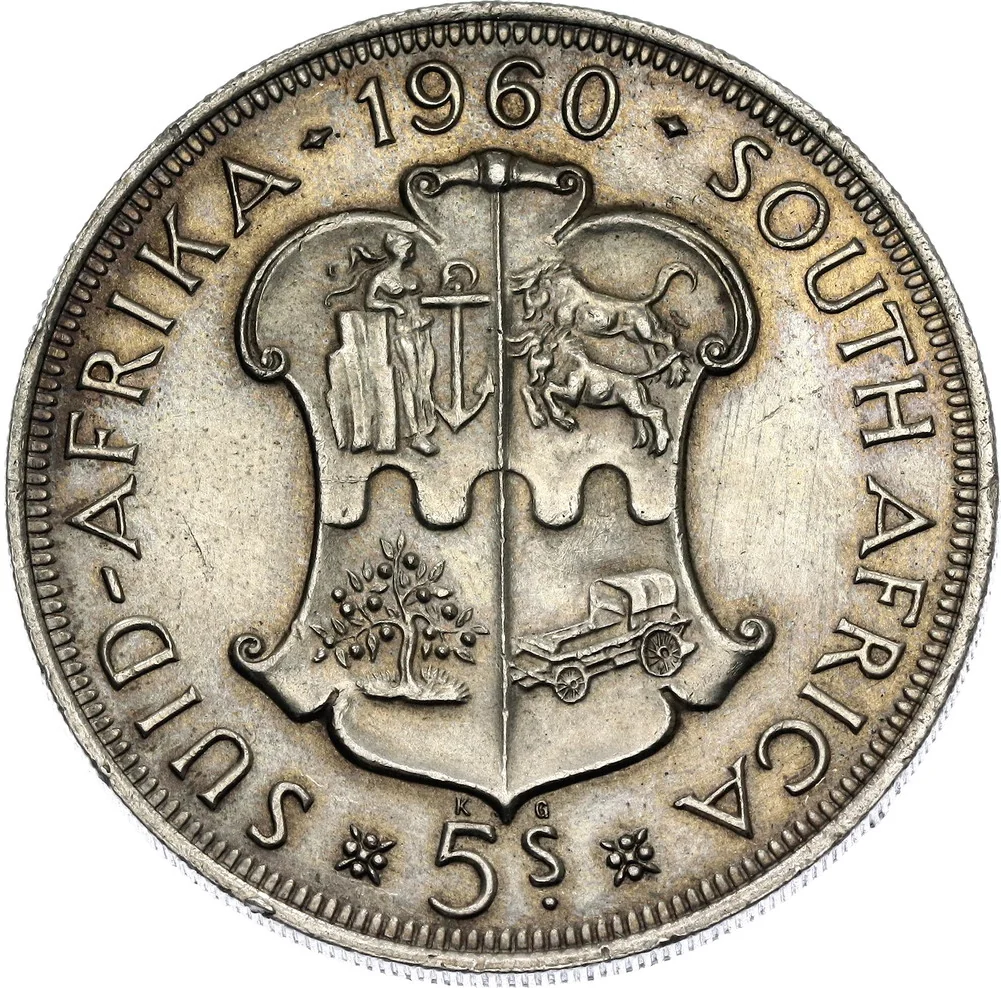
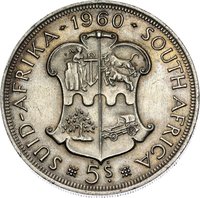
Quartered shield with legend, date above, denomination and engraver's initials below.
Inscription:
SUID-AFRIKA · 1960 · SOUTH AFRICA
K G
5s
K G
5s
Script: Latin
Designer: George Kruger Gray
Edge
Reeded
Categories
| Building> Governmental building |
| Symbols> Coat of Arms |
Mints
| Name | Mark |
|---|---|
| Pretoria | — |
Mintings
| Year | Mint Mark | Mintage | Quality | Collection |
|---|---|---|---|---|
| 1960 | — | 395,897 | ||
| 1960 | — | 22,367 | Prooflike | |
| 1960 | — | 3,360 | Proof |
Historical background
In 1960, South Africa's currency system was firmly anchored to the gold standard, operating under the 1946 Bretton Woods international monetary framework. The South African pound (ZAR) was pegged to the British pound sterling, which itself was pegged to the US dollar, and the US dollar was convertible to gold at $35 per ounce. This structure provided stability and facilitated international trade, which was crucial for an economy heavily dependent on gold and mineral exports. The South African Reserve Bank, established in 1921, managed monetary policy with the primary goal of maintaining this fixed parity and ensuring the free flow of capital.
This monetary stability existed in stark contrast to the profound political and social upheaval of the era. The year 1960 was a watershed, marked by the Sharpeville Massacre in March and the subsequent banning of the ANC and PAC. In response to rising internal unrest and international condemnation, the government instituted stricter capital controls in 1960 to prevent a flight of wealth and to insulate the economy from external political pressure. These measures aimed to secure the country's substantial gold reserves—which were critical for both the domestic currency's backing and for earning vital foreign exchange—from being destabilized by the escalating crisis.
Consequently, while the formal currency arrangement appeared orthodox and solid on the surface, the foundations were being strained by the realities of apartheid. The geopolitical isolation beginning to take shape placed long-term pressure on the currency regime. This tension between a rigid, internationally-aligned financial system and a pariah state pursuing increasingly radical domestic policies would define South Africa's economic challenges in the decades to follow, ultimately leading to the decimalization of the currency and the introduction of the Rand in 1961, shortly after the country became a republic and left the Commonwealth.
This monetary stability existed in stark contrast to the profound political and social upheaval of the era. The year 1960 was a watershed, marked by the Sharpeville Massacre in March and the subsequent banning of the ANC and PAC. In response to rising internal unrest and international condemnation, the government instituted stricter capital controls in 1960 to prevent a flight of wealth and to insulate the economy from external political pressure. These measures aimed to secure the country's substantial gold reserves—which were critical for both the domestic currency's backing and for earning vital foreign exchange—from being destabilized by the escalating crisis.
Consequently, while the formal currency arrangement appeared orthodox and solid on the surface, the foundations were being strained by the realities of apartheid. The geopolitical isolation beginning to take shape placed long-term pressure on the currency regime. This tension between a rigid, internationally-aligned financial system and a pariah state pursuing increasingly radical domestic policies would define South Africa's economic challenges in the decades to follow, ultimately leading to the decimalization of the currency and the introduction of the Rand in 1961, shortly after the country became a republic and left the Commonwealth.
🌱 Common