


Obverse
Description:
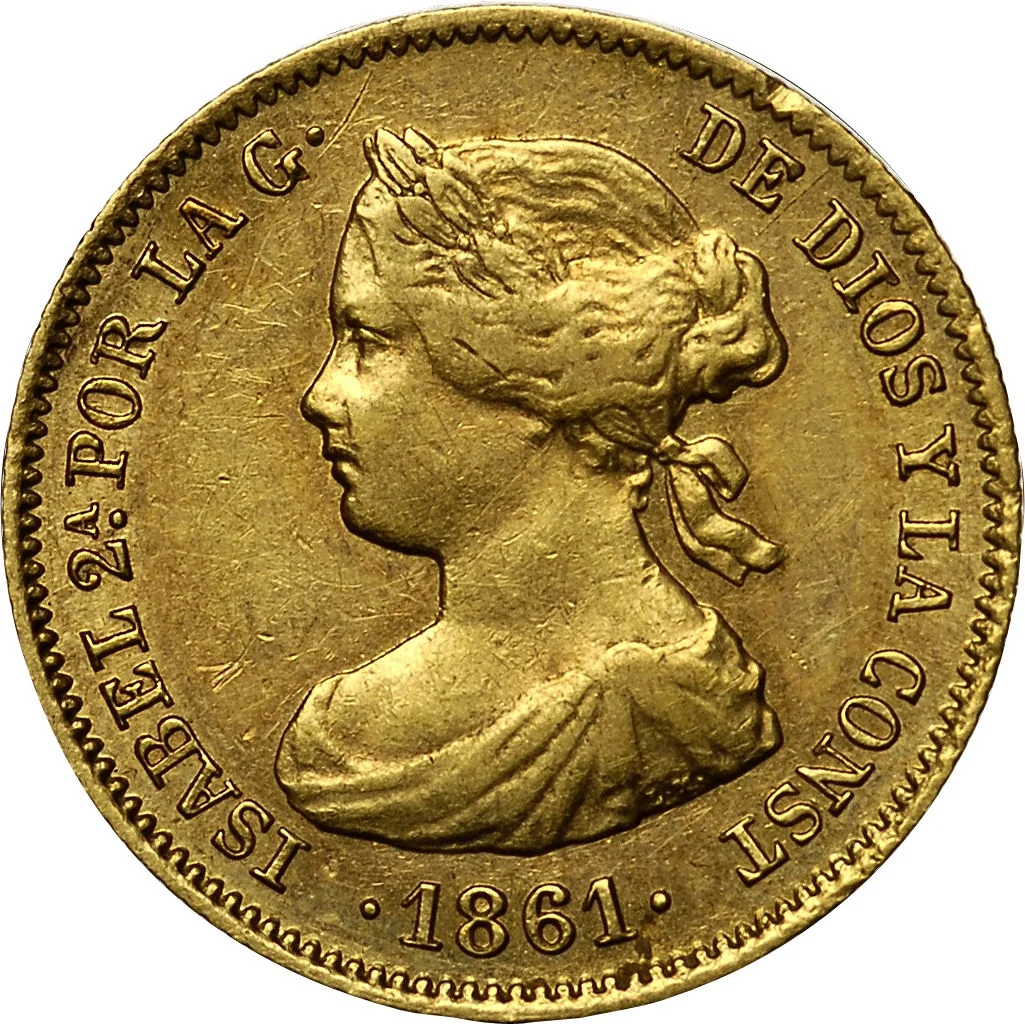
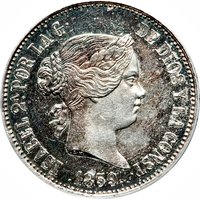
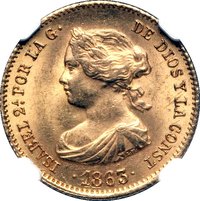
Laureate bust of Isabella II left.
Inscription:
ISABEL 2A. POR LA G· DE DIOS Y LA CONST
·1861·
·1861·
Translation:
Isabel 2nd. By the Grace of God and the Constitution
·1861·
·1861·
Script: Latin
Language: Spanish
Engraver: Luis Marchionni y Hombrón
Reverse
Description:
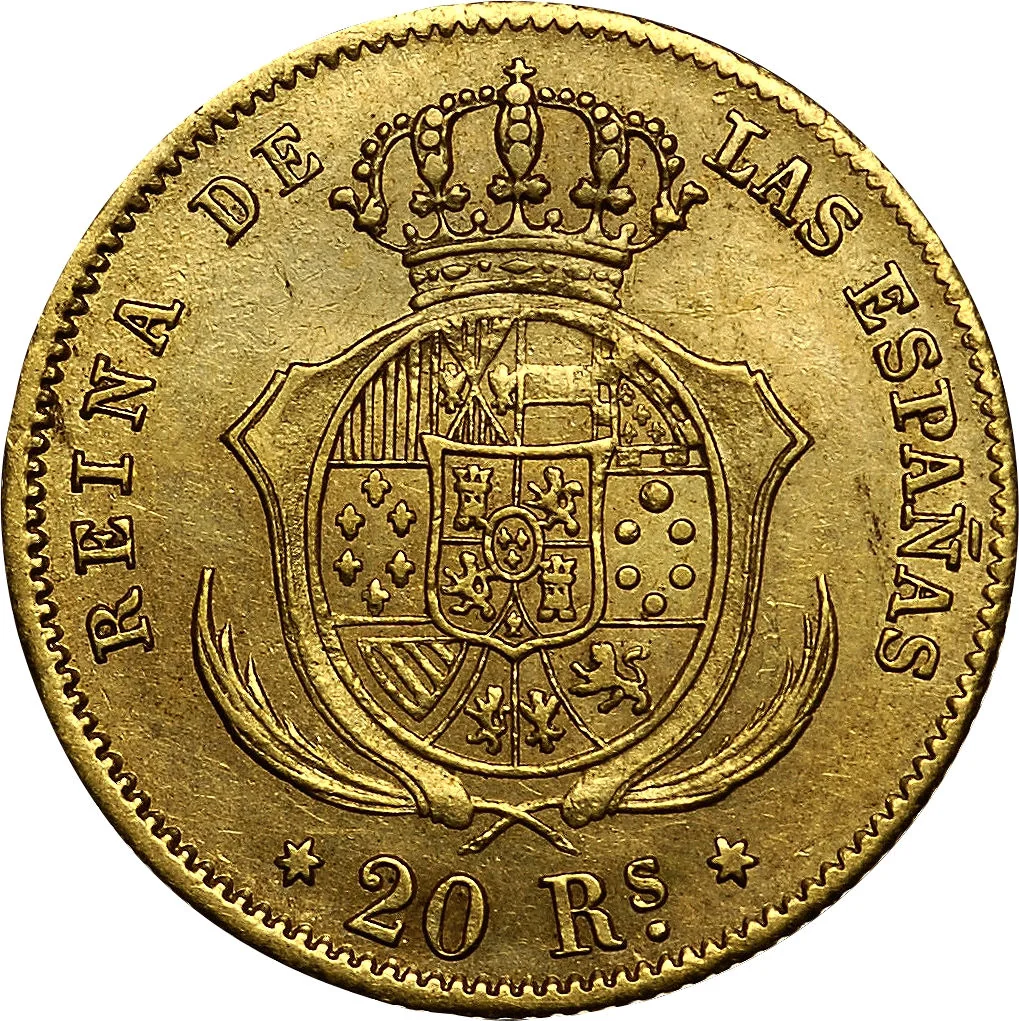
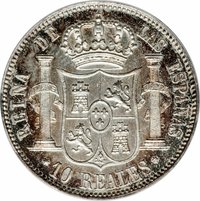
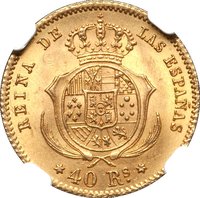
Royal arms of Spain.
Inscription:
REINA DE LAS ESPAÑAS
* 20 RS. *
* 20 RS. *
Translation:
Queen of the Spains
* 20 Reales *
* 20 Reales *
Script: Latin
Language: Spanish
Engraver: Luis Marchionni y Hombrón
Edge
Categories
| Symbols> Coat of Arms |
Mints
| Name | Mark |
|---|---|
| Royal Mint of Madrid | — |
Mintings
| Year | Mint Mark | Mintage | Quality | Collection |
|---|---|---|---|---|
| 1861 | — | — | ||
| 1862 | — | — | ||
| 1863 | — | — |
Historical background
In 1861, Spain's currency system was in a state of transition and instability, rooted in the political and economic turmoil of the preceding decades. The country operated on a bimetallic standard, legally valuing both gold and silver coins, but in practice, the system was dysfunctional. Chronic government budget deficits, largely financed by borrowing from the Bank of Spain and foreign creditors, led to frequent devaluations and a severe loss of public confidence in paper money. The real and its larger unit, the escudo, were the official units of account, but their value was volatile, and a plethora of older, debased coins from different regions still circulated, creating a complex and inefficient monetary environment.
This instability was exacerbated by the global "silver glut" of the mid-19th century, following major silver discoveries in the Americas. As the relative market value of silver fell against gold, it triggered Gresham's Law: cheaper silver coins drove the more valuable gold coins out of circulation and often out of the country. This drained Spain of gold reserves, further weakening the currency and complicating international trade. The government's response was often to authorize the minting of new, lower-quality fractional coins to facilitate everyday commerce, but this only added to the monetary confusion and inflationary pressures.
The situation culminated in a push for reform, setting the stage for the major monetary law of 1864. The goal was to modernize and simplify the system by moving toward a de facto gold standard and introducing a new national currency unit, the peseta, which would eventually be adopted in 1868 following the Glorious Revolution. Therefore, the currency situation in 1861 was one of fragmentation and crisis, directly prompting the legislative efforts that would, within a few years, lead to the creation of the modern Spanish monetary system with the peseta as its cornerstone.
This instability was exacerbated by the global "silver glut" of the mid-19th century, following major silver discoveries in the Americas. As the relative market value of silver fell against gold, it triggered Gresham's Law: cheaper silver coins drove the more valuable gold coins out of circulation and often out of the country. This drained Spain of gold reserves, further weakening the currency and complicating international trade. The government's response was often to authorize the minting of new, lower-quality fractional coins to facilitate everyday commerce, but this only added to the monetary confusion and inflationary pressures.
The situation culminated in a push for reform, setting the stage for the major monetary law of 1864. The goal was to modernize and simplify the system by moving toward a de facto gold standard and introducing a new national currency unit, the peseta, which would eventually be adopted in 1868 following the Glorious Revolution. Therefore, the currency situation in 1861 was one of fragmentation and crisis, directly prompting the legislative efforts that would, within a few years, lead to the creation of the modern Spanish monetary system with the peseta as its cornerstone.
💎 Extremely Rare