

1000 Kuna – Croatia
Non-circulating coins
Commemoration: The Republic of Croatia - Member of EU
Croatia
Context
Year: 2013
Issuer: Croatia 
Issuing organization: National Bank of Croatia
Period:
(since 1991)
Currency:
(1994—2022)
Demonetization: 15 January 2023
Total mintage: 3,000
Material

References
KM: #Click to copy to clipboard103
Numista: #147189
Value
Exchange value: 1000 HRK
Bullion value: $1153.10
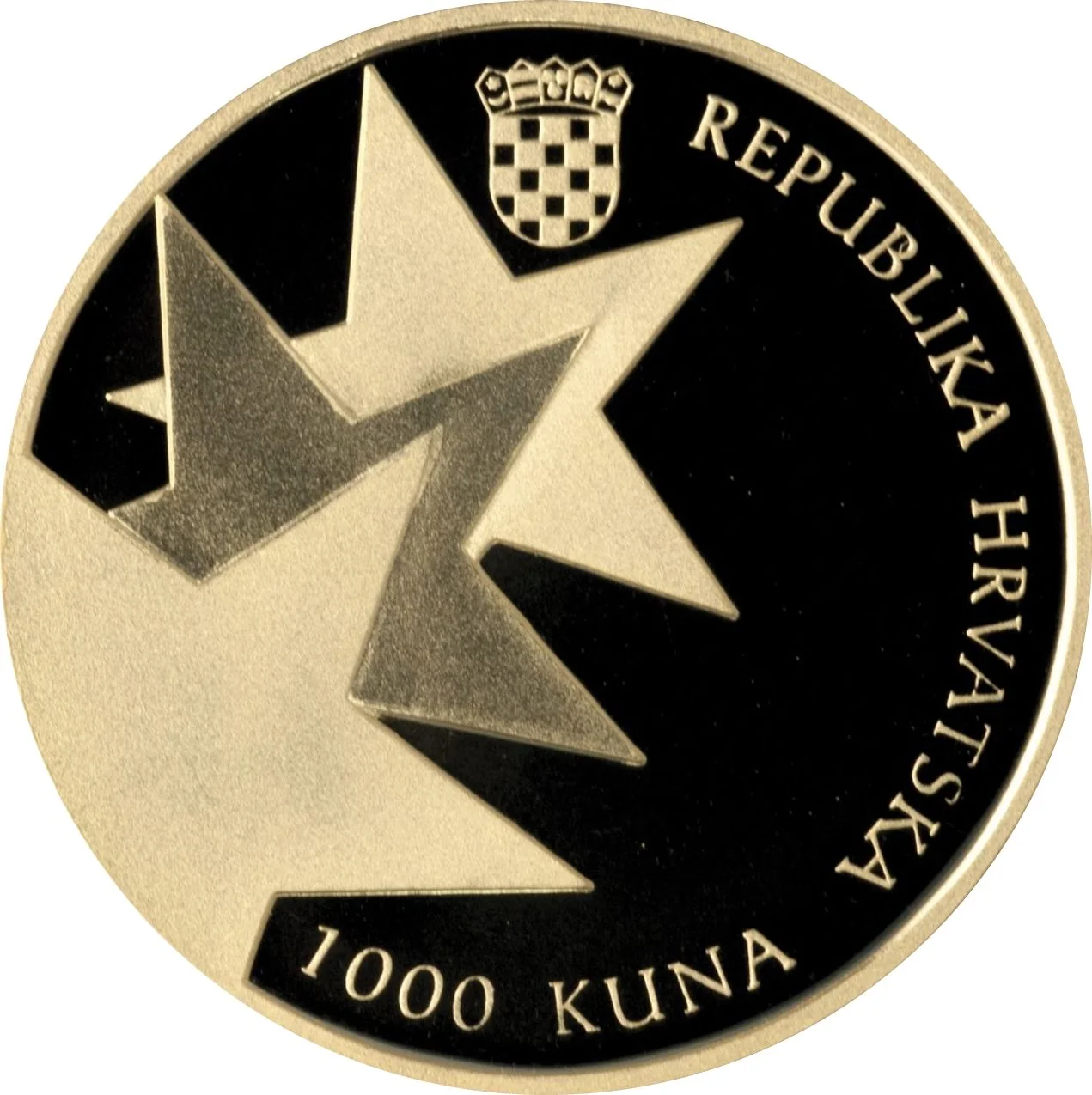
Obverse
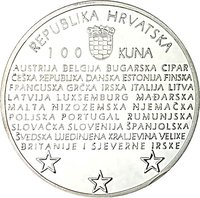
Description:
Three stars, coat of arms, denomination below.
Inscription:
REPUBLIKA HRVATSKA
1000 KUNA
1000 KUNA
Translation:
REPUBLIC OF CROATIA
1000 KUNA
1000 KUNA
Script: Latin
Language: Croatian
Designer: Damir Mataušić
Reverse
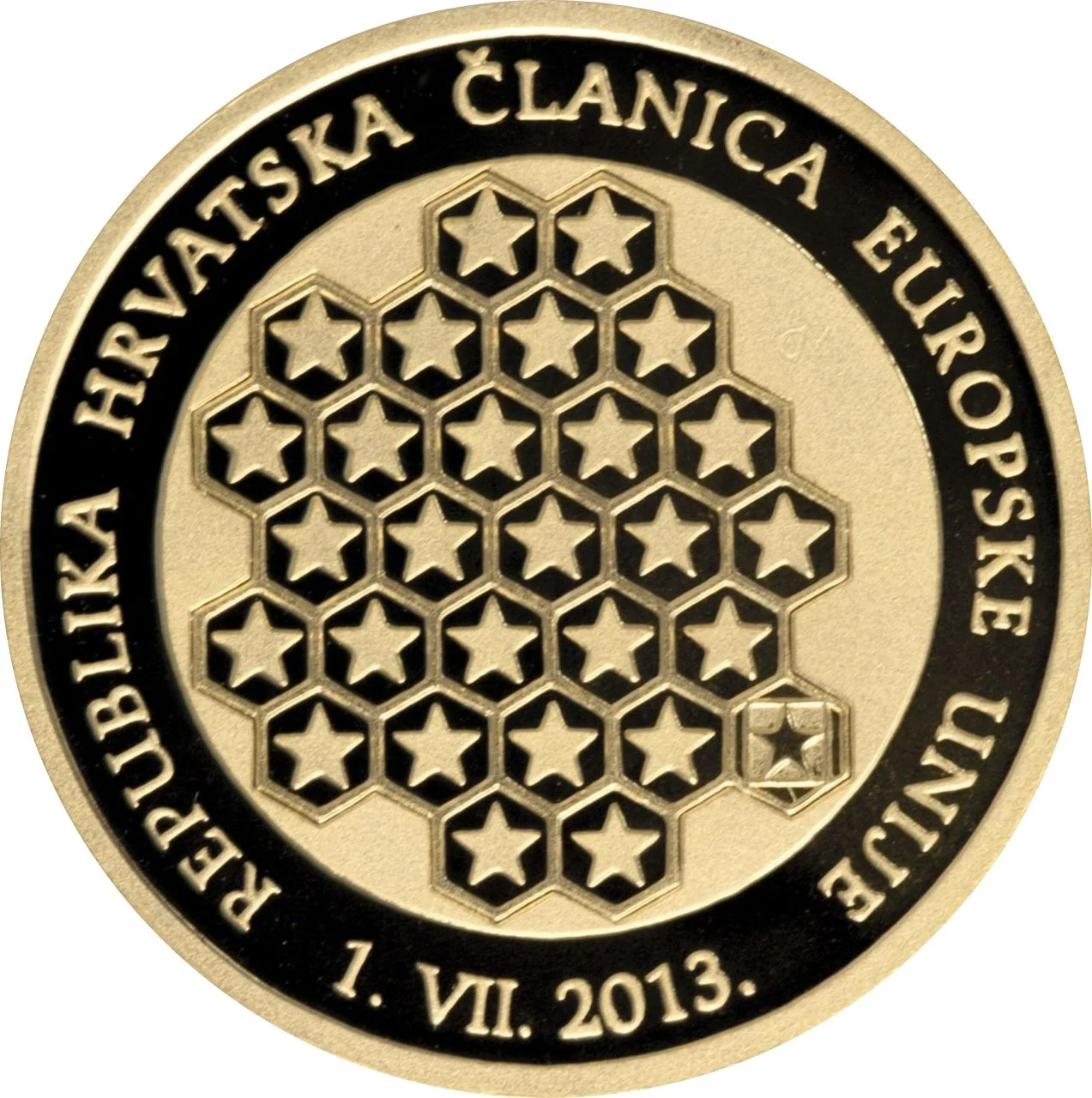
Description:
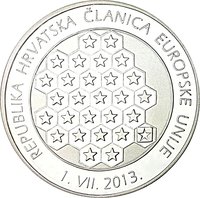
A stylized EU honeycomb of twenty-seven stars gains a twenty-eighth cell. This new cell contains a square topped by a star, symbolizing Croatia's accession. Around the edge is written "REPUBLIKA HRVATSKA CLANICA EUROPSKE UNIJE" with the date "1.VII.2013" below.
Inscription:
REPUBLIKA HRVATSKA ČLANICA EUROPSKE UNIJE 1.VII.2013.
Translation:
REPUBLIC OF CROATIA MEMBER OF THE EUROPEAN UNION 1.VII.2013
Script: Latin
Language: Croatian
Designer: Damir Mataušić
Edge
Mints
| Name | Mark |
|---|---|
| Croatian Mint | — |
Mintings
| Year | Mint Mark | Mintage | Quality | Collection |
|---|---|---|---|---|
| 2013 | — | 3,000 | Proof |
Historical background
In 2013, Croatia stood on the brink of a significant economic transition, operating with the kuna (HRK) as its national currency while preparing for European Union membership on July 1st of that year. The currency situation was stable but overshadowed by the long-term obligation to eventually adopt the euro, a requirement for all new EU members. The kuna, introduced in 1994 after the hyperinflation of the Yugoslav dinar, was firmly pegged to the euro within a managed float, functioning as a de facto satellite currency. This arrangement provided stability but also meant Croatia's monetary policy was largely dictated by the European Central Bank, limiting independent tools to address domestic economic challenges, notably a prolonged recession and high public debt.
The year was marked by careful management to maintain currency stability during the EU accession process. The Croatian National Bank (HNB) prioritized defending the kuna's exchange rate, holding substantial foreign currency reserves to ward off speculative attacks and ensure confidence. There was no serious consideration of devaluation, as a stable kuna was crucial for servicing the high level of euro-denominated foreign debt held by the government, banks, and citizens. However, this "euroization" of liabilities created vulnerability, while the strong kuna was also seen by some exporters as a hindrance to competitiveness, exacerbating a deep six-year recession.
Ultimately, 2013 was a year of laying the groundwork for future euro adoption, though no official target date was set. The focus was on meeting the EU's convergence criteria (the Maastricht criteria), which included exchange rate stability, price stability, and sound public finances. While joining the EU locked in the commitment to eventually replace the kuna, the immediate economic fragility meant that euro adoption was understood to be a medium-term goal, likely a decade away. The primary narrative was one of maintaining the status quo—a stable kuna pegged to the euro—while beginning the arduous process of aligning the economy to meet the strict requirements for entering the Eurozone.
The year was marked by careful management to maintain currency stability during the EU accession process. The Croatian National Bank (HNB) prioritized defending the kuna's exchange rate, holding substantial foreign currency reserves to ward off speculative attacks and ensure confidence. There was no serious consideration of devaluation, as a stable kuna was crucial for servicing the high level of euro-denominated foreign debt held by the government, banks, and citizens. However, this "euroization" of liabilities created vulnerability, while the strong kuna was also seen by some exporters as a hindrance to competitiveness, exacerbating a deep six-year recession.
Ultimately, 2013 was a year of laying the groundwork for future euro adoption, though no official target date was set. The focus was on meeting the EU's convergence criteria (the Maastricht criteria), which included exchange rate stability, price stability, and sound public finances. While joining the EU locked in the commitment to eventually replace the kuna, the immediate economic fragility meant that euro adoption was understood to be a medium-term goal, likely a decade away. The primary narrative was one of maintaining the status quo—a stable kuna pegged to the euro—while beginning the arduous process of aligning the economy to meet the strict requirements for entering the Eurozone.
✨ Legendary