

20 francs – Rwanda
Add to wishlist
Rwanda
Context
Year: 1977
Issuer: Rwanda
Issuing organization: National Bank of Rwanda
Period:
(since 1962)
Currency:
(since 1964)
Demonetized: Yes
Total mintage: 22,000,000
Material
References
KM: #
Numista: #4451
Value
Exchange value: 20 RWF
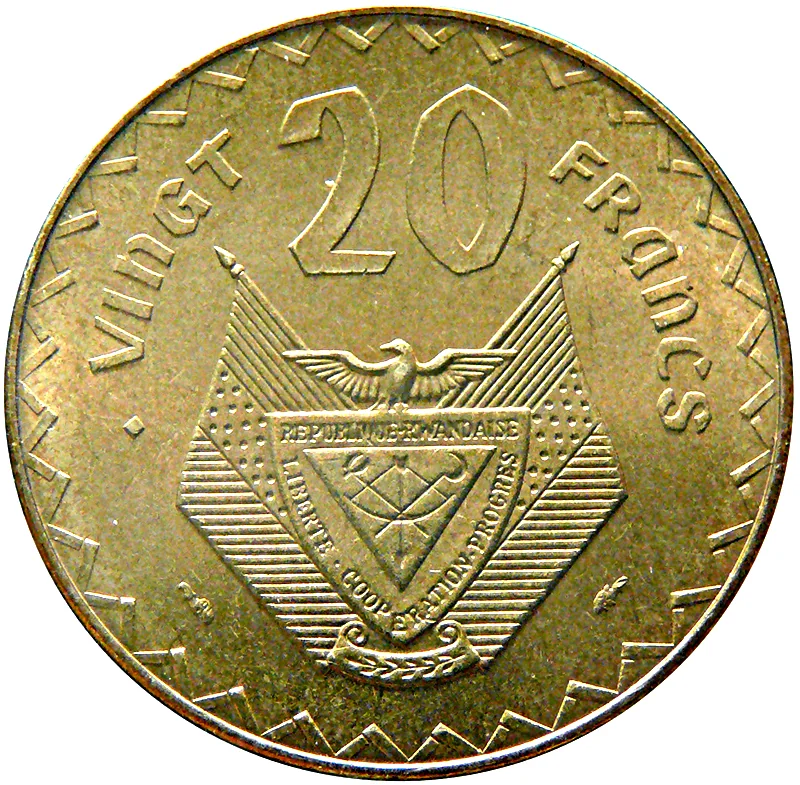
Obverse
Description:
Rwanda's national motto.
Inscription:
20
VINGT FRANCS
RÉPUBLIQUE RWANDAISE
LIBERTÉ · COOPÉRATION · PROGRÈS
VINGT FRANCS
RÉPUBLIQUE RWANDAISE
LIBERTÉ · COOPÉRATION · PROGRÈS
Translation:
Twenty Francs
Rwandan Republic
Liberty · Cooperation · Progress
Rwandan Republic
Liberty · Cooperation · Progress
Script: Latin
Language: French
Engraver: Émile Rousseau
Reverse
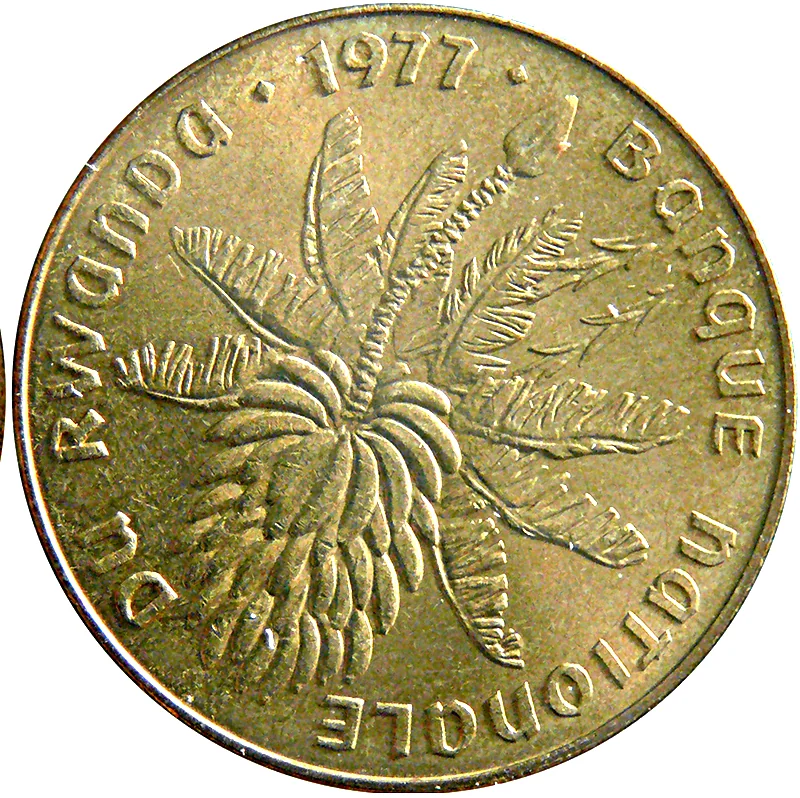
Description:
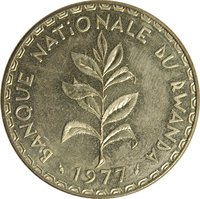
Banana stalk on tree.
Inscription:
BANQUE · NATIONALE · DU · RWANDA
·1977·
·1977·
Translation:
NATIONAL BANK OF RWANDA
·1977·
·1977·
Script: Latin
Language: French
Engraver: Émile Rousseau
Edge
Reeded
Categories
| Symbols> Coat of Arms |
| Plant> Fruit |
Mints
| Name | Mark |
|---|---|
| Monnaie de Paris | — |
Mintings
| Year | Mint Mark | Mintage | Quality | Collection |
|---|---|---|---|---|
| 1977 | — | 22,000,000 |
Historical background
In 1977, Rwanda's currency situation was characterized by the use of the Rwanda Franc (RWF), which had been the nation's sole legal tender since its introduction in 1964, replacing the Franc of the Rwanda-Burundi Monetary Union. The currency was managed by the National Bank of Rwanda (Banque Nationale du Rwanda), established in 1964, which held the responsibility for issuing banknotes and coins and maintaining monetary stability. As a landlocked country with a predominantly agricultural economy, heavily dependent on coffee and tea exports, Rwanda's currency value and monetary policy were closely tied to the volatile fluctuations of global commodity prices and the nation's trade balance.
Economically, the mid-to-late 1970s was a period of significant challenge for Rwanda. Following the global oil crisis of 1973 and a severe drop in world coffee prices after 1976, the country faced mounting trade deficits and inflationary pressures. The government, under President Juvénal Habyarimana, pursued a policy of fiscal restraint and sought external financing, but the currency remained under strain. The Rwanda Franc was not freely convertible on international markets, and its management was geared towards supporting state-led development plans and maintaining essential imports, rather than pursuing a fully liberalized exchange regime.
Within the broader regional context, Rwanda's monetary system operated independently after the dissolution of the joint currency with Burundi. Unlike many former French colonies, Rwanda was not a member of the CFA Franc zone, which provided a fixed exchange rate guarantee from France. This meant Rwanda bore full responsibility for the stability of its own currency without that external anchor, relying on its foreign exchange reserves from exports and aid. Consequently, the currency situation in 1977 reflected a cautious and controlled approach by the central bank, navigating between the need for economic development and the pressures of a weak external position in a difficult global economic climate.
Economically, the mid-to-late 1970s was a period of significant challenge for Rwanda. Following the global oil crisis of 1973 and a severe drop in world coffee prices after 1976, the country faced mounting trade deficits and inflationary pressures. The government, under President Juvénal Habyarimana, pursued a policy of fiscal restraint and sought external financing, but the currency remained under strain. The Rwanda Franc was not freely convertible on international markets, and its management was geared towards supporting state-led development plans and maintaining essential imports, rather than pursuing a fully liberalized exchange regime.
Within the broader regional context, Rwanda's monetary system operated independently after the dissolution of the joint currency with Burundi. Unlike many former French colonies, Rwanda was not a member of the CFA Franc zone, which provided a fixed exchange rate guarantee from France. This meant Rwanda bore full responsibility for the stability of its own currency without that external anchor, relying on its foreign exchange reserves from exports and aid. Consequently, the currency situation in 1977 reflected a cautious and controlled approach by the central bank, navigating between the need for economic development and the pressures of a weak external position in a difficult global economic climate.
🌱 Common