

50 Ngwee – Zambia
Circulating commemorative coins
Commemoration: F.A.O.
Zambia
Context
Material
Diameter: 30 mm
Weight: 11.66 g
Thickness: 1.88 mm
Shape: Dodecagonal
Technique: Milled
Alignment: Medal alignment
flip
References
KM: #Click to copy to clipboard14
Numista: #4439
Value
Exchange value: 0.50 ZMK
Obverse
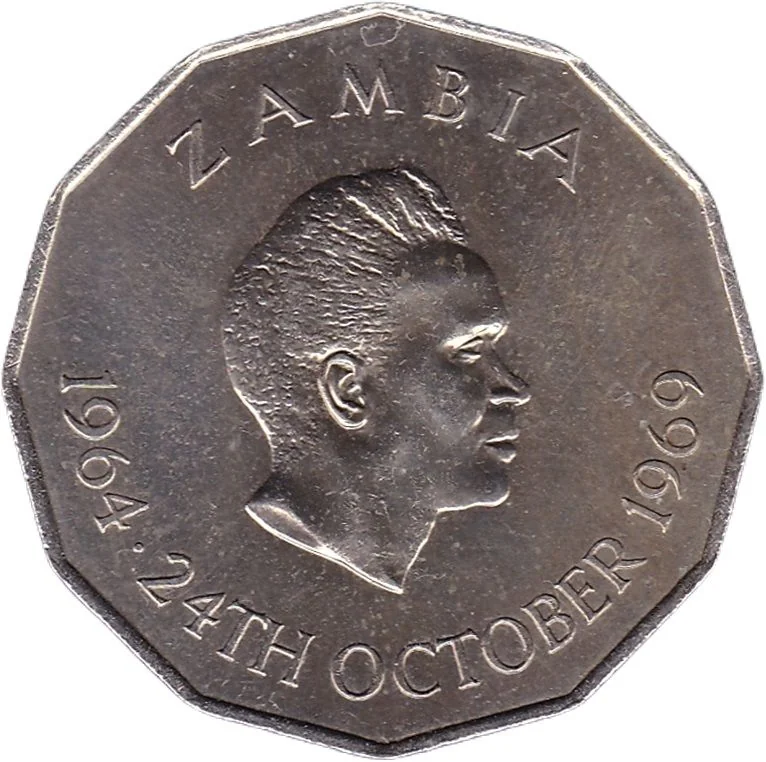
Description:
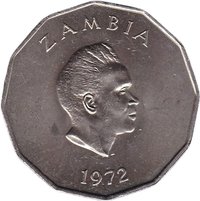
President Kaunda, facing right.
Inscription:
ZAMBIA
1964 · 24TH OCTOBER 1969
1964 · 24TH OCTOBER 1969
Script: Latin
Reverse
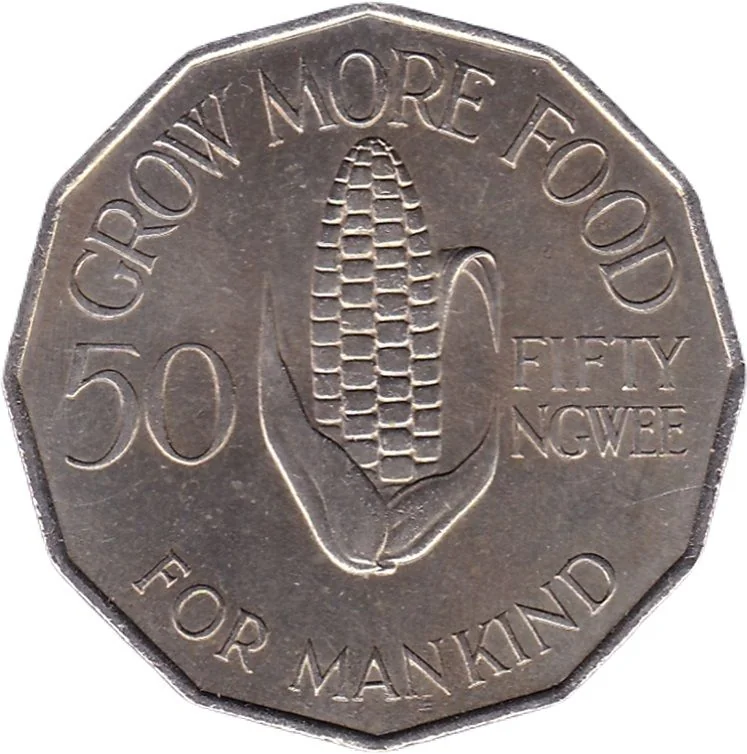
Description:
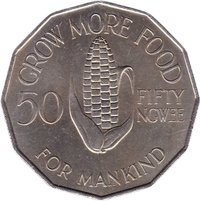
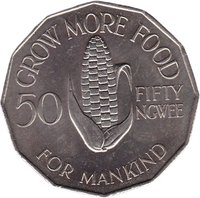
Corn cob centered, text beneath.
Inscription:
GROW MORE FOOD
50 FIFTY NGWEE
FOR MANKIND
50 FIFTY NGWEE
FOR MANKIND
Script: Latin
Edge
Plain
Categories
| Person> Politician |
| Organization> FAO |
Mints
| Name | Mark |
|---|---|
| Royal Mint (Tower Hill) | — |
Mintings
| Year | Mint Mark | Mintage | Quality | Collection |
|---|---|---|---|---|
| 1969 | — | 70,000 |
Historical background
In 1969, Zambia's currency situation was fundamentally shaped by the political and economic philosophy of President Kenneth Kaunda and his ruling United National Independence Party (UNIP). Following independence in 1964, the country retained the Zambian pound, pegged to and managed alongside the British pound sterling. However, a major shift occurred in 1968 with the Mulungushi Reforms, which declared a move toward "Zambian Humanism" and greater state control of the economy. This ideological drive set the stage for the pivotal monetary changes of 1969, as the government sought to assert full economic sovereignty and reduce foreign influence over its financial system.
The key event was the introduction of the first Zambian kwacha on January 16, 1968, which replaced the Zambian pound at a rate of 2 kwacha = 1 pound. While the change itself happened in 1968, the consequential situation throughout 1969 was defined by the government's subsequent actions to cement its control. Most significantly, the Bank of Zambia Act was passed in 1969, nationalizing the central bank and transferring its ownership from private and foreign shareholders (including the Bank of England and Barclays) wholly to the Zambian state. This move severed the last formal institutional links to the sterling area and gave the government direct authority over monetary policy.
The context of 1969 was therefore one of a newly sovereign, but increasingly controlled, currency. The kwacha was initially strong, buoyed by high global copper prices which provided substantial foreign reserves. However, the state-centric policies of the era, including the 1969 takeover of majority stakes in key foreign-owned mines, began to create long-term vulnerabilities. While not yet in crisis, the currency situation in 1969 represented a conscious break from the colonial monetary order, establishing a national currency apparatus that would later face severe challenges from over-dependence on copper, economic mismanagement, and external shocks in the following decades.
The key event was the introduction of the first Zambian kwacha on January 16, 1968, which replaced the Zambian pound at a rate of 2 kwacha = 1 pound. While the change itself happened in 1968, the consequential situation throughout 1969 was defined by the government's subsequent actions to cement its control. Most significantly, the Bank of Zambia Act was passed in 1969, nationalizing the central bank and transferring its ownership from private and foreign shareholders (including the Bank of England and Barclays) wholly to the Zambian state. This move severed the last formal institutional links to the sterling area and gave the government direct authority over monetary policy.
The context of 1969 was therefore one of a newly sovereign, but increasingly controlled, currency. The kwacha was initially strong, buoyed by high global copper prices which provided substantial foreign reserves. However, the state-centric policies of the era, including the 1969 takeover of majority stakes in key foreign-owned mines, began to create long-term vulnerabilities. While not yet in crisis, the currency situation in 1969 represented a conscious break from the colonial monetary order, establishing a national currency apparatus that would later face severe challenges from over-dependence on copper, economic mismanagement, and external shocks in the following decades.
🌱 Common