

500 Schilling (Austrian Railroad) – Austria
Non-circulating coins
Commemoration: 150th Anniversary - Austrian Railroad
Austria

Obverse
Description:
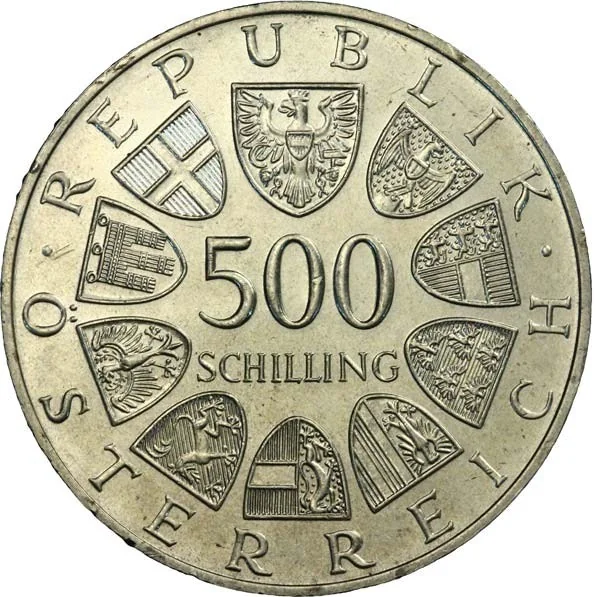
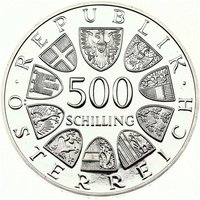
Austrian coat of arms within a ring of shields representing its nine federal states.
Inscription:
· REPUBLIK ·
500
SCHILLING
ÖSTERREICH
500
SCHILLING
ÖSTERREICH
Translation:
REPUBLIC
500
SCHILLING
AUSTRIA
500
SCHILLING
AUSTRIA
Script: Latin
Language: German
Engraver: Edwin Grienauer
Reverse
Description:
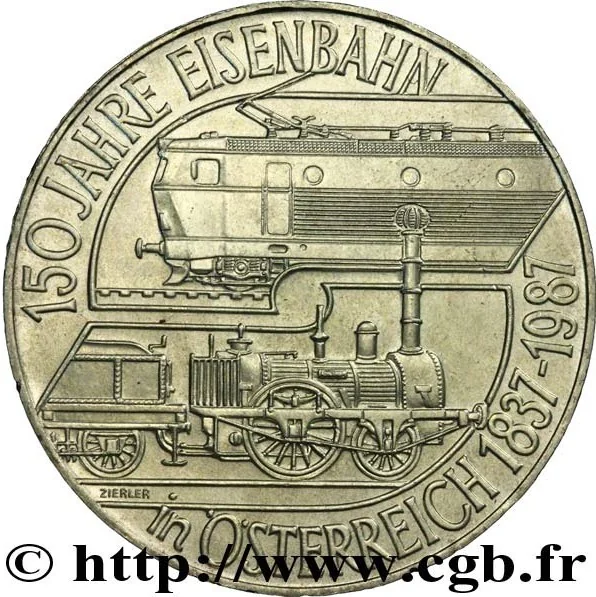
Trains, dates lower right.
Inscription:
150 JAHRE EISENBAHN
ZIERLER
in ÖSTERREICH 1837-1987
ZIERLER
in ÖSTERREICH 1837-1987
Translation:
150 YEARS RAILWAY
ZIERLER
in AUSTRIA 1837-1987
ZIERLER
in AUSTRIA 1837-1987
Script: Latin
Language: German
Engraver: Alfred Zierler
Edge
Categories
| Transportation> Train |
Mints
| Name | Mark |
|---|---|
| Münze Österreich | — |
Mintings
| Year | Mint Mark | Mintage | Quality | Collection |
|---|---|---|---|---|
| 1987 | — | 152,000 | ||
| 1987 | — | 94,800 | Proof |
Historical background
In 1987, Austria's currency situation was defined by its participation in the European Monetary System (EMS), specifically through its membership in the Exchange Rate Mechanism (ERM). The Austrian schilling was not officially part of the ERM but was unilaterally and very successfully pegged to the Deutsche Mark (DM), a policy known as the "hard currency policy" (Hartwährungspolitik). This deliberate anchoring, established in the 1970s, was a cornerstone of Austrian economic policy, designed to import the anti-inflationary credibility of the Bundesbank and ensure monetary stability.
The year fell within a period of remarkable success for this strategy. The schilling's unwavering peg to the DM provided a stable framework for trade and investment, particularly with its largest trading partner, West Germany. This stability was a key factor in Austria's low inflation rate, which was consistently among the lowest in Europe. The policy enjoyed broad political and social consensus, viewed as essential for economic prosperity and a symbol of national reliability, even as it meant Austria effectively ceded control over its domestic monetary policy to the decisions made by the German central bank.
However, this stability existed within a broader context of European currency turbulence. The EMS itself was under strain from divergent economic policies among member states, leading to periodic realignments of central rates. While Austria's unilateral peg shielded it from direct involvement in these crises, it also meant the country had no formal say in EMS decisions. The situation in 1987 thus reflected a quiet, national success story built on a dependent relationship with the DM, operating in parallel to the more volatile formal mechanisms of European exchange rate cooperation. This arrangement would persist until Austria's full integration into the European Union and the eventual adoption of the euro.
The year fell within a period of remarkable success for this strategy. The schilling's unwavering peg to the DM provided a stable framework for trade and investment, particularly with its largest trading partner, West Germany. This stability was a key factor in Austria's low inflation rate, which was consistently among the lowest in Europe. The policy enjoyed broad political and social consensus, viewed as essential for economic prosperity and a symbol of national reliability, even as it meant Austria effectively ceded control over its domestic monetary policy to the decisions made by the German central bank.
However, this stability existed within a broader context of European currency turbulence. The EMS itself was under strain from divergent economic policies among member states, leading to periodic realignments of central rates. While Austria's unilateral peg shielded it from direct involvement in these crises, it also meant the country had no formal say in EMS decisions. The situation in 1987 thus reflected a quiet, national success story built on a dependent relationship with the DM, operating in parallel to the more volatile formal mechanisms of European exchange rate cooperation. This arrangement would persist until Austria's full integration into the European Union and the eventual adoption of the euro.
⭐ Rare