

5 Euro – Latvia
Non-circulating coins
Commemoration: Curonian kings
Latvia
Context

Material
References
KM: #Click to copy to clipboard198
Numista: #146886
Value
Exchange value: 5 EUR = $5.91
Bullion value: $58.24
Inflation-adjusted value: 7.10 EUR
Obverse
Description:
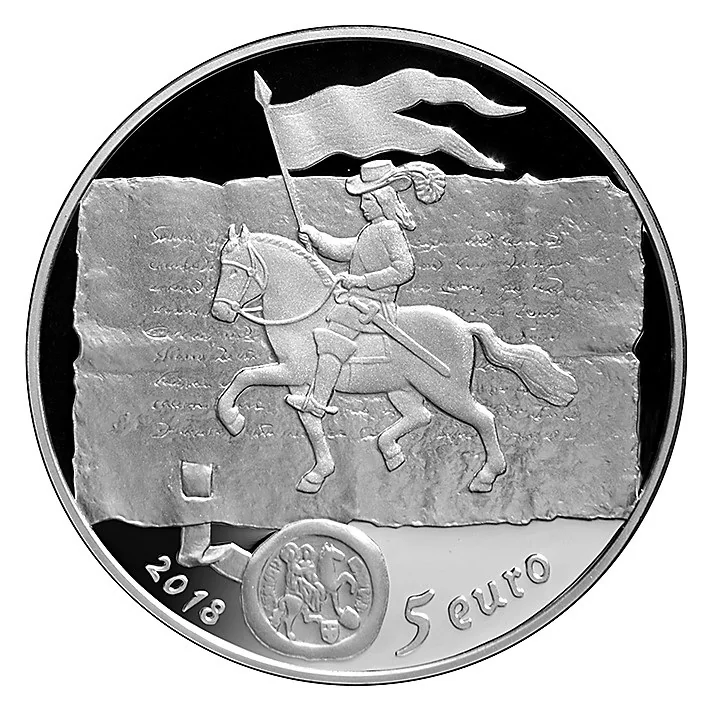
A central rider on horseback, with a feathered hat, sword, and banner. Below, the document's seal is flanked by "2018" and "5 EURO".
Inscription:
2018
5 EURO
5 EURO
Script: Latin
Engraver: Ligita Franckeviča
Designer: Arvīds Priedīte
Reverse
Description:
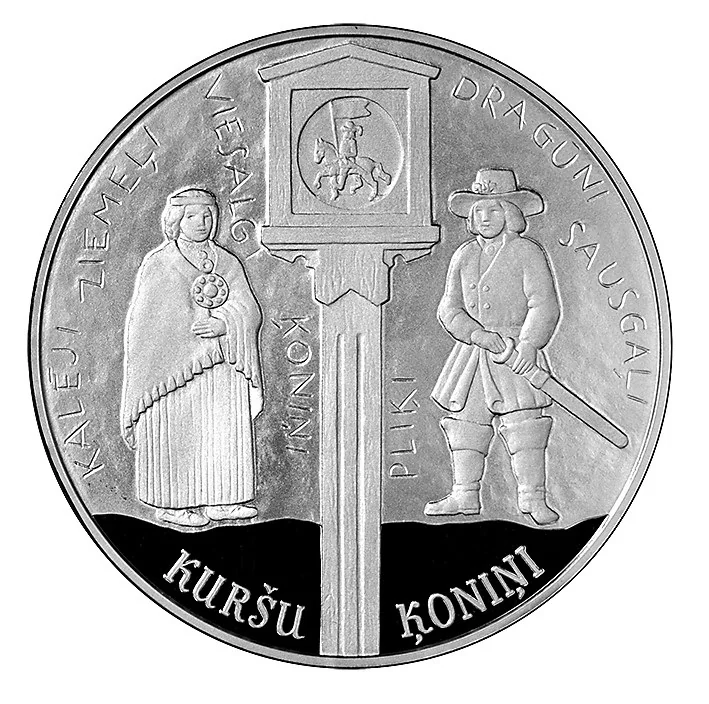
The coin features the Peniķi column with Ķoniņciems' coat of arms, flanked by a woman in folk costume and a man with a sword. The background lists Courland's seven free villages: KALĒJI, ZIEMEĻI, VIESALGI, ĶONIŅI, PLIĶI, DRAGŪNI, and SAUSGAĻI. Below is the inscription KURŠU ĶONIŅI.
Inscription:
KALĒJI ZIEMEĻI VIESALGI ŅONIŅI PLIĶI DRAGŪNI SAUSGAĻI
KURŠU ĶONIŅI
KURŠU ĶONIŅI
Translation:
Beautiful northern guests, little fathers, plump warriors, dried fish;
Kurs' king
Kurs' king
Script: Latin
Language: Latvian
Engraver: Ligita Franckeviča
Designer: Arvīds Priedīte
Edge
The edge bears the inscriptions LATVIJAS BANKA and LATVIJAS REPUBLIKA, separated by rhombic dots.
Legend:
LATVIJAS BANKA ◊ LATVIJAS REPUBLIKA ◊
Translation:
LATVIJAS BANKA ◊ LATVIJAS REPUBLIKA ◊
Language: Latvian
Mints
| Name | Mark |
|---|---|
| Lithuanian Mint | — |
Mintings
| Year | Mint Mark | Mintage | Quality | Collection |
|---|---|---|---|---|
| 2018 | — | 2,500 | Proof |
Historical background
In 2018, Latvia was in its fourth year as a member of the Eurozone, having adopted the euro on January 1, 2014. This transition from the national currency, the lats, was largely viewed as a success, solidifying the country's economic and political integration with core European institutions. By 2018, the euro was well-established in daily use, providing macroeconomic stability, eliminating exchange rate risk with major trading partners, and facilitating trade and investment flows within the single market. Public opinion, which had been divided at the time of adoption, had generally shifted to acceptance of the euro as the normal state of affairs.
The broader currency situation in 2018 was characterized by Latvia's participation in the European Central Bank's (ECB) monetary policy framework. This meant that key interest rates and quantitative easing measures were set by the ECB in Frankfurt, aimed at the Eurozone as a whole rather than Latvia's specific economic conditions. While this provided stability, it also meant Latvia had relinquished independent monetary tools. During this period, the ECB maintained historically low interest rates and continued its asset purchase program, which contributed to low borrowing costs and supported economic growth in Latvia, but also raised concerns about potential overheating in the real estate market.
Domestically, the currency situation was stable but not without underlying discussions. Some economic analysts and political voices occasionally questioned whether the one-size-fits-all ECB policy was optimal for Latvia's rapidly growing economy, which was outpacing the Eurozone average. However, these were academic debates rather than calls for change; there was no serious political movement to revert to a national currency. The primary financial focus in 2018 was on combating money laundering and strengthening the banking sector's reputation following the 2018 collapse of ABLV Bank, issues related to financial governance rather than the currency itself. Thus, the euro's role as Latvia's currency was a settled and functioning reality.
The broader currency situation in 2018 was characterized by Latvia's participation in the European Central Bank's (ECB) monetary policy framework. This meant that key interest rates and quantitative easing measures were set by the ECB in Frankfurt, aimed at the Eurozone as a whole rather than Latvia's specific economic conditions. While this provided stability, it also meant Latvia had relinquished independent monetary tools. During this period, the ECB maintained historically low interest rates and continued its asset purchase program, which contributed to low borrowing costs and supported economic growth in Latvia, but also raised concerns about potential overheating in the real estate market.
Domestically, the currency situation was stable but not without underlying discussions. Some economic analysts and political voices occasionally questioned whether the one-size-fits-all ECB policy was optimal for Latvia's rapidly growing economy, which was outpacing the Eurozone average. However, these were academic debates rather than calls for change; there was no serious political movement to revert to a national currency. The primary financial focus in 2018 was on combating money laundering and strengthening the banking sector's reputation following the 2018 collapse of ABLV Bank, issues related to financial governance rather than the currency itself. Thus, the euro's role as Latvia's currency was a settled and functioning reality.


💎 Extremely Rare