


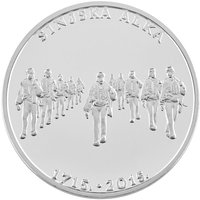
20 Kuna (Alka Tournament in Sinj) – Croatia
Non-circulating coins
Commemoration: 300th Anniversary of Alka Tournament in Sinj
Croatia
Context
Material
References
KM: #Click to copy to clipboard105
Numista: #146850
Value
Exchange value: 20 HRK
Bullion value: $206.89
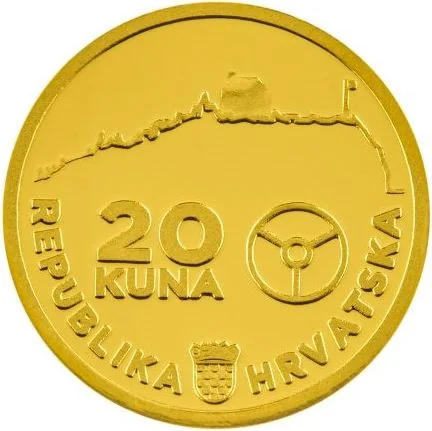
Obverse
Description:
Sinj in background, denomination center, Alka ring beside, coat of arms below.
Inscription:
20
KUNA
REPUBLIKA HRVATSKA
KUNA
REPUBLIKA HRVATSKA
Translation:
Twenty Kuna
Republic of Croatia
Republic of Croatia
Script: Latin
Language: Croatian
Designer: Luka Petrinjak
Reverse
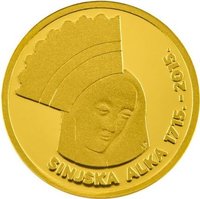
Description:
Our Lady of Sinj portrait.
Inscription:
SINJSKA ALKA 1715.-2015.
Translation:
SINJSKA ALKA 1715-2015
Script: Latin
Language: Croatian
Designer: Luka Petrinjak
Edge
Plain
Mintings
| Year | Mint Mark | Mintage | Quality | Collection |
|---|---|---|---|---|
| 2014 | — | 30,000 | Proof |
Historical background
In 2014, Croatia was in a unique and transitional currency situation, operating with the kuna (HRK) as its official national currency while being a newly acceded member of the European Union. Having joined the EU on July 1, 2013, the country was legally obligated to eventually adopt the euro, but no fixed timetable was set. The kuna, introduced in 1994 after the period of hyperinflation following independence, had proven to be a remarkably stable currency, tightly managed by the Croatian National Bank (HNB) against the euro. This stability was a point of national pride and a key factor in maintaining economic confidence.
The year was marked by ongoing public and political debate about the costs and benefits of euro adoption. Proponents argued that adopting the euro would reduce transaction costs, eliminate exchange rate risk for the heavily euroized economy (where a majority of savings and loans were already denominated in euros), and provide a stronger anchor for monetary policy. Opponents, however, expressed concerns about the loss of independent monetary policy and the symbolic surrender of a key element of national sovereignty so soon after the Homeland War. Furthermore, Croatia was still grappling with the aftermath of a six-year recession, with high public debt and unemployment, making the strict Maastricht convergence criteria for euro entry seem a distant challenge.
Consequently, the practical currency environment in 2014 was one of de facto "euroization." Many major purchases, such as real estate and automobiles, were often priced in euros, and the kuna's exchange rate was effectively pegged to the euro within a very narrow band. The HNB's primary focus was on maintaining this stability, managing foreign currency reserves, and preparing the financial infrastructure for a future euro changeover, even as the official target date remained uncertain and contingent on meeting EU fiscal benchmarks.
The year was marked by ongoing public and political debate about the costs and benefits of euro adoption. Proponents argued that adopting the euro would reduce transaction costs, eliminate exchange rate risk for the heavily euroized economy (where a majority of savings and loans were already denominated in euros), and provide a stronger anchor for monetary policy. Opponents, however, expressed concerns about the loss of independent monetary policy and the symbolic surrender of a key element of national sovereignty so soon after the Homeland War. Furthermore, Croatia was still grappling with the aftermath of a six-year recession, with high public debt and unemployment, making the strict Maastricht convergence criteria for euro entry seem a distant challenge.
Consequently, the practical currency environment in 2014 was one of de facto "euroization." Many major purchases, such as real estate and automobiles, were often priced in euros, and the kuna's exchange rate was effectively pegged to the euro within a very narrow band. The HNB's primary focus was on maintaining this stability, managing foreign currency reserves, and preparing the financial infrastructure for a future euro changeover, even as the official target date remained uncertain and contingent on meeting EU fiscal benchmarks.
✨ Legendary