

5 cents – United States
Add to wishlist
United States
Context
Years: 1867–1883
Issuer: United States
Period:
(since 1776)
Currency:
(since 1785)
Total mintage: 105,259,059
Material
References
KM: #
Numista: #4411
Value
Exchange value: 0.05 USD = $0.05
Obverse
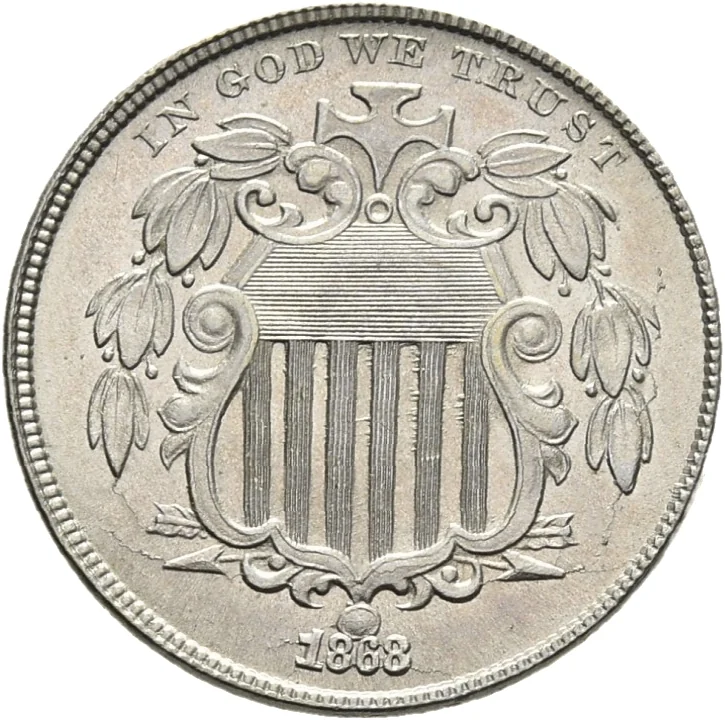
Description:
Garland over shield
Inscription:
IN GOD WE TRUST
1872
1872
Script: Latin
Engraver: James Barton Longacre
Reverse
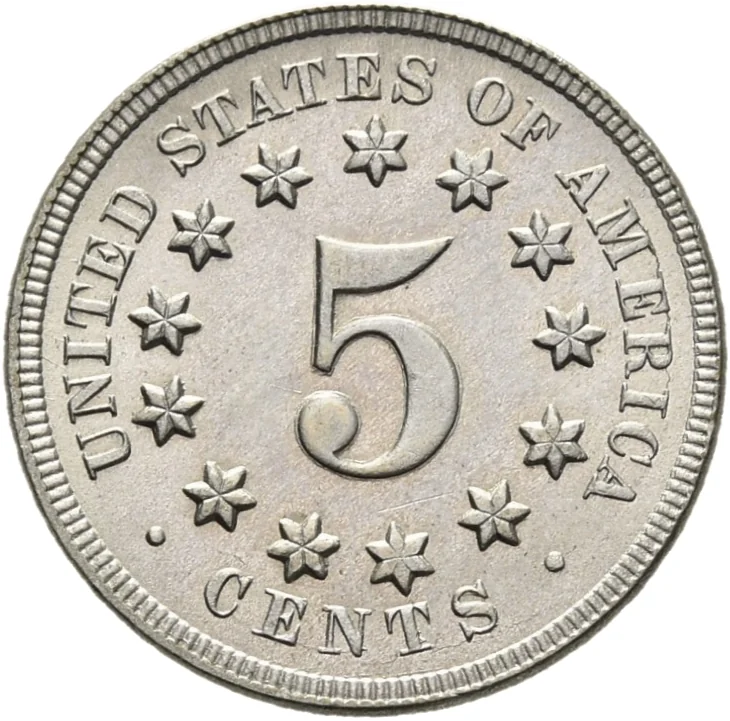
Description:
Centered among 13 stars.
Inscription:
UNITED STATES OF AMERICA
5
·CENTS·
5
·CENTS·
Script: Latin
Engraver: James Barton Longacre
Edge
Plain
Categories
| Object> Cold weapons |
Mints
| Name | Mark |
|---|---|
| United States Mint of Philadelphia | — |
Mintings
| Year | Mint Mark | Mintage | Quality | Collection |
|---|---|---|---|---|
| 1867 | — | 28,890,500 | ||
| 1867 | — | 600 | Proof | |
| 1868 | — | 28,817,000 | ||
| 1868 | — | 600 | Proof | |
| 1869 | — | 16,395,000 | ||
| 1869 | — | 600 | Proof | |
| 1870 | — | 4,806,000 | ||
| 1870 | — | 1,000 | Proof | |
| 1871 | — | 561,000 | ||
| 1871 | — | 960 | Proof | |
| 1872 | — | 6,036,000 | ||
| 1872 | — | 950 | Proof | |
| 1873 | — | — | ||
| 1873 | — | 1,100 | Proof | |
| 1874 | — | 3,538,000 | ||
| 1874 | — | 700 | Proof | |
| 1875 | — | 2,097,000 | ||
| 1875 | — | 700 | Proof | |
| 1876 | — | 1,150 | Proof | |
| 1876 | — | 2,530,000 | ||
| 1877 | — | 900 | Proof | |
| 1878 | — | 2,350 | Proof | |
| 1879 | — | — | ||
| 1879 | — | 3,200 | Proof | |
| 1880 | — | 16,000 | ||
| 1880 | — | 3,955 | Proof | |
| 1881 | — | 68,800 | ||
| 1881 | — | 3,575 | Proof | |
| 1882 | — | 11,472,900 | ||
| 1882 | — | 3,100 | Proof | |
| 1883 | — | — | ||
| 1883 | — | 5,419 | Proof |
Historical background
In 1867, the United States was navigating a complex and contentious currency landscape defined by the aftermath of the Civil War. The nation operated on a dual system of "greenbacks"—fiat paper money issued by the federal government since 1862 to finance the war—and specie (gold and silver coin). This created a fluctuating exchange rate, as greenbacks traded at a discount to gold, leading to price instability and speculative markets. The core debate, which would dominate politics for decades, was between "hard money" advocates (creditors, bankers, and many in the Northeast) who demanded a swift return to the gold standard to ensure stable, deflationary currency, and "soft money" proponents (debtors, farmers, and many in the South and West) who favored retaining or even expanding the greenback supply to ease repayment of debts and foster economic expansion.
Legislatively, the period was one of contraction and preparation for resumption. The Contraction Act of 1866, passed over significant opposition, authorized the Treasury to retire a portion of the greenbacks in circulation, a policy that exacerbated economic hardship in some regions and was soon halted. The dominant financial policy, however, was guided by the Public Credit Act of 1869, which was being formulated in spirit if not yet in law. It promised to repay all federal war bonds in gold, not greenbacks, signaling a clear commitment to eventually restoring the pre-war gold standard and protecting the interests of bondholders.
Thus, the currency situation in 1867 was a tense and transitional phase. The economy functioned with an imperfect and unpopular paper system while political and financial elites charted a course back to metallic money. This setting sowed the seeds for the intense social and political conflicts of the following decades, including the rise of the Greenback Party and the eventual, but painful, achievement of specie resumption in 1879.
Legislatively, the period was one of contraction and preparation for resumption. The Contraction Act of 1866, passed over significant opposition, authorized the Treasury to retire a portion of the greenbacks in circulation, a policy that exacerbated economic hardship in some regions and was soon halted. The dominant financial policy, however, was guided by the Public Credit Act of 1869, which was being formulated in spirit if not yet in law. It promised to repay all federal war bonds in gold, not greenbacks, signaling a clear commitment to eventually restoring the pre-war gold standard and protecting the interests of bondholders.
Thus, the currency situation in 1867 was a tense and transitional phase. The economy functioned with an imperfect and unpopular paper system while political and financial elites charted a course back to metallic money. This setting sowed the seeds for the intense social and political conflicts of the following decades, including the rise of the Greenback Party and the eventual, but painful, achievement of specie resumption in 1879.
🌱 Very Common