

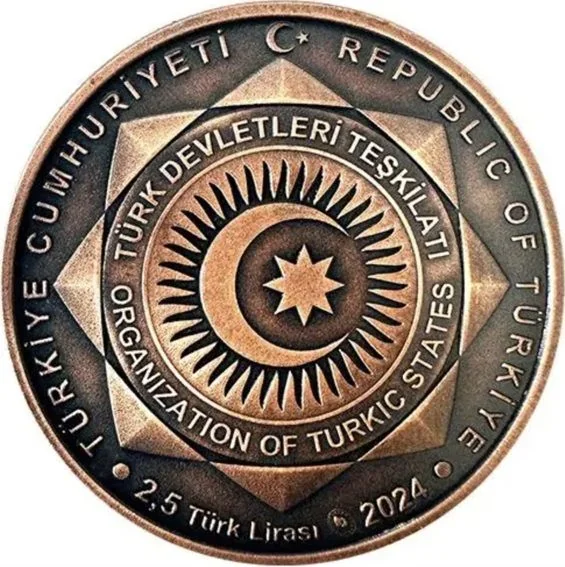



Obverse
Description:
Emblem of the Turkic States.
Inscription:
TÜRKİYE CUMHURİYETİ REPUBLIC OF TÜRKİYE
TÜRK DEVLETLERİ TEŞKİLATI
ORGANIZATION OF TURKIC STATES
· 2,5 Türk Lirası 2024 ·
TÜRK DEVLETLERİ TEŞKİLATI
ORGANIZATION OF TURKIC STATES
· 2,5 Türk Lirası 2024 ·
Translation:
REPUBLIC OF TÜRKİYE
ORGANIZATION OF TURKIC STATES
· 2.5 Turkish Liras 2024 ·
ORGANIZATION OF TURKIC STATES
· 2.5 Turkish Liras 2024 ·
Script: Latin
Reverse
Description:
Flags of Turkic States members.
Inscription:
· DİLDE, FİKİRDE, İŞTE BİRLİK ·
TÜRKİYE KAZAKİSTAN ÖZBEKİSTAN TÜRKMENİSTAN KKTC MACARİSTAN KIRGIZİSTAN AZERBAYCAN
3 Ekim 2009
· TÜRK DEVLETLERİ TEŞKİLATI ·
TÜRKİYE KAZAKİSTAN ÖZBEKİSTAN TÜRKMENİSTAN KKTC MACARİSTAN KIRGIZİSTAN AZERBAYCAN
3 Ekim 2009
· TÜRK DEVLETLERİ TEŞKİLATI ·
Translation:
Unity in Language, Thought, and Work
TURKEY KAZAKHSTAN UZBEKISTAN TURKMENISTAN TRNC HUNGARY KYRGYZSTAN AZERBAIJAN
3 October 2009
· TURKIC STATES ORGANIZATION ·
TURKEY KAZAKHSTAN UZBEKISTAN TURKMENISTAN TRNC HUNGARY KYRGYZSTAN AZERBAIJAN
3 October 2009
· TURKIC STATES ORGANIZATION ·
Script: Latin
Language: Turkish
Edge
Reeded
Mints
| Name | Mark |
|---|---|
| Turkish State Mint | — |
Mintings
| Year | Mint Mark | Mintage | Quality | Collection |
|---|---|---|---|---|
| 2024 | — | 5,000 |
Historical background
In 2024, Turkey's currency situation remains defined by a prolonged crisis of confidence in the Turkish lira (TRY), driven by persistent high inflation and unorthodox monetary policy. Despite a decisive shift in June 2023 towards more conventional economics—including significant interest rate hikes from 8.5% to 50% by March 2024 under a new finance team—the lira continues to face severe pressure. Annual inflation soared to nearly 70% in April 2024, severely eroding purchasing power and leading to a widespread preference for foreign currencies and gold as stores of value, a process known as "dollarization."
The government's earlier adherence to a low-interest rate policy, based on the unorthodox view that high rates cause inflation, depleted central bank reserves and led to a heavily managed exchange rate that ultimately proved unsustainable. While the current tight monetary policy aims to anchor inflation expectations and rebuild policy credibility, its effects are lagging. The lira has experienced controlled but steady depreciation, with authorities allowing gradual weakening to avoid a sudden crash, while implementing complex regulations to direct lira lending and manage foreign exchange demand for imports.
Looking forward, the key challenges for 2024 include sustaining the painful disinflation process without triggering a severe recession, rebuilding depleted foreign exchange reserves, and encouraging a reversal of dollarization to restore the lira's primary role in the economy. Success hinges on maintaining policy consistency to regain domestic and international investor trust, as any perceived deviation back towards unorthodox measures could trigger renewed volatility. The currency's stability is therefore intrinsically linked to the broader battle against inflation and the government's long-term commitment to orthodox economic stewardship.
The government's earlier adherence to a low-interest rate policy, based on the unorthodox view that high rates cause inflation, depleted central bank reserves and led to a heavily managed exchange rate that ultimately proved unsustainable. While the current tight monetary policy aims to anchor inflation expectations and rebuild policy credibility, its effects are lagging. The lira has experienced controlled but steady depreciation, with authorities allowing gradual weakening to avoid a sudden crash, while implementing complex regulations to direct lira lending and manage foreign exchange demand for imports.
Looking forward, the key challenges for 2024 include sustaining the painful disinflation process without triggering a severe recession, rebuilding depleted foreign exchange reserves, and encouraging a reversal of dollarization to restore the lira's primary role in the economy. Success hinges on maintaining policy consistency to regain domestic and international investor trust, as any perceived deviation back towards unorthodox measures could trigger renewed volatility. The currency's stability is therefore intrinsically linked to the broader battle against inflation and the government's long-term commitment to orthodox economic stewardship.

✨ Legendary