

200 dollars – Canada
Add to wishlist
Canada
Context
Material
References
KM: #
Numista: #438218
Value
Exchange value: 200 CAD
Bullion value: $9651.96
Inflation-adjusted value: 205.97 CAD
Obverse
Description:
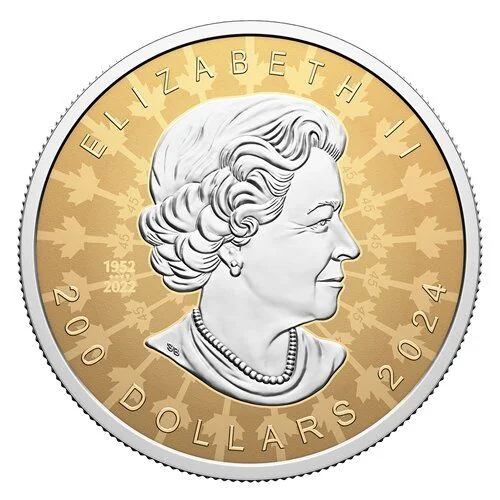
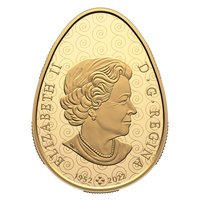
The obverse repeats the field pattern and features the platinum‑plated effigy of Queen Elizabeth II at age 77, facing right, bare‑headed and wearing jewelry. It includes the double dates "1952" and "2022," separated by four pearls representing her four Canadian coin effigies.
Inscription:
ELIZABETH II
1952 ⁘ 2022
200 DOLLARS 2024
1952 ⁘ 2022
200 DOLLARS 2024
Script: Latin
Designer: Susanna Blunt
Reverse
Description:
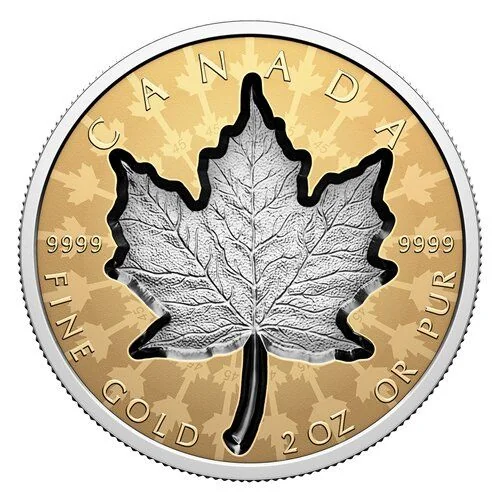
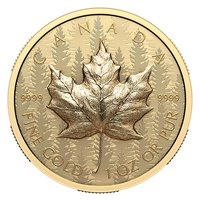
The reverse features Walter Ott’s incuse Gold Maple Leaf design, platinum-plated to a depth of 1.5 mm. The "maple burst" background includes a micro-engraved "45" on the central leaves, marking the 45th anniversary (1979-2024).
Inscription:
CANADA
9999 9999
FINE GOLD 2 OZ OR PUR
9999 9999
FINE GOLD 2 OZ OR PUR
Script: Latin
Designer: Walter Ott
Edge
Reeded
Mints
| Name | Mark |
|---|---|
| Royal Canadian Mint of Ottawa | — |
Mintings
| Year | Mint Mark | Mintage | Quality | Collection |
|---|---|---|---|---|
| 2024 | — | 300 | Proof |
Historical background
In 2024, Canada's currency situation is defined by a persistent battle with inflation and the resulting high-interest rate environment set by the Bank of Canada. After hitting a multi-decade high in 2022, inflation has cooled but remains stubbornly above the central bank's 2% target, driven by core pressures from services, housing costs, and wage growth. This has forced the Bank of Canada to maintain its benchmark interest rate at a 22-year high of 5% for an extended period, creating a cautious stalemate as it seeks clearer, sustained evidence that inflationary pressures are fully subdued before considering cuts.
The Canadian dollar (CAD) has consequently traded in a relatively narrow range, primarily influenced by the differential between Canadian and U.S. monetary policy. The "loonie" has shown resilience but faces headwinds, often weakening when market expectations pivot toward earlier or deeper rate cuts by the Bank of Canada compared to the U.S. Federal Reserve. Its value is also sensitive to global commodity prices, particularly oil, though this traditional support has been inconsistent amid fluctuating global demand and geopolitical tensions.
Looking forward, the key domestic narrative is the timing and pace of the anticipated easing cycle. Households and businesses are grappling with the high cost of borrowing, which is dampening economic growth and increasing debt servicing burdens. The central bank faces a delicate balancing act: cutting rates too soon could re-ignite inflation, while acting too late could unnecessarily deepen an economic slowdown. The currency's trajectory for the remainder of 2024 will hinge almost entirely on this pivot, alongside external factors like the strength of the U.S. economy and global risk sentiment.
The Canadian dollar (CAD) has consequently traded in a relatively narrow range, primarily influenced by the differential between Canadian and U.S. monetary policy. The "loonie" has shown resilience but faces headwinds, often weakening when market expectations pivot toward earlier or deeper rate cuts by the Bank of Canada compared to the U.S. Federal Reserve. Its value is also sensitive to global commodity prices, particularly oil, though this traditional support has been inconsistent amid fluctuating global demand and geopolitical tensions.
Looking forward, the key domestic narrative is the timing and pace of the anticipated easing cycle. Households and businesses are grappling with the high cost of borrowing, which is dampening economic growth and increasing debt servicing burdens. The central bank faces a delicate balancing act: cutting rates too soon could re-ignite inflation, while acting too late could unnecessarily deepen an economic slowdown. The currency's trajectory for the remainder of 2024 will hinge almost entirely on this pivot, alongside external factors like the strength of the U.S. economy and global risk sentiment.
✨ Legendary