

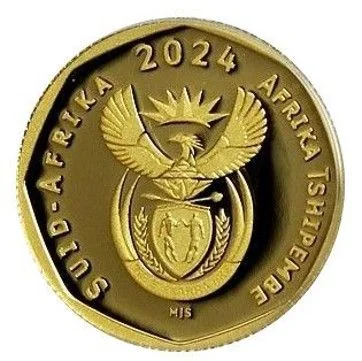

10 cents – South Africa
Add to wishlist
South Africa
Context
Year: 2024
Issuer: South Africa
Issuing organization: South African Reserve Bank
Period:
(since 1961)
Currency:
(since 1961)
Material


References
KM: #
Numista: #437958
Value
Exchange value: 0.10 ZAR
Bullion value: $517.18
Inflation-adjusted value: 0.11 ZAR
Obverse
Description:
Coat of arms with date, flanked by "South Africa" in Afrikaans and Venda.
Inscription:
2024
MJS
SUID-AFRIKA AFRIKA TSHIPEMBE
MJS
SUID-AFRIKA AFRIKA TSHIPEMBE
Translation:
SOUTH AFRICA AFRICA TSHIPEMBE
Script: Latin
Engraver: Thinus Scheepers
Reverse
Description:
A Cape honey bee in flight over the veld.
Inscription:
Au 999.9 1/10 oz
SDN
10c
SDN
10c
Script: Latin
Engraver: Thinus Scheepers
Designer: Sujay Sanan
Edge
Legend:
SARB R5 SARB R5 SARB R5 SARB R5 SARB R5 SARB R5 SARB R5 SARB R5 SARB R5 SARB R5
Categories
| Animal> Insect |
| Symbols> Coat of Arms |
Mints
| Name | Mark |
|---|---|
| South African Mint | — |
Mintings
| Year | Mint Mark | Mintage | Quality | Collection |
|---|---|---|---|---|
| 2024 | — | — | Proof |
Historical background
In 2024, South Africa's currency, the rand, continues to face significant volatility and pressure, primarily driven by a combination of domestic structural challenges and global financial currents. The persistent issues of severe load-shedding (rolling blackouts), logistical bottlenecks at key state-owned ports and railways, and high levels of public debt have eroded investor confidence and constrained economic growth. These longstanding domestic headwinds are compounded by a precarious fiscal outlook, with concerns over the sustainability of government spending and the potential for further credit rating downgrades.
Externally, the rand remains highly sensitive to global risk sentiment and U.S. monetary policy. As a liquid emerging market currency, it weakened considerably through 2023 and into 2024 amid a "higher-for-longer" interest rate environment in advanced economies, which diverts investment away from riskier assets. Furthermore, geopolitical tensions and fluctuating commodity prices—despite South Africa's mineral exports—add layers of uncertainty. The currency's value is thus often a barometer of both international market dynamics and the perceived pace of domestic reforms.
Looking ahead, the trajectory of the rand in 2024 hinges critically on the government's ability to implement tangible reforms to stabilize energy supply, fix transport logistics, and curb fiscal deficits. Upcoming national elections also introduce a degree of political uncertainty that markets are closely monitoring. While a weaker rand benefits certain export sectors, it exacerbates imported inflation and living costs for South Africans, keeping the South African Reserve Bank in a difficult position as it balances growth concerns against its inflation-targeting mandate. The currency's stability, therefore, remains inextricably linked to concrete progress on the country's structural reforms.
Externally, the rand remains highly sensitive to global risk sentiment and U.S. monetary policy. As a liquid emerging market currency, it weakened considerably through 2023 and into 2024 amid a "higher-for-longer" interest rate environment in advanced economies, which diverts investment away from riskier assets. Furthermore, geopolitical tensions and fluctuating commodity prices—despite South Africa's mineral exports—add layers of uncertainty. The currency's value is thus often a barometer of both international market dynamics and the perceived pace of domestic reforms.
Looking ahead, the trajectory of the rand in 2024 hinges critically on the government's ability to implement tangible reforms to stabilize energy supply, fix transport logistics, and curb fiscal deficits. Upcoming national elections also introduce a degree of political uncertainty that markets are closely monitoring. While a weaker rand benefits certain export sectors, it exacerbates imported inflation and living costs for South Africans, keeping the South African Reserve Bank in a difficult position as it balances growth concerns against its inflation-targeting mandate. The currency's stability, therefore, remains inextricably linked to concrete progress on the country's structural reforms.


✨ Legendary