

50 Francs – Cameroon
Circulating commemorative coins
Commemoration: Independence
Cameroon
Context
Material
Diameter: 31 mm
Weight: 12 g
Thickness: 2.1 mm
Shape: Round
Composition: Copper-nickel
Technique: Milled
Alignment: Coin alignment
flip
References
KM: #Click to copy to clipboard13
Numista: #4379
Value
Exchange value: 50 FCFA
Obverse
Description:
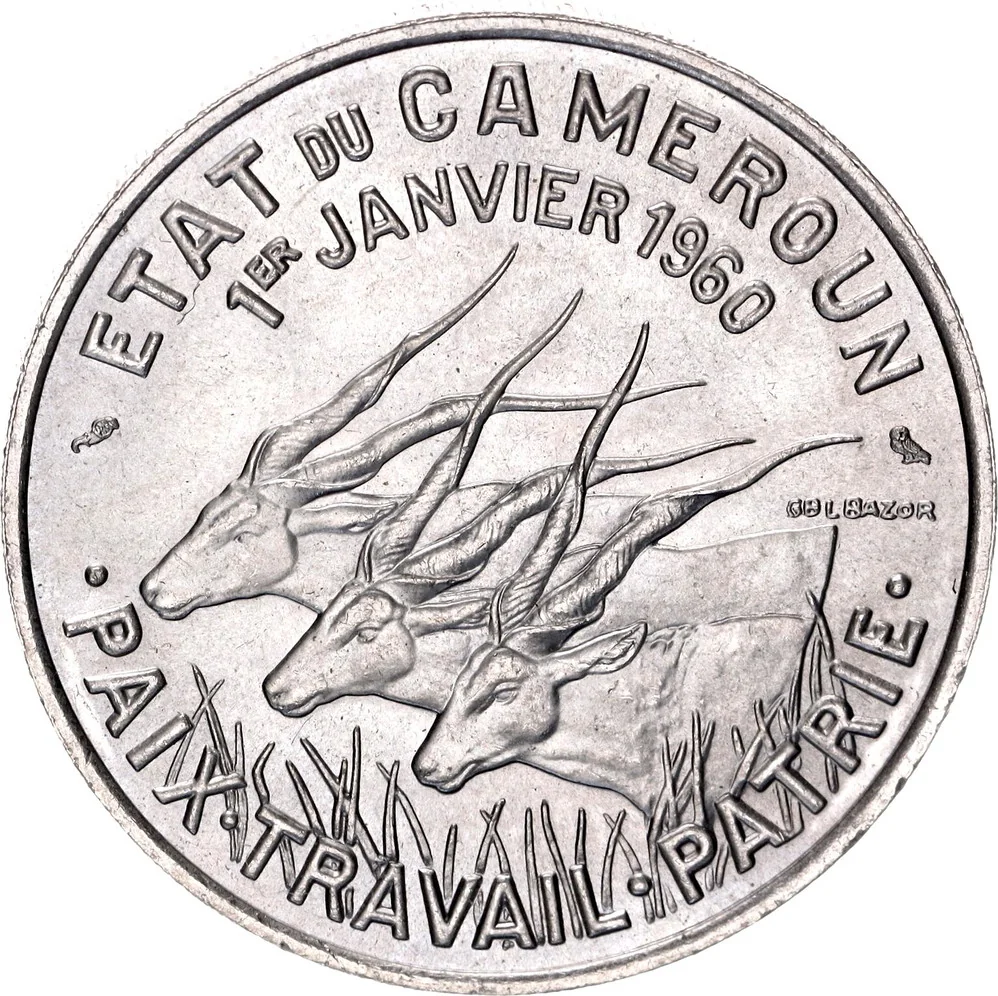
Three giant elands facing left.
Inscription:
ETAT DU CAMEROUN
1er JANVIER 1960
G.B.L. BAZOR
PAIX • TRAVAIL • PATRIE
1er JANVIER 1960
G.B.L. BAZOR
PAIX • TRAVAIL • PATRIE
Translation:
State of Cameroon
1st January 1960
G.B.L. Bazor
Peace • Work • Fatherland
1st January 1960
G.B.L. Bazor
Peace • Work • Fatherland
Script: Latin
Language: French
Engraver: Lucien Georges Bazor
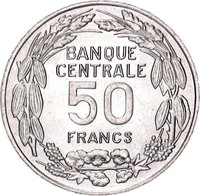
Reverse
Description:
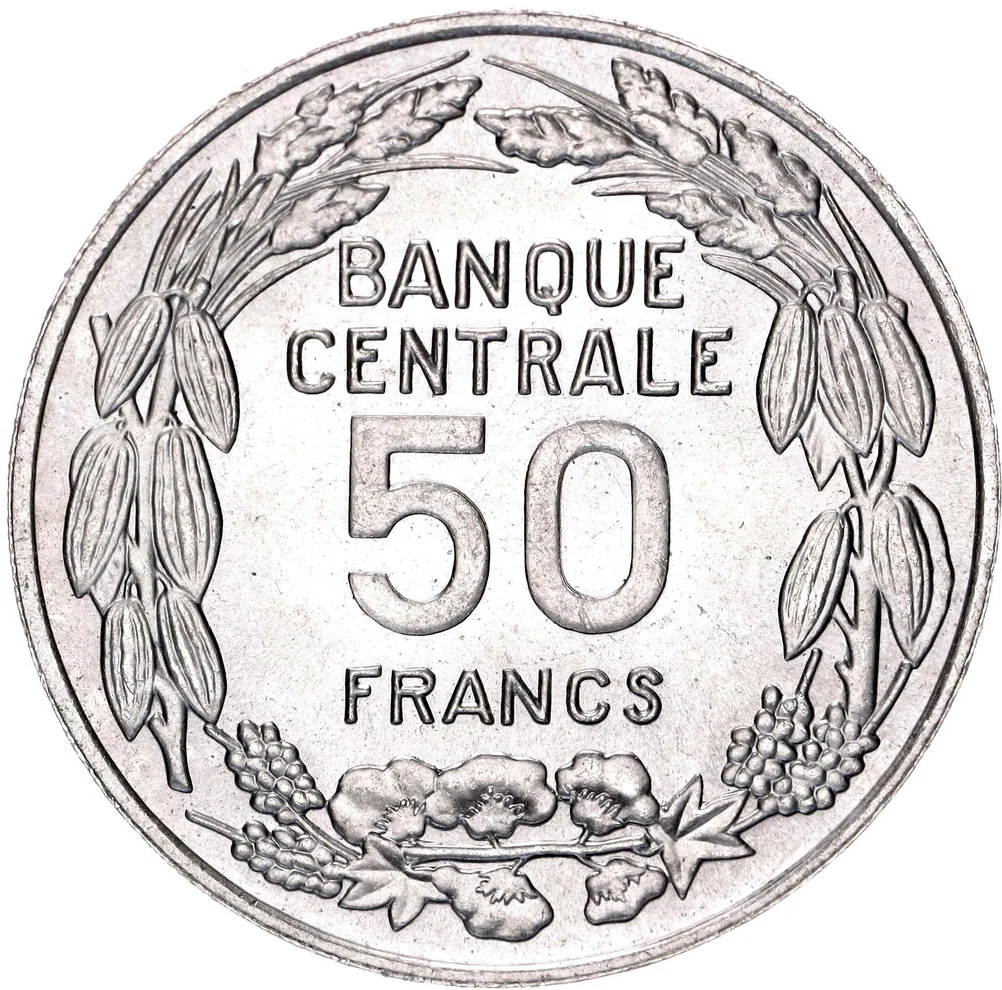
Wheat wreath with cocoa pods and coffee beans.
Inscription:
BANQUE
CENTRALE
50
FRANCS
CENTRALE
50
FRANCS
Translation:
Central Bank
50
Francs
50
Francs
Script: Latin
Language: French
Engraver: Lucien Georges Bazor
Edge
Reeded
Mints
| Name | Mark |
|---|---|
| Monnaie de Paris | — |
Mintings
| Year | Mint Mark | Mintage | Quality | Collection |
|---|---|---|---|---|
| 1960 | — | 9,000,000 |
Historical background
Upon independence in 1960, Cameroon inherited a complex currency situation shaped by its colonial partition. The former French-administered territory (which became independent as the Republic of Cameroon) was part of the CFA franc zone, using the Communauté Financière Africaine franc (CFA). This currency was pegged to the French franc, guaranteed by the French Treasury, and provided monetary stability but was seen by some as a continuation of French economic influence.
Simultaneously, the southern part of the former British-administered trust territory (Southern Cameroons) voted to join the new federation in 1961. This region was integrated into the sterling zone and used the British West African pound. This created an immediate practical challenge: a single federated nation with two distinct monetary systems and central banks, complicating internal trade and economic policy.
The new federal government therefore prioritized monetary unification as a key symbol of national integration. This was achieved in 1962 with the creation of a new Banque Centrale des Etats de l'Afrique Equatoriale et du Cameroun and the introduction of a single CFA franc for the entire federation. The choice of the CFA franc over the sterling reflected both the larger economic weight of the Francophone region and the existing institutional links to France, decisively shaping Cameroon's post-independence economic alignment.
Simultaneously, the southern part of the former British-administered trust territory (Southern Cameroons) voted to join the new federation in 1961. This region was integrated into the sterling zone and used the British West African pound. This created an immediate practical challenge: a single federated nation with two distinct monetary systems and central banks, complicating internal trade and economic policy.
The new federal government therefore prioritized monetary unification as a key symbol of national integration. This was achieved in 1962 with the creation of a new Banque Centrale des Etats de l'Afrique Equatoriale et du Cameroun and the introduction of a single CFA franc for the entire federation. The choice of the CFA franc over the sterling reflected both the larger economic weight of the Francophone region and the existing institutional links to France, decisively shaping Cameroon's post-independence economic alignment.
🌱 Common