


5 euro – Latvia
Add to wishlist
Non-circulating coins
Commemoration: Building the Unbuilt
Latvia
Context
Material
Weight: 25 g
Silver Weight:: 24.98 g
Shape: Square with rounded corners
Composition: 99.9% Silver
Magnetic: No
Alignment: Medal alignment
flip

References
KM: #
Numista: #437834
Value
Exchange value: 5 EUR
Bullion value: $62.33
Inflation-adjusted value: 5.07 EUR
Obverse
Description:
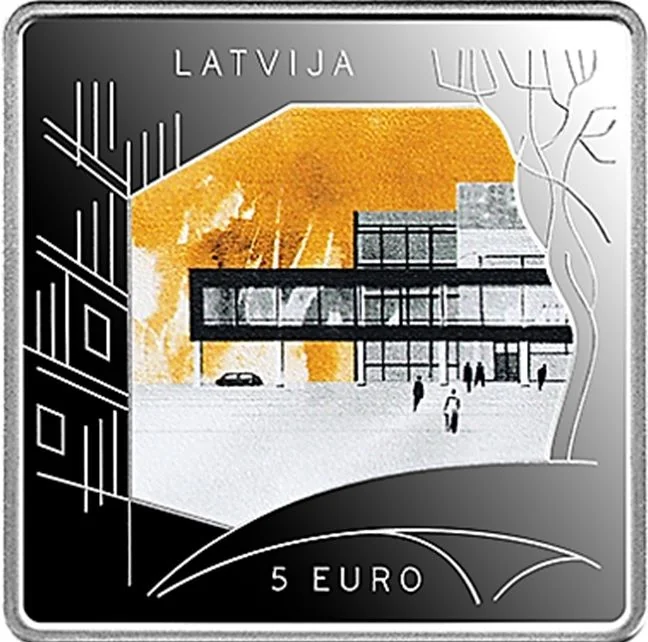
Marta Staņa's project sketches: Dailes Theatre (center), Rēzekne stage roof (below), Brīvības iela 313 facade (left), a wooden shape (right). LATVIA at the top, 5 EURO at the bottom.
Inscription:
LATVIJA
5 EURO
5 EURO
Script: Latin
Designer: Rūta Jumīte
Reverse
Description:
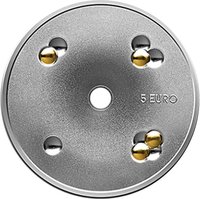
Fragments of Marta Staņa's unrealised sketches: a Gaiziņkalns viewing tower (center), elements of the Budapest National Theatre (right), a wooden shape (left). "2024" (top right), "MARTA STAŅA" (bottom left).
Inscription:
2024
MARTA STAŅA
MARTA STAŅA
Translation:
Marta Staņa
Script: Latin
Language: Latvian
Designer: Rūta Jumīte
Edge
Plain
Mints
| Name | Mark |
|---|---|
| Royal Dutch Mint | — |
Mintings
| Year | Mint Mark | Mintage | Quality | Collection |
|---|---|---|---|---|
| 2024 | — | 2,500 | Proof |
Historical background
In 2024, Latvia's currency situation is defined by its stable and integrated position within the Eurozone. As a member since 2014, the country uses the euro (EUR) as its sole legal tender, having successfully transitioned from the Latvian lats. This membership anchors Latvia's financial system to the European Central Bank (ECB), meaning domestic monetary policy, including interest rates and inflation control measures, is set at the euro area level. The primary focus for Latvian authorities and businesses is therefore not on exchange rate fluctuations but on navigating the common Eurozone challenges of managing inflation and ensuring economic competitiveness within the single currency area.
The key domestic discussions around currency in 2024 revolve around the economic implications of euro membership. While the euro has eliminated exchange rate risk with major trading partners and bolstered financial stability, Latvia, like other smaller Eurozone economies, must contend with a one-size-fits-all monetary policy that may not always perfectly align with its specific economic cycle. Current debates often focus on fiscal policy as the main tool for addressing local economic conditions, alongside efforts to improve productivity and manage inflation, which has been a concern across Europe following the energy crisis and geopolitical tensions.
Looking ahead, Latvia's currency stability is intrinsically linked to the broader health of the Eurozone and the ECB's policy trajectory. The Latvian economy benefits from the credibility and deep capital markets of the euro, which supports investment and trade. The main "currency situation" for Latvia in 2024 is thus one of embedded stability, with national economic strategy focused on leveraging the advantages of euro membership while using structural reforms and prudent fiscal management to mitigate any disadvantages of not having an independent monetary policy.
The key domestic discussions around currency in 2024 revolve around the economic implications of euro membership. While the euro has eliminated exchange rate risk with major trading partners and bolstered financial stability, Latvia, like other smaller Eurozone economies, must contend with a one-size-fits-all monetary policy that may not always perfectly align with its specific economic cycle. Current debates often focus on fiscal policy as the main tool for addressing local economic conditions, alongside efforts to improve productivity and manage inflation, which has been a concern across Europe following the energy crisis and geopolitical tensions.
Looking ahead, Latvia's currency stability is intrinsically linked to the broader health of the Eurozone and the ECB's policy trajectory. The Latvian economy benefits from the credibility and deep capital markets of the euro, which supports investment and trade. The main "currency situation" for Latvia in 2024 is thus one of embedded stability, with national economic strategy focused on leveraging the advantages of euro membership while using structural reforms and prudent fiscal management to mitigate any disadvantages of not having an independent monetary policy.



✨ Legendary