

10000 Vatu (Independence) – Vanuatu
Non-circulating coins
Commemoration: 1st. Anniversary of Independence
Vanuatu
Context

Material

References
KM: #Click to copy to clipboard2
Numista: #435792
Value
Exchange value: 10000 VUV
Bullion value: $2443.82
Obverse
Description:
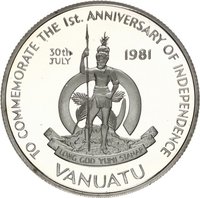
Vanuatu's coat of arms depicts a Melanesian warrior before a curved boar's tusk and a scroll inscribed "LONG GOD YUMI STANAP".
Inscription:
TO COMMEMORATE THE 1st. ANNIVERSARY OF INDEPENDENCE
30th JULY 1981
LONG GOD YUMI STANAP
VANUATU
30th JULY 1981
LONG GOD YUMI STANAP
VANUATU
Translation:
TO COMMEMORATE THE 1st. ANNIVERSARY OF INDEPENDENCE
30th JULY 1981
LONG GOD YUMI STANAP
VANUATU
30th JULY 1981
LONG GOD YUMI STANAP
VANUATU
Script: Latin
Reverse
Edge
Milled.
Categories
| Animal> Crustacean |
| Event> Independence |
| Symbols> Coat of Arms |
Mints
| Name | Mark |
|---|---|
| Royal Mint | — |
Mintings
| Year | Mint Mark | Mintage | Quality | Collection |
|---|---|---|---|---|
| 1981 | — | 538 | ||
| 1981 | — | 1,054 | Proof |
Historical background
In 1981, the currency situation in the newly independent Republic of Vanuatu was one of transition and foundational establishment. Having gained independence from the Anglo-French Condominium just one year earlier, in July 1980, the nation faced the immediate task of asserting its monetary sovereignty. At independence, the archipelago used two currencies: the Australian dollar and the New Hebrides franc, which was pegged to the French franc. This dual-currency system was a legacy of the complex Condominium government and was ill-suited for a unified nation seeking economic self-determination.
Consequently, 1981 was a pivotal year dedicated to creating and introducing a new national currency. The Vanuatu government, led by Prime Minister Walter Lini, passed the necessary legislation to establish the Vanuatu Monetary Authority (the precursor to the Reserve Bank of Vanuatu) and to issue the vatu (VUV). The vatu was designed to be a non-decimal currency initially, with no smaller subunit, symbolizing a clean break from colonial systems. The planning and logistical preparations throughout 1981 were intense, setting the stage for the vatu's introduction as the sole legal tender, which would finally occur on 1 January 1982.
The underlying economic rationale was to gain control over domestic monetary policy and seigniorage rights, while also fostering a tangible symbol of national identity. The transition was managed as a straightforward replacement, with the vatu initially maintaining parity with the New Hebrides franc, which itself was linked to the French franc. Therefore, in 1981, while the Australian dollar and New Hebrides franc remained in circulation, the focus was entirely on the administrative and technical groundwork for launching a stable national currency that would support Vanuatu's fledgling independent economy.
Consequently, 1981 was a pivotal year dedicated to creating and introducing a new national currency. The Vanuatu government, led by Prime Minister Walter Lini, passed the necessary legislation to establish the Vanuatu Monetary Authority (the precursor to the Reserve Bank of Vanuatu) and to issue the vatu (VUV). The vatu was designed to be a non-decimal currency initially, with no smaller subunit, symbolizing a clean break from colonial systems. The planning and logistical preparations throughout 1981 were intense, setting the stage for the vatu's introduction as the sole legal tender, which would finally occur on 1 January 1982.
The underlying economic rationale was to gain control over domestic monetary policy and seigniorage rights, while also fostering a tangible symbol of national identity. The transition was managed as a straightforward replacement, with the vatu initially maintaining parity with the New Hebrides franc, which itself was linked to the French franc. Therefore, in 1981, while the Australian dollar and New Hebrides franc remained in circulation, the focus was entirely on the administrative and technical groundwork for launching a stable national currency that would support Vanuatu's fledgling independent economy.
✨ Legendary