

1 sol – Peru
Add to wishlist
Non-circulating coins
Commemoration: Bicentennial of the birth of Antonio Raimondi
Peru
Context
Year: 2024
Issuer: Peru
Issuing organization: Central Reserve Bank of Peru
Period:
(since 1822)
Total mintage: 5,000
Material
References
KM: #
Numista: #435068
Value
Exchange value: 1 PEN
Bullion value: $75.71
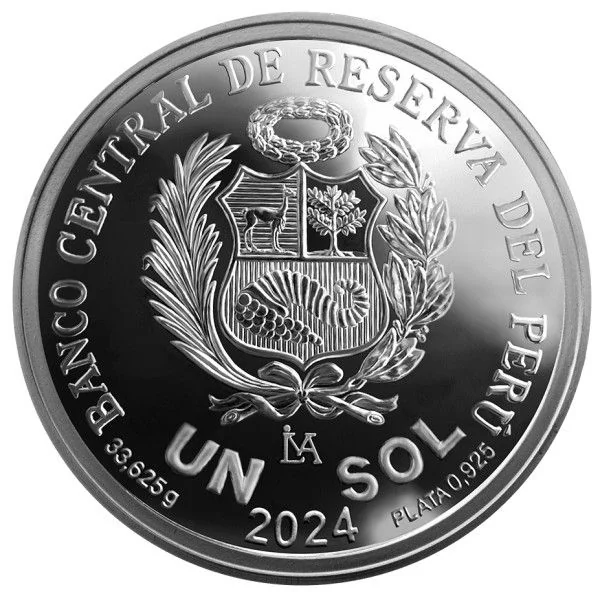
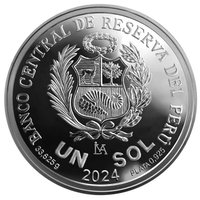
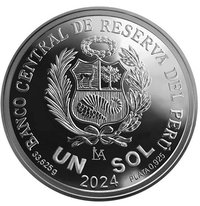
Obverse
Description:
Crest Date Value
Inscription:
BANCO CENTRAL DE RESERVA DEL PERÚ
UN SOL
33,625g 2024 PLATA 0,925
UN SOL
33,625g 2024 PLATA 0,925
Translation:
CENTRAL RESERVE BANK OF PERU
ONE SOL
33.625g 2024 SILVER 0.925
ONE SOL
33.625g 2024 SILVER 0.925
Script: Latin
Language: Spanish
Designer: Felipe Escalante Chuñocca
Reverse
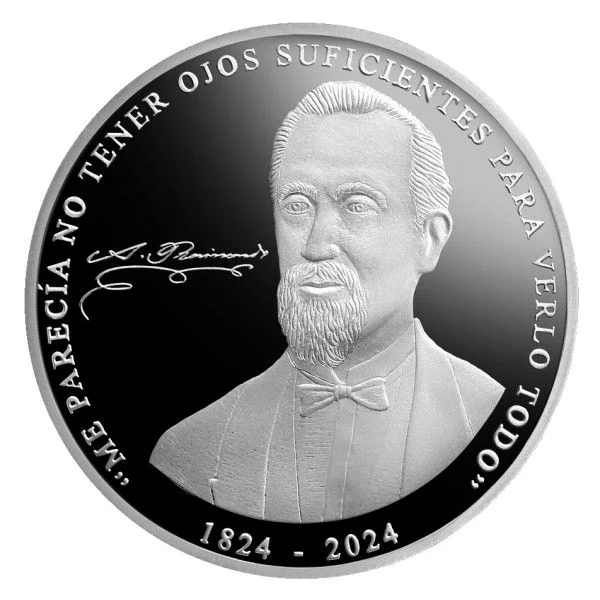
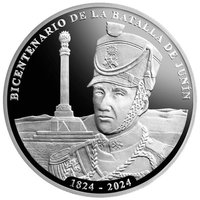
Description:
The bust of Antonio Raimondi is shown with his quote, “I SEEMED I DID NOT HAVE ENOUGH EYES TO SEE EVERYTHING,” his signature, and the dates “1824 – 2024.”
Inscription:
“ME PARECÍA NO TENER OJOS SUFICIENTES PARA VERLO TODO"
1924-2024
1924-2024
Translation:
It seemed to me I did not have enough eyes to see it all
1924-2024
1924-2024
Script: Latin
Language: Spanish
Designer: Felipe Escalante Chuñocca
Edge
Reeded
Mints
| Name | Mark |
|---|---|
| Lima | LIMA |
Mintings
| Year | Mint Mark | Mintage | Quality | Collection |
|---|---|---|---|---|
| 2024 | LIMA | 5,000 | Proof |
Historical background
Peru's currency situation in 2024 is characterized by the Peruvian Sol (PEN) demonstrating notable resilience and stability despite a challenging domestic political climate and a sluggish economy. Following a period of significant depreciation in 2022 and early 2023, driven by political instability and global monetary tightening, the Sol has stabilized and even appreciated moderately against the US Dollar. This strength is largely attributed to high interest rates maintained by the Central Reserve Bank of Peru (BCRP) to combat inflation, which has made holding Soles attractive for carry-trade investors. Furthermore, consistent mineral exports, particularly copper, have provided a steady inflow of foreign currency, bolstering the exchange rate.
However, this stability exists alongside underlying economic fragility. The country entered a technical recession in 2023, and growth projections for 2024 remain modest. While annual inflation has decelerated to within the BCRP's target range (1%-3%), it required maintaining the benchmark interest rate at 6.25% for an extended period, a level restrictive for economic recovery. The currency's strength, partly market-driven, also presents a paradox by making Peruvian non-traditional exports more expensive and potentially hindering broader economic growth, leading to calls from some sectors for cautious intervention.
Looking ahead, the primary challenges for the Sol in 2024 are domestic and political. The key risk is not a sudden external shock but a potential escalation of political tensions or policy uncertainty that could undermine investor confidence and trigger capital outflows. The BCRP's future monetary policy, balancing inflation control with the need to stimulate the economy, will be critical. Most analysts forecast a gradual easing of interest rates in the latter half of the year, which could modestly weaken the Sol, but expect overall volatility to remain contained barring a major political crisis. The currency's fate is thus tightly linked to Peru's ability to navigate its internal governance challenges.
However, this stability exists alongside underlying economic fragility. The country entered a technical recession in 2023, and growth projections for 2024 remain modest. While annual inflation has decelerated to within the BCRP's target range (1%-3%), it required maintaining the benchmark interest rate at 6.25% for an extended period, a level restrictive for economic recovery. The currency's strength, partly market-driven, also presents a paradox by making Peruvian non-traditional exports more expensive and potentially hindering broader economic growth, leading to calls from some sectors for cautious intervention.
Looking ahead, the primary challenges for the Sol in 2024 are domestic and political. The key risk is not a sudden external shock but a potential escalation of political tensions or policy uncertainty that could undermine investor confidence and trigger capital outflows. The BCRP's future monetary policy, balancing inflation control with the need to stimulate the economy, will be critical. Most analysts forecast a gradual easing of interest rates in the latter half of the year, which could modestly weaken the Sol, but expect overall volatility to remain contained barring a major political crisis. The currency's fate is thus tightly linked to Peru's ability to navigate its internal governance challenges.
✨ Legendary