

20 kroner – Denmark
Add to wishlist
Circulating commemorative coins
Commemoration: Queen Magrethe II's abdication and King Frederik X accession to the throne
Denmark
Context
Year: 2024
Issuer: Denmark
Issuing organization: National Bank of Denmark
Ruler: Frederick X
Currency:
(since 1873)
Total mintage: 1,000,000
Material
References
KM: #
Numista: #434775
Value
Exchange value: 20 DKK
Inflation-adjusted value: 20.21 DKK
Obverse
Description:
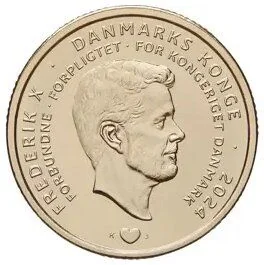
Portrait of King Frederik X facing right, with his motto and year. Below, the Danish mint's heart mark, flanked by the initials of the chief cashier and design chief.
Inscription:
FREDERIK X • DANMARKS KONGE • 2024
FORBUNDNE • FORPLIGTET • FOR KONGERIGET DANMARK
K ♥︎ J
FORBUNDNE • FORPLIGTET • FOR KONGERIGET DANMARK
K ♥︎ J
Translation:
FREDERIK X • KING OF DENMARK • 2024
UNITED • COMMITTED • FOR THE KINGDOM OF DENMARK
K ♥︎ J
UNITED • COMMITTED • FOR THE KINGDOM OF DENMARK
K ♥︎ J
Script: Latin
Language: Danish
Designers: Eva Hjorth, Jeanette Skov Jensen
Reverse
Description:
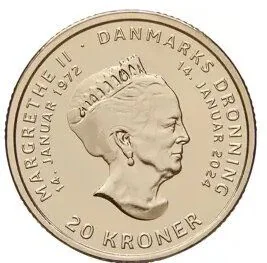
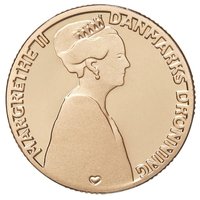
Queen Margrethe II facing right.
Title and reign encircling.
Value below.
Title and reign encircling.
Value below.
Inscription:
MARGRETHE II • DANMARKS DRONNING
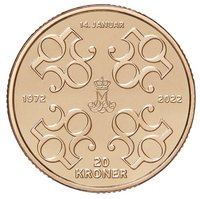
14. JANUAR 1972 14. JANUAR 2024
20 KRONER
14. JANUAR 1972 14. JANUAR 2024
20 KRONER
Translation:
Margrethe II, Queen of Denmark
14 January 1972 14 January 2024
20 Kroner
14 January 1972 14 January 2024
20 Kroner
Script: Latin
Language: Danish
Designers: Eva Hjorth, Jeanette Skov Jensen
Edge
Reeded sections
Categories
| Event> Coronation |
| Person> Monarch |
Mints
| Name | Mark |
|---|---|
| Mint of Finland | — |
Mintings
| Year | Mint Mark | Mintage | Quality | Collection |
|---|---|---|---|---|
| 2024 | ♥︎ | 1,000,000 |
Historical background
In 2024, Denmark maintains its long-standing and stable currency framework, with the Danish krone (DKK) firmly pegged to the euro through the European Exchange Rate Mechanism II (ERM II). This policy, managed by the independent Danmarks Nationalbank, is a cornerstone of Danish economic stability. The central bank's primary objective is to keep the exchange rate fixed at approximately 7.46038 kroner per euro, with a very narrow permitted fluctuation band of ±2.25%. This commitment often requires the bank to intervene in foreign exchange markets or adjust interest rates, even independently of the European Central Bank, to maintain the peg and control capital flows.
The Danish krone peg enjoys broad political and public support, viewed as a critical shield against currency volatility and a facilitator of trade with the EU, Denmark's largest trading partner. There is no serious political movement to adopt the euro, as the current arrangement provides the benefits of eurozone stability without ceding full monetary sovereignty. Economically, Denmark continues to demonstrate the robustness of this model, maintaining a strong balance of payments, substantial foreign exchange reserves, and AAA credit ratings, which underpin market confidence in the fixed exchange rate policy.
Looking ahead, the main challenges in 2024 revolve around navigating the external monetary policy environment. With the European Central Bank and other major central banks in a cycle of adjusting interest rates after a period of increases to combat inflation, Danmarks Nationalbank must carefully calibrate its own rates to maintain the krone's peg. This can sometimes lead to domestic interest rates that are not perfectly aligned with the internal Danish economic cycle. However, the consensus is that the system will continue to function effectively, preserving monetary stability as its key contribution to the Danish economy.
The Danish krone peg enjoys broad political and public support, viewed as a critical shield against currency volatility and a facilitator of trade with the EU, Denmark's largest trading partner. There is no serious political movement to adopt the euro, as the current arrangement provides the benefits of eurozone stability without ceding full monetary sovereignty. Economically, Denmark continues to demonstrate the robustness of this model, maintaining a strong balance of payments, substantial foreign exchange reserves, and AAA credit ratings, which underpin market confidence in the fixed exchange rate policy.
Looking ahead, the main challenges in 2024 revolve around navigating the external monetary policy environment. With the European Central Bank and other major central banks in a cycle of adjusting interest rates after a period of increases to combat inflation, Danmarks Nationalbank must carefully calibrate its own rates to maintain the krone's peg. This can sometimes lead to domestic interest rates that are not perfectly aligned with the internal Danish economic cycle. However, the consensus is that the system will continue to function effectively, preserving monetary stability as its key contribution to the Danish economy.
🌟 Limited