

20 Mark (August Bebel) – German Democratic Republic
Non-circulating coins
Commemoration: 60th Anniversary of Death of August Bebel
Germany
Context
Year: 1973
Country: Germany 
Issuer: German Democratic Republic 
Period:
(1949—1990)
Currency:
(1948—1990)
Demonetization: 30 June 1990
Total mintage: 100,000
Material
References
KM: #Click to copy to clipboard46
Numista: #43358
Value
Exchange value: 20 DDM
Bullion value: $37.12
Inflation-adjusted value: 77.95 DDM
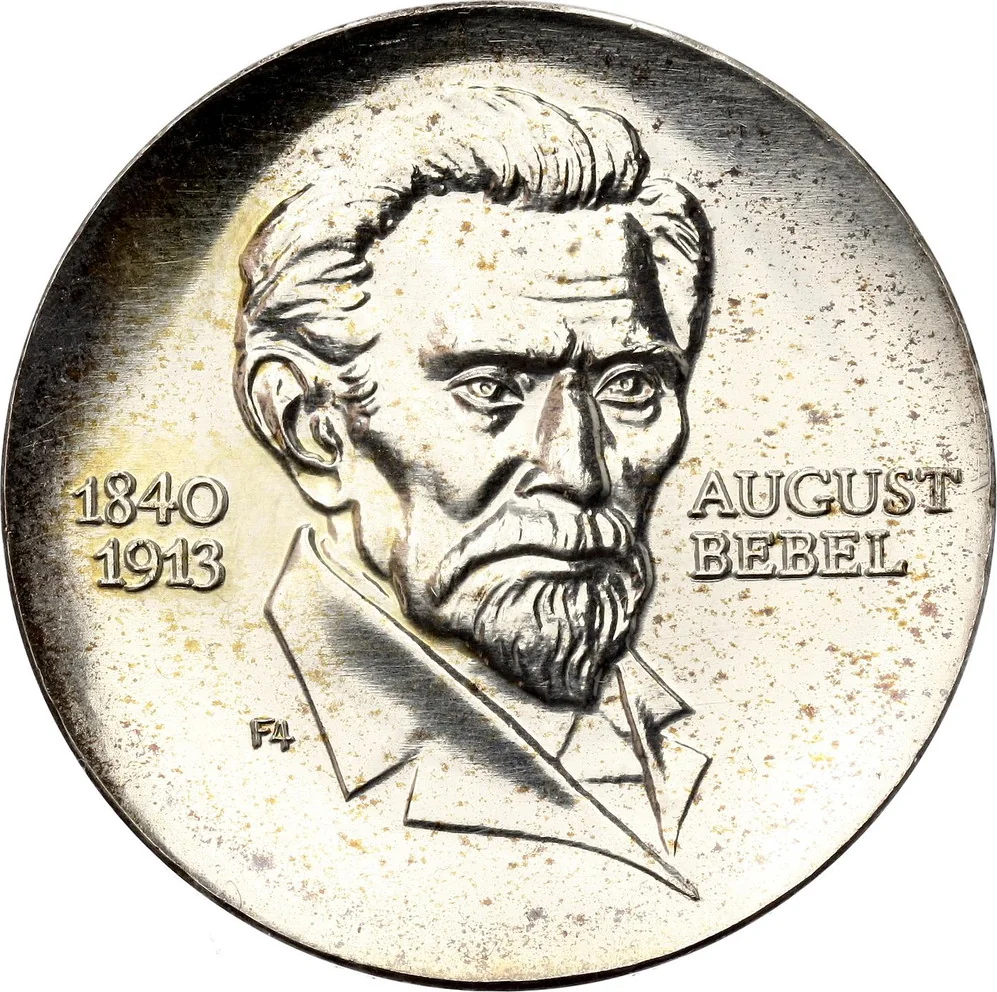
Obverse
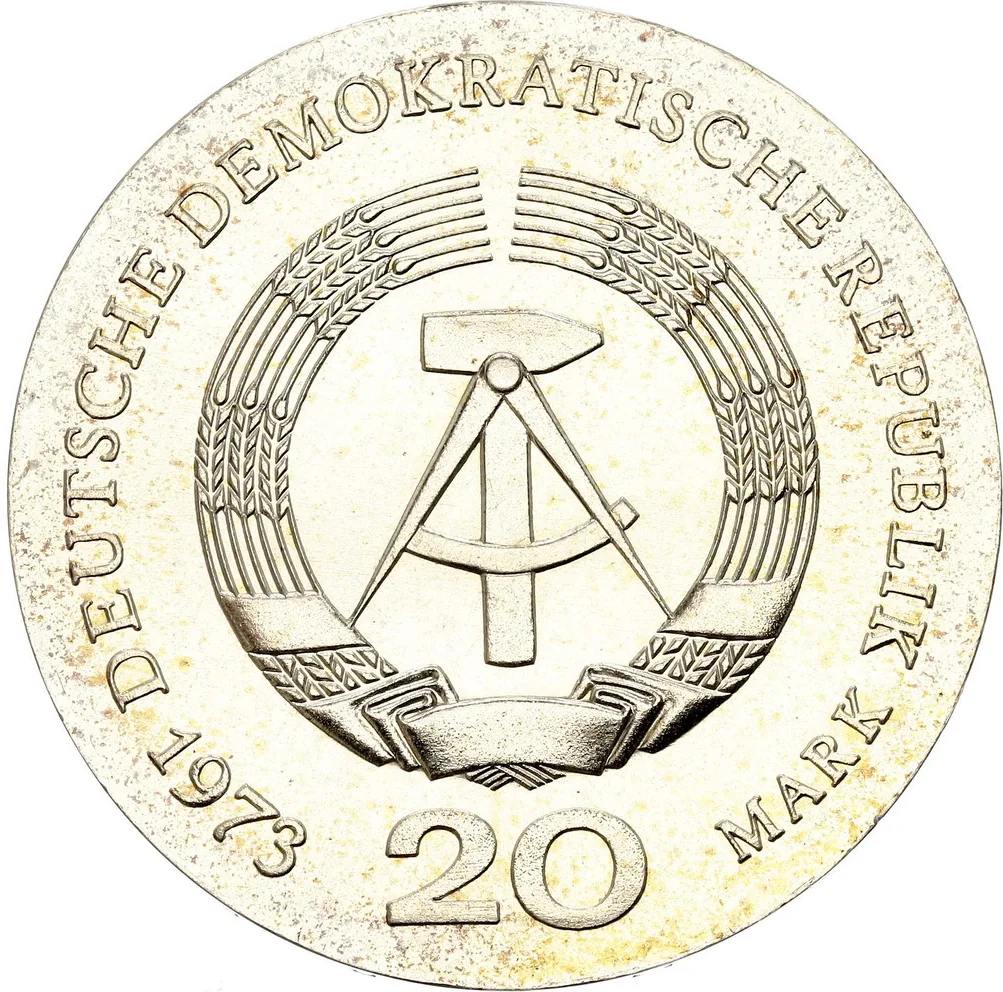
Reverse
Description:
Portrait of August Bebel, dates left, name right.
Inscription:
1840
1913
AUGUST
BEBEL
F4
1913
AUGUST
BEBEL
F4
Script: Latin
Engravers: Wilfried Fitzenreiter, Axel Bertram
Edge
Smooth with inscription
Legend:
20 MARK * 20 MARK * 20 MARK *
Categories
| Event> Death anniversary |
Mints
| Name | Mark |
|---|---|
| Berlin | A |
Historical background
In 1973, the currency situation in the German Democratic Republic (GDR) was defined by the rigid separation of its monetary system from that of West Germany and the non-convertibility of its official currency, the Mark der DDR (M). Internally, the Ostmark was a stable but controlled instrument of the state-planned economy, with its value and circulation meticulously managed to suppress inflation, mask economic inefficiencies, and enforce political priorities. However, this internal stability came at the cost of severe artificiality, as the currency's official exchange rate (set at 1 M = 1 West German Deutsche Mark for certain privileged transactions) was vastly overvalued compared to its actual purchasing power and economic standing.
Externally, the GDR mark was a non-convertible currency with no meaningful role in international trade, which was conducted primarily in hard currencies like the US Dollar or via clearing agreements with other Eastern Bloc nations. This created a chronic shortage of Western convertible currency, a critical problem the state sought to alleviate through a complex and discriminatory dual-currency system. The most prominent feature was the creation of "Forum Checks," a quasi-currency issued by the Genex gift delivery service, which could be purchased with Western Deutsche Marks and used in special Intershop stores stocked with high-quality imported and luxury goods unavailable to the general populace.
Thus, the 1973 currency landscape starkly mirrored the GDR's political and economic realities: an outwardly stable but artificially maintained official economy for its citizens, existing parallel to a privileged shadow economy accessible only with Western hard currency. This system not only highlighted the growing disparity between the GDR's economic performance and that of the Federal Republic of Germany but also served as a constant, visible reminder to its own population of the state's inability to provide a competitive standard of living, thereby undermining the very socialist legitimacy it sought to project.
Externally, the GDR mark was a non-convertible currency with no meaningful role in international trade, which was conducted primarily in hard currencies like the US Dollar or via clearing agreements with other Eastern Bloc nations. This created a chronic shortage of Western convertible currency, a critical problem the state sought to alleviate through a complex and discriminatory dual-currency system. The most prominent feature was the creation of "Forum Checks," a quasi-currency issued by the Genex gift delivery service, which could be purchased with Western Deutsche Marks and used in special Intershop stores stocked with high-quality imported and luxury goods unavailable to the general populace.
Thus, the 1973 currency landscape starkly mirrored the GDR's political and economic realities: an outwardly stable but artificially maintained official economy for its citizens, existing parallel to a privileged shadow economy accessible only with Western hard currency. This system not only highlighted the growing disparity between the GDR's economic performance and that of the Federal Republic of Germany but also served as a constant, visible reminder to its own population of the state's inability to provide a competitive standard of living, thereby undermining the very socialist legitimacy it sought to project.
⭐ Rare